- Saturday, 11 April 2026

In Fond Memory Of Barun Shumsher Rana

About 56 years ago, I was a newly appointed officer at the Cooperative Bank (later it became Agriculture Development Bank). It was the Nepali year 2023 BS and I was in training. Workshops were running. The trainers were U.S. advisors, government directors and secretaries. The Bank had come up with the objective of lending loans to farmers. Until recently, people received loans from traditional money lenders in the country. But the new land reform law had sent them off the scene and bankshad replaced the traditional moneylenders.
Now the question was: Could the newly set up bank aggressively replace them all? Naturally, the banks' outlets require processes and time to lend money! As such, what would happen to farmers? With this in mind, I wrote an article, arguing the government had better forge a network between the bank and landholders, who were moneylenders too. The title of my article was 'Credit Supply To The Farmer.'
Visitig Barun Raja
My office was in the backyards of the existing complex of Nepal Bank Ltd. The Rising Nepal (TRN) had its isolated office (not in the Gorkhapatra block) and was west of Nepal Bank across a south-facing lane in a rented building. It took a few hundred steps away from my office. Eventually, as the article was completed and I had it typed, I visited TRN office. The typescript was in my hand but I had no idea who to see. Luckily, someone signalled me, 'upstairs!' Still unaware of where and who, I made two flights and stood abruptly before a doorway with a nameplate - Barun Shamsher Rana, chief editor. Shortly, I hitched because I'd little dare my boss to be that free forward. But the door guy waved at me, ‘Go in!’ and so I had dashed off before him!
The room Barun Raja was in nowhere looked like an office chamber. It's a bedroom into a rough-and-ready office. That's where I'd met him - fiftyish, in grey hair, in Nepali attires – Daura, suruwal, coat and topi. He had cool, cheering and unassuming looks.
That was my first encounter with the founding editor of TRN (risinep for short then) – Barun Raja. The month was Bhadra (unable to recall the exact month and day)!
As I greeted him, he raised his brows against the table papers and noticed me with typescript. Soon he understood me, stretched out his hand from the chair, received the script and put it on the table. Meanwhile, I was thinking a highbrow like him mustn’t have time but just to say, ‘got you, see to it later, busy now!’ But no, his eyes were over the first page. Then he spoke about my title, 'Why this word 'Supply'? Drop it!' I gave a brief response, 'sounds good indeed, sir!'
On the third day, TRN had gracefully published the content uncut, unedited under the title – 'Credit to The Farmer." I still remember the beginning phrase 'Credit as a tool of production ….' that I'd painfully constructed (no idea if TRN archive holds it yet)!
It’d electrified me! Meanwhile, as if twice shy, I went quiet, said nothing about it to others, to no one in the office and not to my brother even. I was just 23, a greenhorn indeed.
Meeting With Account Chief Then
I visited the office again after a couple of weeks! I was supposed to collect a reward of twenty-five rupees. The chief account officer then was Padmadhar Acharya and we're delighted with each other. He's my senior at Biratnagar school and college.
Then, I had another life. The article and Raja both became a myth. It wasn't my crash writing, although I never took to such creative skills later. I even forgot how it had taxed my energy and time over library research and language refining. However, Kathmandu or outside TRN rarely missed me, but I was little aware of when Raja's tenure ended.
Now, I’m reinventing myself – so to say, after fifty-six years! I'd but can only recall brief moments with Raja! I thought I must see the accounts officer. I know that he is at the ashram now in Venkatesh Mandir, Gaushala and has been its chief (swami) for the last sixteen years.
So, I visited him. There, we flew back to the old nostalgic days. Moments later I put my queries about TRN's beginning days. He said: 'King Mahendra was convinced of media power and so Barun Raja was his one role model to meld the palace and people together!
As for Barun Raja, he said, ‘ hailing from an upper-class (Rana) family, he's a good fellow and a good taskmaster. Before being linked to it, he was with the newly established Tribhuvan University (English Faculty as a professor).
TRN itself was his breakthrough in the media forum.'
Until his tenure ended, he had received file papers, let in clacks of typewriters and had a flawless scratch of pen on paper as the editor. His counterpart then was Gopal Prasad Bhattarai (Gorkhapatra). They soon formed a unique team and synchronised their papers, nonetheless in constant touch with the royal palace. They enjoyed their workloads. Alongside, they had a lighter side too - it was their late-night partying!
Vantage Point
Kathmandu then had a weird story. One should call them primitive days since visitors from other districts here would say, 'I've been to Nepal!' A visit to Kathmandu was a visit to Nepal then. Another revealing picture was that Kathmandu stood out for the New Road part - strictly from RNAC to Bhugol Park. In those days, local English broadsheets or print media were rare and if any were there, it croaked like frogs in the rains and vanished! Journalism (for English) was amateurish then.
In truth, one English paper among the couple on record then was The Commoner (editor: Gopal Das Shrestha). But it was a personal undertaking circulating limited copies either to peepal tree retailers or government offices.
That was the evidence of English readership while in some out districts too, its appetite was not less. No English broadsheet as such in the pre-TRN era.
Thirst for News
A peep across the news trade then bears significance here. The news market in Nepal was then glutted with (Indian) English and Hindi newspapers and periodicals. Marginal cities in the south like Biratnagar, Birgunj, Bhairahawa and Nepalgunj too were annexed with such Indian prints.
New Road then had a small newsstand more like the newspaper hub of India. It was opposite the peepal tree towards the Ranjana gully. It helped no less yet, had maintained and contained the news thirst and thrust, and supplied daily newspapers and periodicals from New Delhi. The government offices were its subscribers but received them only the next morning because Delhi Kathmandu had late afternoon
flights. The irony was that no matter how stale, the news refreshed the officers with the first-morning tea!
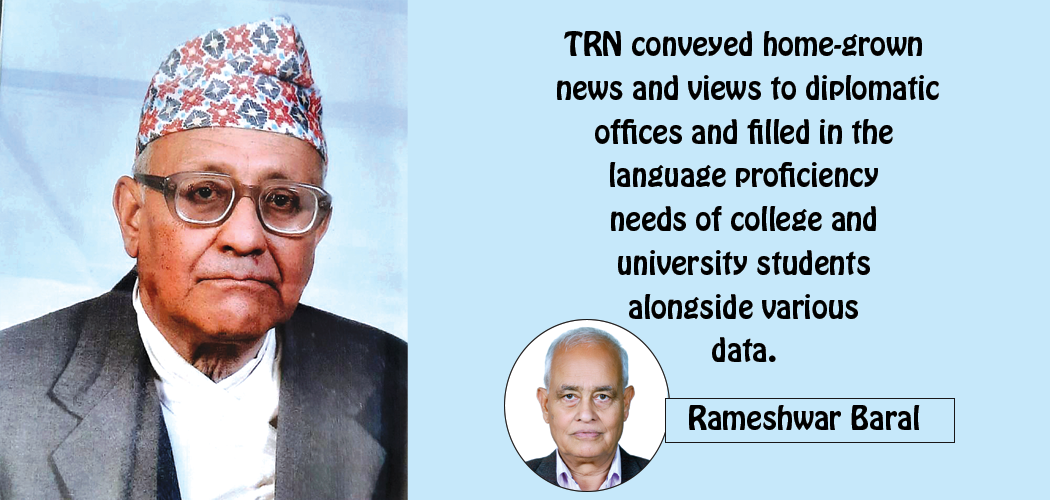
TRN conveyed home-grown news and views to diplomatic offices and filled in the language proficiency needs of college and university students alongside various data.
Based on the timeline of media and reporting, Barun Raja was a key player. The trend he set exclusively reflects him in TRN's global glory. So TRN owes it to Raja and owes it to his pen too, that's the fountain of brilliance and erudition. Not that alone, writing, reporting, torrents of pressmen and media houses, and news outlets of today all resound through him.
(The author is a retired lecturer of English)

-original-thumb.jpg)