- Thursday, 28 May 2026

A Strong Urge For Women’s Freedom
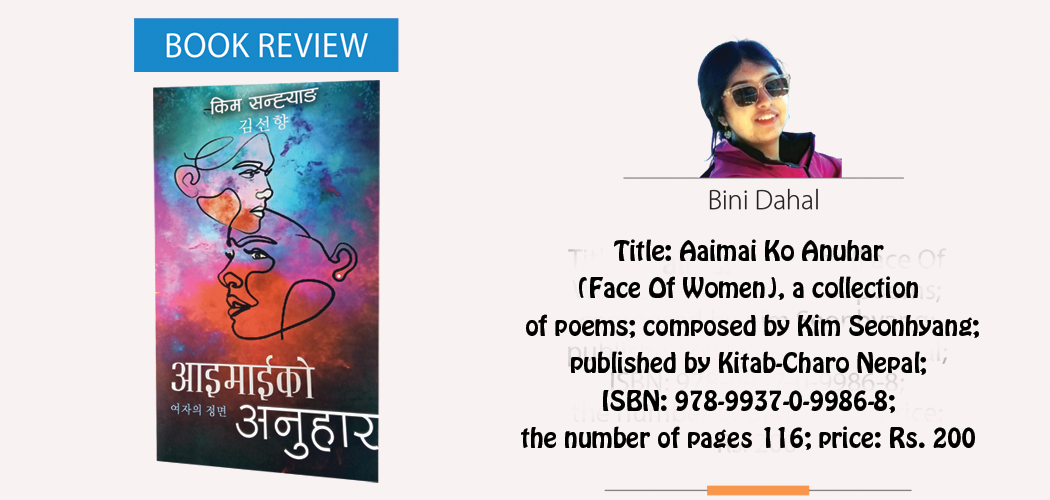

Well-written poetry always captivate the hearts and minds of people. And this holds exceptionally true for veteran Korean poetess Kim Seonhyang’s anthology of poems ‘Yeoja ae Jeongmyeon’ (Aaimai Ko Anuhar). Poems included in this collection have been translated into Nepali from Korean.
Born in Daejeon city of South Korea in 1966, Kim is well-known for her revolutionary poems that often break the traditional norms of society. With a total of 51 poems, this compilation is divided into four parts. The poetess does not seem to have followed any verse style while composing poems. Going through her poems, one feels she can write about anything that has happened or is happening around her. While she focuses on portraying the varied facets of Korean society, some of her poems are also about Beijing, Paris, London, etc.
One of the poems is Sakshi ko Suruwat, which is based on the Korean women who were made sex slaves (known as Comfort Women) by the Japanese military in the past. The poetess presents Kim Hagsun, a Korean woman living in China, who was taken hostage by the Japanese troops and got tortured physically and mentally.
The scars all over her body are proof of her suffering. Despite her distresses, she is presented as a determined character who is ready to fight for the truth and justice. She believes that more and more women with such miseries will come forward to fight suppression and exploitation against women.
Ekal Aama presents the struggles of a single mother. Here the poetess gives reference to a single mother who works in a salon while raising her three daughters. She works hard for her daughters but she totally forgets herself.
Her hands are rough, a clear indication of her constant hard work. When she touches her body with those hands, her body feels like dry winter trees.
Pwalharu depicts the sad reality of Korean society. Hidden cameras or miniature spy cameras are found in changing rooms and in females’ public washrooms. That causes a high level of insecurity and distress among Korean women. The poetess presents a gloomy situation for women who have to think and check every nook and corner to see if any hole exists there to hide.
Niger Nadi Kinaarma is about a woman who sees Negro men washing clothes and fears that she will get washed in the same way as the clothes in the hands of those strong men. This indicates a weak female mentality worldwide. Men are considered strong while women are always weak and fear that something bad may happen to them.
In another poem, Mahila Haru sheds light on different kinds of women living in Korean society. She gives reference to a college girl who is having a cheap deal with a drunken man at a shopping mall’s parking lot. Likewise, a cleaner is cleaning the toilet pan while shedding her tears; a not-so-popular female poet who despite writing for over 10 years fails to gain popularity and is not paid for her work in cash but in alcohol; a woman searches for men in a nightclub to fill her stomach; a woman who makes false allegations of domestic violence only to win divorce case and is living with a young lover.
Thus, the poetess highlights varied types of women and the anomalies associated with them. Some are working hard to survive while others attempt to find the wrong ways for subsistence.
Maile Sabai Dekhe deals with a 2009 disaster that occurred in the Yongsan district of Seoul in South Korea. The poetess describes how people had climbed the top of the Namildang building of Yongsan to prevent displacement and how they died.
Other poems included in this collection are equally worth reading as they give some message.
Kim’s poems mostly mirror her society. She has presented the painful society of the social structure and various incidents taking place there. It is not an easy task to translate poems from one language to another.
However, the translators have tried their best to ensure that justice is given to the poetess’ words, and the message she has attempted to convey.
While reading her poems, even readers with no prior knowledge about Korean history or society will be able to feel and understand her emotions and revolutionary motive.
Poems are called the reflection of contemporary society and Kim seems to have justified this in her work.
The translation of her powerful poems has acted as a bridge between Nepali and Korean societies. Her poems offer a lot of insights into the situation of many Korean women. They inspire women to fight for their rights.
To sum up, the faces of women echo varied emotions. They cannot be just presented as an epitome of beauty and gentleness but also as revolutionaries with much strength and defiance. This is the key message that the poetess has tried to convey through this wonderful collection of poems.
(Bini is a college student.)
-square-thumb.jpg)