- Sunday, 12 April 2026

'Rising dengue cases in Kathmandu challenging'
File photo.

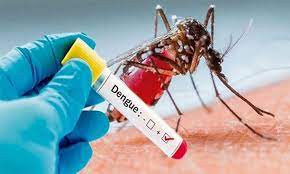
By Mahima Devkota, Kathmandu, July 11: Medical doctors have warned that the rising number of dengue cases in Kathmandu Valley can be challenging to public health as the country is already dealing with an increasing number of COVID-19 cases and surging cholera cases.
According to the Epidemiology and Disease Control
Division (EDCD), so far, four cases of dengue have been confirmed in Kathmandu while
the total number of dengue cases in the country for this year has reached 164.
Two dengue cases were confirmed only a few days ago in Lalitpur, which
indicated a reemerge of dengue in Lalitpur.
Satis Bista, Chief of the Health Office, Lalitpur, said
that a total of 11 cases have been confirmed this month only. It was reported
by a private hospital, Ganesh Man Singh Hospital. The patients were from
Tikhedewal, ward-5 of Lalitpur Metropolitan City.
Dr. Sher Bahadur Pun, Chief of the Clinical Research
Unit at Sukraraj Tropical and Infectious Disease Hospital in Teku, said, “Already
when cholera and COVID-19 cases are rising, resurging dengue cases is a bad
warning to public health. On top of that, Nepal suffered a dengue epidemic just
three years back. If dengue spread is not checked in time, there is a high risk
of resurgence of the dengue epidemic again."
Nepal dealt with the dengue epidemic in the year 2019.
That year, Dengue started in Dharan and spread to 68 districts across the
country. At least six people died and over 16,000 people were hospitalized.
This was the first time in the history of Nepal that dengue got spread over
almost all geographical regions and stayed for a long time. Even though it was
predicted that it might turn into an epidemic, we failed to stop the spread of
dengue, Dr. Pun said.
Dengue is a virus. So far, there are four species of
dengue, ‘1’, ‘2’, ‘3’, and ‘4’ in Nepal. The virus was first confirmed in Nepal
in 2004. Since then, it has been observed every year in Nepal. The dengue virus
is transmitted by Aedes mosquitoes.
The virus is spread both by infected mosquitos and
infected individuals. That is when infected mosquito bites a healthy person
then it is transmitted to that person, and if the mosquito bites an infected
person then the virus enters the mosquito’s body through the blood and can
transmit to another healthy person after 8-12 days.
It is because people are still unaware of what dengue
is, how it is spread when mosquitoes bite more and what to do if dengue is
suspected. Dengue was observed in Kathmandu last year as well.
This year, a total of 51 cases of dengue have been
reported in Lumbini, 41 in Bagmati, 26 in Province 1, 19 in Sudur Paschim
Province, 12 in Madhesh Province, and seven in Gandaki Province. The highest
number of cases, 31, has been recorded in Dhading, 17 in Bardiya, 11 in
Rupandehi, 12 in Sankhuwasabha, and 11 in Lalitpur.
Dr Samir Mani Dixit, a public health expert, said that
mosquitos grow in stagnant water, especially water collected in discarded
drums, vehicle tires, and discarded bags. Therefore, there is a need to be
aware of it.
The main symptoms of dengue are fever, headache, eye
pain, joint and muscle pain, nausea or vomiting, and small lumps on the body. The
way to remain safe from mosquitoes is to use mosquito nets in the evening.
24 to 48 hours of fever reduction is important. During
this time, patients may have severe symptoms such as severe abdominal pain,
nausea, and vomiting, bleeding from the nose or vomiting blood from the nose,
vomiting or blood in stool, fatigue, restlessness, and increased liver size.
Dr. Gokarna Dayal, Chief of the Vector Control Section
at the EDCD, said that disregarding the symptoms and not visiting the hospital
during illness helps in the spread of dengue. Therefore, there is a need to
visit a doctor and be cautious about the health and hygiene of settlements and
nearby areas.
Meanwhile, Chief of the Health Office, Lalitpur, Satis Bista, said that a programme to search and destroy dengue has already been started following the detection of dengue cases in the district.


-square-thumb.jpg)