- Thursday, 28 May 2026

Tackle Domestic Violence Effectively
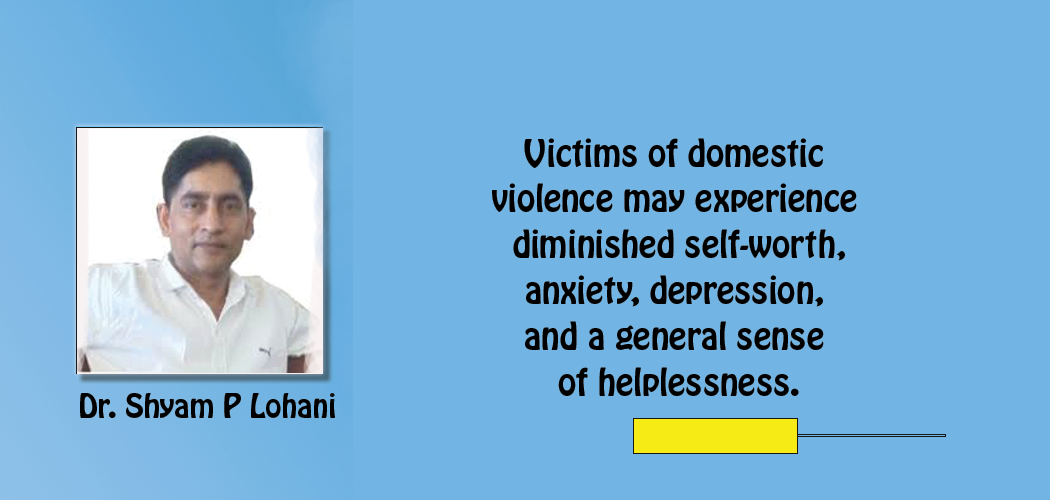

Dr. Shyam P Lohani
Domestic violence can range from physical to sexual, or psychological in nature. Domestic violence, also called intimate partner violence, happens between people in an intimate relationship. It ranges from emotional to sexual, and/or physical abuse and even threats of abuse. This form of violence is most often directed toward women. However, abuse by an intimate partner can happen to anyone irrespective of age and gender. Domestic violence has also been found in heterosexual and same-sex relationships.
In a global survey, it was found that around one in three women is affected either by physical or sexual violence by an intimate partner at some stage in life (WHO, 2021). The data shows between 3-50 per cent of women have experienced domestic violence in the preceding year. The statistics show nearly 1 in 10 men have also experienced contact sexual violence, physical violence, or stalking by an intimate partner during their lifetime and reported at least one impact of the violence (CDC, 2022).
Growing problem
This has been a growing problem in our society owing to its social norms, culture, and role. Studies have shown that around 50 per cent of Nepali women have experienced some form of violence at some point in their lives, with 15 per cent experiencing sexual violence.
Domestic violence is said to have occurred when a person repeatedly aims to control their partner either through physical, sexual, or emotional abuse. People of any age, gender, race, or sexual orientation can be the victim of domestic violence. Behaviours such as to scare, physically harm, or control a partner are included in this kind of violence. There have been reports of an increase in cases of domestic violence during the first and second COVID-19 lockdowns globally.
The unequal power dynamics often take their toll in domestic violence in which one partner tries to assert control over the other in a variety of ways. It has been found that domestic violence begins or increases during pregnancy. In that particular scenario, this violence puts the health of the victim as well as the health of the baby at risk. It can range from insults, threats, emotional abuse, and sexual coercion. Abusers may use children, pets, or other family members as well as inanimate objects as emotional leverage to get their victim to follow their demand or wish.
Abusers often are difficult to spot. They can seem smart, trustworthy, and charming with a unique personality trait in public, but in private, they behave just the opposite and often are cruel. Many abusers may have learned violence from their family members and repeat the same with their own partners or children. They are also more likely to have legal as well as substance abuse problems and significant numbers have alcohol use issues.
Abusers most often keep their victims isolated from family, friends, work, and any other outside sources of support. Perpetrators may have short tempers and become violent during an episode of violence. After the incident, they become apologetic and try to woo their partner back with charm and affection and promise to change, but the offensive behaviour rarely stops.
There are numerous risk factors for domestic violence, but they are not limited to a lower level of education, prior history of violence in the family, anti-social personality traits, harmful use of substances and alcohol use, and social norms.
Victims of domestic violence may experience diminished self-worth, anxiety, depression, and a general sense of helplessness. Other effects include confusion or hopelessness, panic attacks, and post-traumatic stress disorder (PTSD). These symptoms resolve only after professional help and take time to overcome the feelings of worthlessness and helplessness.
The impact of domestic violence is enormous in terms of social and economic costs, especially to women, their families, and societies. There have been reports of an increase in suicidal tendencies among victims of domestic violence, unintended pregnancies, abortion, and sexually transmitted infections.
There have been studies showing an association between domestic violence in pregnancy and an increase in the likelihood of miscarriage, stillbirth, pre-term delivery, and low birth weight babies. Domestic violence, in particular sexual violence during childhood, has been shown to lead to increased smoking, substance use, and risky sexual behaviors among adults. Physical marks, from bruises and broken bones to shortness of breath and extreme fear, are some of the symptoms seen among victims.
Prevention
All forms of intimate partner violence are preventable. Strategies to promote healthy, respectful, and non-violent relationships are an important part of prevention programmes. The WHO and UN Women have designed a framework for preventing domestic violence which was endorsed by several other UN agencies.
There have been several strategies recommended for preventing domestic violence such as social and economic empowerment programmes, community mobilisation to change unequal gender norms, school-based programmes enhancing equality among students and safety at schools, and group-based participatory education. Moreover, early childhood moral education at home and gender-sensitive curricula in schools have been found to cause a tremendous impact in terms of reduction in domestic violence incidences.
The prevention and response to domestic violence require a multi-sectorial approach and the role of the health sector is crucial. However, there is a need to train health workers in responding to the victim with a holistic and empathetic approach.
(Dr. Lohani is the clinical director at the Nepal Drug and Poison Information Centre. lohanis@gmail.com)