- Thursday, 28 May 2026

No End To Nuclear Threat

Hira Bahadur Thapa
Against the background of escalating ongoing Russia-Ukraine war concerns have been expressed about prospects of conflict being turned into nuclear, though inadvertently. Such fears are not without any logic considering the fact that one of the parties to conflict is nuclear-armed. Russia is one of the original nuclear weapon capable states whose nuclear edge over its current adversary induces its leadership to brandish nuclear threat with the intention of silencing its critics especially in the West.
A cursory look at the statements coming from Russian President Vladimir Putin, the first being on February 24 the day Russia invaded Ukraine, signal the hidden threat of resorting to nuclear weapons use, which has alarmed the international community. Putin said, “No matter who tries to stand in our way or all the more to create threats for our security and our people, they must know that Russia will respond immediately, and the consequences will be such as you have never seen in your entire history”.
The above statement has been widely interpreted as a nuclear threat. Commenting on possibilities of the Russia-Ukraine becoming a nuclear war, a doomsday scenario, the UN Secretary-General Antonio Guterres has said, “The prospects of nuclear conflict once unthinkable, is now back within the realm of possibility”.
Deterrence
The existence of nuclear weapons has been justified by its proponents arguing that nuclear deterrence dissuades countries from going to nuclear war. They have very often cited the example of averting Third World War which would not have been possible without the possession of nuclear weapons by internationally acknowledged nuclear powers. The original possessors of nuclear weapons as recognised by the Treaty on the Non-Proliferation of Nuclear Weapons (NPT) when it was signed in 1968 are China, France, Russia, the UK and the US.
The theory of nuclear deterrence is quite controversial. The essence of this theory is that once nuclear weapons are acquired by countries, they hesitate to use them for fear of nuclear retaliation, the consequences of which can be immeasurably devastating, but this principle of avoiding war due to retention of nuclear weapons applies to nuclear armed countries when engaged in military confrontation as exemplified by the event of 1999 Indo-Pak war in Kargil. Even the 1962 Cuban missile crisis when the US and former Soviet Union were on the brink of nuclear war, the same was averted for fear of nuclear annihilation. In that case the possession of nuclear weapons by the US and former Soviet Union played a useful role.
During Cold War, the US and former Soviet Union were restrained to fight with nuclear weapons when the nuclear deterrence principle was the decisive factor as both of them own large nuclear arsenals. In other words, perception that use of nuclear weapons by both belligerents would not guarantee any success to either of them is a disincentive to resort to nuclear war. That is why some experts have expounded the theory of Mutual Assured Destruction (MAD) being useful in the avoidance of prospective war and have tried to justify the existence of nuclear weapons.
The ground reality is different from what these experts have claimed to be true. There are many proxy wars ever since the World War II ended. Any research done on these wars would expose the support lent by two nuclear superpowers, the US and Russia, to their allies, both overt and covert. Their support has exacerbated proxy wars.
There are countless proxy wars fought in different regions of the world. Such wars have been fought in Africa, Asia and Latin America during the Cold War, some of which are still going on in places like Yemen and Syria. In all of these wars one can notice the involvement of two superpowers. The prevalence of wars as mentioned above nullifies the argument in favour of nuclear weapons as some are keen to give credit to these weapons for avoiding great power conflict.
Nuclear weapons possession by powerful countries has not averted wars in Iraq in 2003, Crimea annexation in 2014, long proxy war in Syria and more importantly the Ukraine-Russia war. To the contrary, their retention by Russia has emboldened it further to escalate the war and even intimidate its adversaries by threatening to use nuclear weapons. President Putin has used nuclear weapons as a shield behind which it has been occupying Ukrainian territories in flagrant violation of UN’s sacrosanct principles.
Status quo
In creating a world of discrimination vis-à-vis nuclear weapons acquisition the NPT is also to be blamed as it has maintained the status quo permitting the original possessors to retain their nuclear arsenals but denying the newcomers. Despite this, four new members have joined the nuclear club although NPT does not recognise them technically. These are Israel, India, Pakistan and North Korea. Some are also trying secretly to obtain them. Considering the prospects of nuclear weapons proliferation two former US Secretaries of State Henry Kissinger and George P Schultz, a former Defence Secretary William Perry and former Senator Sam Nunn lobbied back in 2007 for the complete abolition of nuclear weapons. Their commentary in this regard was published by the Wall Street Journal.
Nuclear weapons threat is alarmingly becoming serious and taking this into account the UN has brought a new treaty since 2021, which intends to prohibit nuclear weapons. With 122 UN members already in the treaty regime is an example of long determined efforts by the international community to establish a world without nuclear weapons but unfortunately it has yet to be acceded by nuclear armed countries.
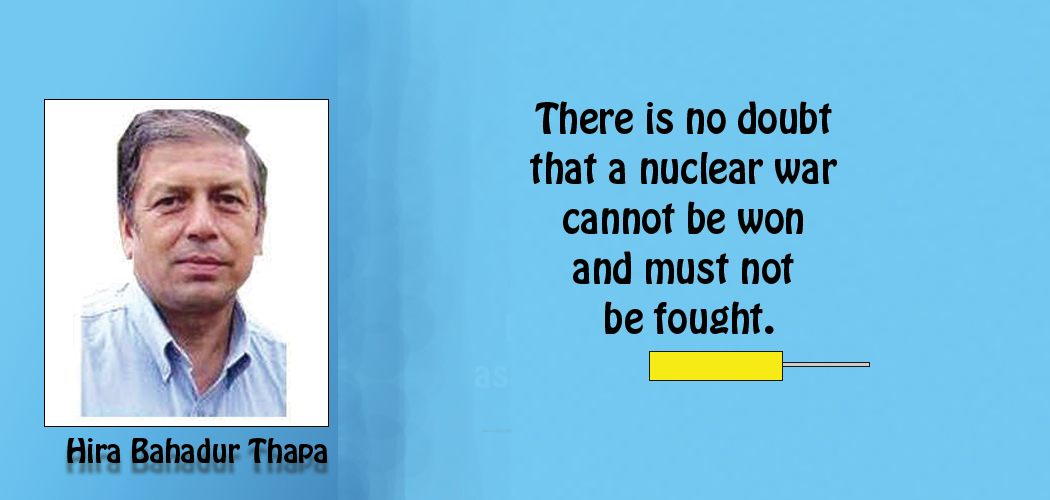
This is the only treaty that makes the use or threat of use of nuclear weapons illegal. Russian threat of nuclear weapons in its war with Ukraine is against international norms. There is no doubt that a nuclear war cannot be won and must not be fought.
(Thapa was Foreign Relations Advisor to the Prime Minister from 2008-09.)