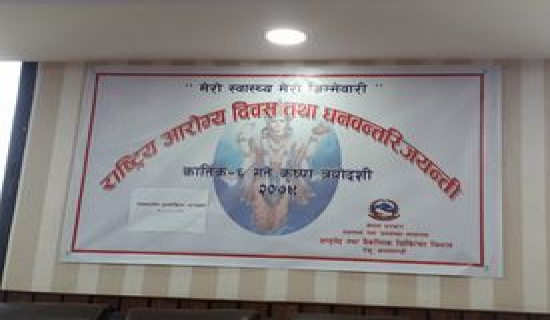
Janai Purnima and Gaijatra festivals are being celebrated at Patan Durbar square of Lalitpur district. On the occasion of Janai Purnima, those who wear the ‘Janai’ (the sacred thread) around their body from the left shoulder change the sacred thread after having a haircut and a bath on the occasion of ‘Janai Purnima’ also known as ‘Rishi Tarpani’.
Two children died drowning while swimming in the Kankai canal at Shivasatakshi Municipality-9 in the Jhapa district on Thursday.
Janai Purnima is observed on the full moon day of Srawana month. All the Tagadharis Hindu males who wear the Janai the sacred thread on their chests replaced the new one that is sanctified by the priest. Janai is a sacred thread which is only given to males during the religious ceremony of Bratabandhan, which is a formal process of accepting individuals in their religion. On the auspicious day of Janai Purnima, the festival is celebrated in different manners by various groups.
Managing solid waste in the valley is becoming challenging day by day. On one hand, the rapid urbanisation together with the changing lifestyle and consumption patterns is contributing a lot to the rise of solid waste. On the other hand, the valley is still heavily reliant on dumping and landfilling techniques for waste management. Currently, only around 10% to 15% of waste goes for reduction or recycling while the rest of the waste still goes for landfilling and dumping.
Media reports these days bring several issues to the fore regarding the state of higher education in the country. Of them, the problems and anomalies that plague Tribhuvan University – the country's premier seat of higher learning consuming the larger share of the higher education budget - are found occupying more space than the others. A cursory scan of the news items printed in the daily newspapers reveals a plethora of academic, administrative, financial and managerial woes and problems taking a toll on the performance of the university.
For most people, the impression of a city is- a vibrant and easy life, availability of modern facilities, and an utmost interactive arena. Many people have a dream to settle and be part of city life. Whether it is for higher study or employment, we throng the city. It is natural for everyone to aspire for a better life, so deserting villages and crowding cities is a common phenomenon. It's me, you, them and our families, relatives and friends- many are in the city. Is the city hospitable, comfortable and fulfilling as we aspire it to be? It is a question that warrants attention. For many, despite being a vibrant place, the city appears cold and dead. This is not the place that we expect it to be. If there is any place where we face the most contradictions, it is the city. An anthology of poems, ''The Selfish City'', penned by Bhoj Kumar Dhamala, argues, that the city is selfish. The title of the under-review anthology, 'The Selfish City', rivets us to ponder the contradictory aspects of the city. It is, however, the reflection of the contradictory self of we people. What is the business, hustle and bustle, and hurry in the city for? Poet Dhamala marvellously summarises: 'Just two meals a day is what one needs/Identity disguised for so-called supremacy'. He attacks the pride of one's life in the city as everyone is disguised much for a higher life, a standard of living. But, what's this all for? Just two meals a day! The so-called grandiose is nothing more than an essential reality. He argues people are yearning for money as if they are 'to eat golden rice.' Erosion of trust is another bitter and biting reality of city life. The collection of 54 poems is a post/modern mirror. Decadence, delusion, deviation, deconstruction, extreme polarity, disarray, chaos, confusion and urbanisation are some of the dominant themes in Dhamala's poems. Similarly, most of the poems show the contradictory nature of humans. Of course, the entire nature is fed and run with the binary and bipolar ethos. As we, people, are unavoidable parts of nature, contrast is integral. It is because of the contrast and contradiction, people understand what life is and how situations should be handled. In another poem, 'Wake Up Kathmandu', he employs the same tool and paints Kathmandu as 'pregnant with pain' and a place for achievement. Here, Kathmandu as pregnant with pain can be interpreted in many other ways: It is transforming; socio-cultural and political movements emerge and grow here time and again; new issues get birth and rebirth. The theme of the title poem and this poem are similar. On the one hand, Kathmandu is a place to nurture utopia, while it is a hellish place the dwellers are bound to live on the other. As a dweller of Kathmandu city, the poet finds himself a helpless onlooker to this situation. These can be dubbed urban poetry. Irrespective of the downcast painting of life and time, the poet wants people to be restrained, responsible and disciplined for a smooth life span. In the poem, 'A-synchronization', he writes: Harnessing oneself to self-discipline will protect/ one from the final dot of life, orientation to the past/Pondering upon the present for a better tomorrow. These lines also give a spiritual glimpse- of the oriental philosophy of life, the concept of re/incarnation- birth and rebirth. One can explain the words, 'past', 'present' and 'tomorrow', as the signal of birth and rebirth. He wants us to 'ponder upon a present for a better tomorrow.' He may have sought correction in life. A purgatory sense to cleanse life from decadence, disarray and degeneration can be observed in these lines. With this, he hopes it will help achieve synchronisation.'Ebb and Flow is another poem employing contrast. 'On the journey of ebb and flow/experiencing/The excellent and meagre/Cosmic world where lies a sad reality' shows contradiction- good and bad, up and down. In the later lines, he talks about perennial love but warns that it is miles away. This is a picture of our life cycle.The poems on climate change and subsequent adversity are other important reminders of the present time. The poem, 'Ecological Apocalypse', makes us aware of impending environmental tragedy. What a suffocation it is in the atmosphere with polluted air, and how quickly desertification is going. 'Technological encroachment, human ambition, concretisation, replacement and suffocation, nowhere fresh air or clear sky, mere blinding haze. And we, the rational ones, are lost'. As the writer said, it is a present reality that we are facing extreme weather events caused by climate change. Who are those behind this concretisation? Of course, the esurient, materialistic and individualistic nature of humans is behind the present chaos. Humans, as the off-springs of nature, must be serious to save mother Earth. How much innovation and discoveries are too much to the cost of nature? This poem makes everyone pose this question. As supreme beings, our behaviour needs immediate correction, otherwise, we face the apocalypse. It is a warning the poet makes. Another poem, "Climate Change," has a similar theme. In the very beginning, he makes a warning, 'Extreme, it's extreme, you know the surrounding/Once lively, now outrageous.' Nature, once peaceful and pleasing, has begun showing its wrath - all because of harm and dishonour it is meted out. It is what the poem says.Love, sex and pandemic are other topics the poet dwells on. 'Representation' is a symbolic poem talking about sex sans love. It can be a representation of modern life where sexual perversion is prevalent. Sex can be a culmination of love, an event to share love, and a complement to love and affection, but it has turned into a cheap activity to please the carnal side of life. In conclusion, Mr Dhamala has finely pictured the human contradiction meticulously through his creation. All poems are dovetailed in twelve lines- four lines in each stanza. In some of the poems, better wording is expected for further craftsmanship. The poems however can contribute to urban literature. The book, published by Ambar Publication House, costs Rs 395.
Poets are people who love to explain aestheticism through words with high faith and say they are always keen and try their best to admire truth beautifully. Poet Kalanidhi Dahal, with his newly launched under-review poetry book entitled "Aafain Bhaye Sundara", imagines how beautiful our society would have been, had we made our thoughts and deeds beautiful.
About 56 years ago, I was a newly appointed officer at the Cooperative Bank (later it became Agriculture Development Bank). It was the Nepali year 2023 BS and I was in training. Workshops were running. The trainers were U.S. advisors, government directors and secretaries. The Bank had come up with the objective of lending loans to farmers. Until recently, people received loans from traditional money lenders in the country. But the new land reform law had sent them off the scene and bankshad replaced the traditional moneylenders.
Nepal and China have enjoyed friendly relations since time immemorial. The bilateral ties have been deepened further with the establishment of diplomatic relations between the two immediate neighbours in 1955. The frequent exchanges of high-level visits have taken the bilateral ties to newer heights. The bilateral relations between the two countries have been based on friendliness, understanding, mutual support, cooperation and respect for each other’s sensitivities. Both nations have relentless faith in the ideals of the Five Principles of Peaceful Co-existence, which include mutual respect for territorial integrity and sovereignty, mutual non-aggression, mutual non-interference in internal affairs, equality and cooperation for mutual benefit and peaceful co-existence. And Nepal has remained committed to her ‘One-China policy’. Minister for Foreign Affairs Dr. Narayan Khadka, who was on a three-day official visit to China from August 9 to 11, has also assured his Chinese counterpart Wang Yi of Nepal’s unwavering commitment to the ‘One-China policy’.
Nonalignment is firmly embedded in geophysical setting of Nepal. The roots of Nepal’s nonalignment go back to the teachings of the unifier of Nepal, King Prithvi Narayan Shah, who exhorted the posterity with a mantra that Nepal is “like a tarul (a root vegetable) between two stones.” This comes to constitute the kernel of its association with the incarnation of nonaligned movement (NAM) after the end of World War II. Located between two huge neighbours India and China - two most populous countries with two different political and social systems, now the centre of gravity of global geopolitics - “tarul between two stones” remains a ‘geopolitical code’ for Nepal.
There can no longer be any doubt about the facts of what happened in Washington, DC on January 6, 2021. Despite being told by his own inner circle, including by his loyal attorney general, William Barr, that he had lost a fair election in November 2020, US President Donald Trump broke democracy’s cardinal rule: He refused to accept his defeat and has been pushing conspiracy theories about electoral “fraud” ever since. Trump deliberately incited an armed mob to storm the Capitol, and when the crowd started baying for Vice President Mike Pence to be hanged, he did nothing and told his staff tha
In a classroom, let’s take two students, one very informed and the other not so much. A clear distinction is seen between the two when class discussions are held. The one with the knowledge is sure to lead the discussion backed up with concrete facts – better than his/her counterpart. Thus, the main idea is that information is power. And this simple concept can be applied in a democratic setting as well where information is considered to be the backbone of democratic practice.
Dhunche-Kathmandu road section along Pasang Lhamu Highway has come to a complete halt after a landslide on Tuesday hit Betrawati Kalikasthan. Nearly 50 metres of the road has been washed away by the landslide in Uttargaya Rural Municipality-5, Banuwa.
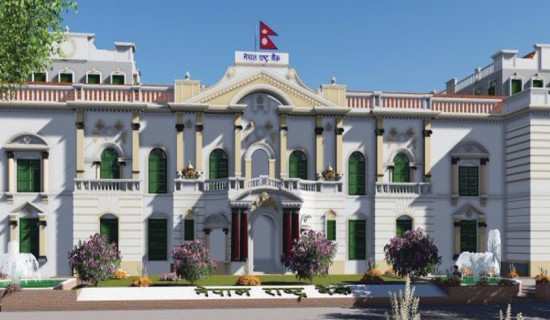
Nepal Chamber of Commerce (NCC) warned of a deterioration in business environment and country’s economy due to the policies adopted by the Nepal Ratra Bank (NRB) in the new monetary policy.
Before the construction of the East-West Highway, there was an evident business boom in Koilabas market of Dang. Apart from Koilabas, there were not many goods available in Dang, which is now known as a business place. Koilabas was the business centre not only of Dang but also of the entire Rapti region. Due to its proximity with India, it was easy to bring goods there, so businessmen also preferred to do business there. But at present, there is almost no business activity in Koilabas.