- Wednesday, 8 April 2026

TRN Online
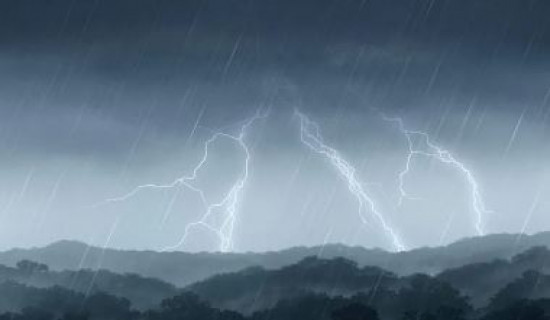
Rain with thunder likely across the country
Weather across the country is likely to remain partly to generally cloudy throughout the day today with the possibility of light to moderate rainfall at many places of the country, according to the Department of Hydrology and Meteorology.
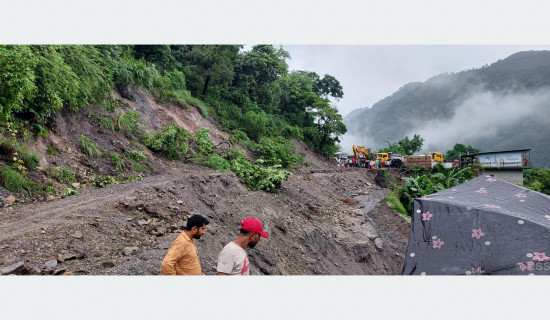
Traffic disrupted in the Palpa-Butwal road section
The Palpa-Butwal road section of the Siddhartha Highway has been disrupted yet again due to a landslide near Hiyudekhola of Tinau Rural Municipality-5 in Palpa.
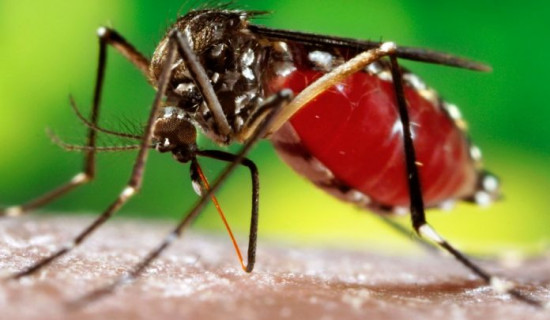
Campaigns against dengue in Hetauda
With the sharp rise in dengue patients of late, the Hetauda Sub-Metropolitan City has prepared to begin a door-to-door campaign.
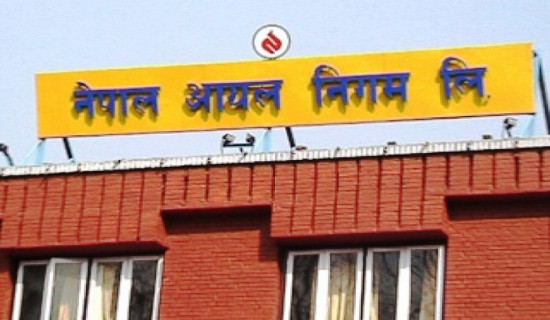
NOC owes Rs 21 billion to the Indian Oil Corporation
The Nepal Oil Corporation (NOC) has said that it has to pay Rs 21 billion till the last of August to the Indian Oil Corporation (IOC) for the purchase of petroleum products.

Snakes' Role In Ecology
Having suitable habitats for snakes, Nepal is home to numerous species of legless reptiles. National parks, other protected areas and their corridors are the major habitats for snakes. They also live in bushes, farms, swamp meadows and riversides. A variety of venomous snake species such as King Cobra and Krait are mostly found in tropical and sub-tropical regions while numerous other species are sighted at places with altitudes of 3,500 to 4,000 metres above sea level. Though people have a negative perception towards snakes in general, these species, as stated by herpetologists, play an essential role in maintaining balance in the entire ecosystem. In fact, snakes can be both predator as well as prey in most ecosystems. The population
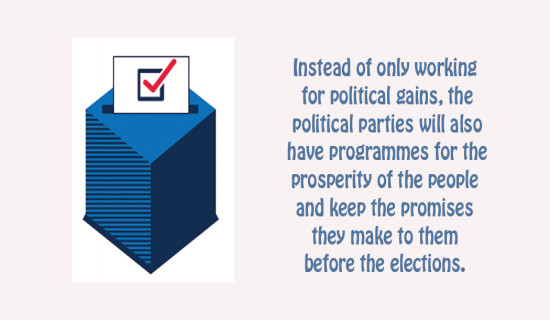
Keep Electoral Promises
The House of Representatives and Provincial Assembly elections are fast approaching in the country now. The elections will take place soon after the two greatest festivals of most Nepalis, Dashain and Tihar, are over. How political leaders canvass during this festive occasion is also being observed with keen interest by the general public. In spite of the criticism of the political leaders who, the people feel are not doing their best for the general public, they still are very interested in casting their votes. If one is to go by the results of the local level elections some months ago, it can be assumed that more fresh faces will be seen after the upcoming elections for members in the parliament. This will mean that independent and young candidates will also have to be included in the government after the polls at the central level and the provinces as well. This will be a jolt for the traditional parties, but choosing the right candidates will go a long way in steering the natio
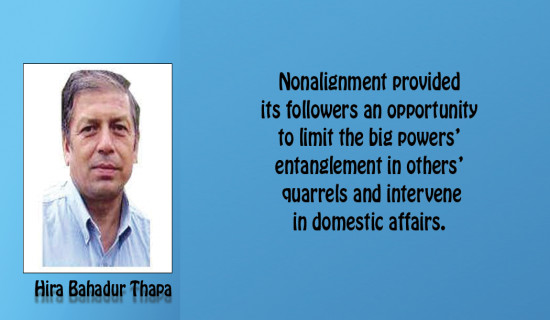
Strategic Autonomy Through Nonalignment
Nonalignment was born in the heydays of Cold War that started following the end of World War II. Superpower rivalry between the United States and the then Soviet Union erupted with the competition to expand their influence in their periphery and beyond. The possession of atomic weapons first by the US in 1945 and followed by the Soviet Union in 1949 added fuel to their strategic competition as both gained more destructive power to dominate others. A wave of decolonisation in the 1950s and the 1960s brought independence to a large number of developing countries in Asia, Africa and Latin America. As both superpowers exerted their influence on these countries to toe their policies and join their alliance for security, there was a need for them to pursue a policy of nonalignment. Being nonaligned, the smaller and newly independent countries could avoid being drawn to either of the blocks created by the world’s two superpowers.
Stay Alert To Avoid Dengue
We are always trying to protect ourselves from mosquitoes during the nighttime. And in the daytime, we rarely pay attention to the presence of these blood-sucking insects. But such negligence on our part could potentially lead to transmission of dengue. This viral infection causes a flu-like illness. It may sometimes cause a deadly complication, too. With the arrival of every monsoon, mainly from June to September, the mosquito population grows considerably. Construction of roads and drains is so bad that potholes filled with stagnant water often become a perfect ground for mosquitoes to breed. The changing weather pattern is another factor contributing to an exponential rise in the number of mosquitoes. The weather is hot and humid and it is exactly the kind of weather that these species of insects enjoy.
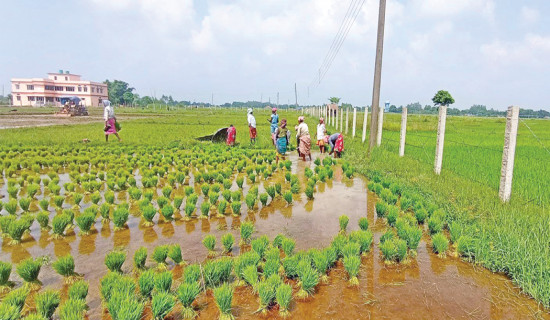
Jhapa farmers plant paddy as an experiment
Farmers in Kamal Rural Municipality of Jhapa district planted paddy of ‘Biji’ species in the second week of Nepali month of Bhadra. They planted for the production of rice seeds. Planting paddy at the end of August is a new practice in Nepal. In cooperation with Caritas Nepal, the paddy was collectively planted in Kamal Rural Municipality-2, said local Tanka Kattel, who is also an agricultural technician. He informed that the paddy was planted as an experiment through the Santhal Utthan IPM farmers group which was formed with the participation of indigenous marginalised communities. After seeing that the field was barren, the paddy was planted as a new practice, seeking permission from the concerned farmers, Kattel said.
476 local levels fully electrified, 35 still out of NEA coverage
Almost 111 years after the first hydropower – Pharping Hydropower – was established by Rana Prime Minister Chandra Shumsher Rana as Chandrajyoti hydro-electric power station in Pharping, Kathmandu, in 1911, electricity has reached 92 per cent population of Nepal. Until five years ago, Nepali people had to live braving power outage up to 18-hours a day. But now Nepal is exporting 364 MW power to India every day. It took many years for the country to produce power to meet local demands. In next two years, remaining 8 per cent Nepali people will also get access to power supplied by the Nepal Electricity Authority (NEA).

NOC hikes price of diesel, kerosene by Rs. 6 a liter
Price of petrol, cooking gas and aviation fuel has, however, been kept as it is.
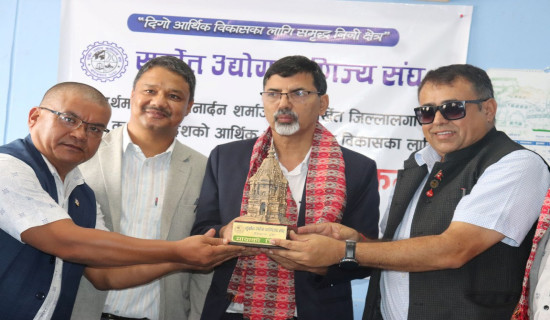
'Karnali province will be prosperous from construction of roads, tunnels'
At a programme organised by Surkhet Chamber of Commerce and Industry on Thursday, Minister Sharma said the first precondition to development was transport infrastructure.
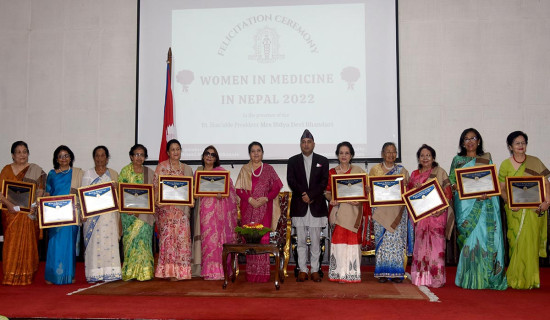
President Bhandari honours female doctors
At a program held at Rashtrapati Bhavan, she presented special honors to 15 women doctors who have contributed to the field of Nepali medicine on the recommendation of the Nepal Doctors Association.
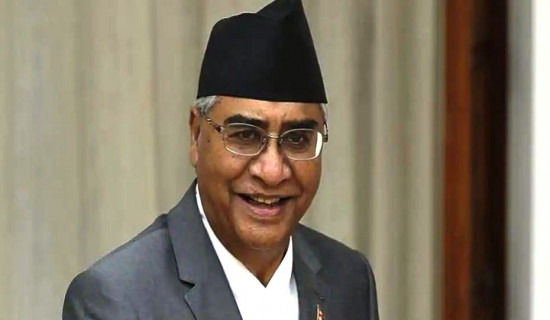
PM Deuba recommended as HoR member candidate from Dadeldura
A meeting of the NC Dadeldura Regional Committee today unanimously recommended Deuba as the candidate for HoR member in the poll under the first-past-the-post system.
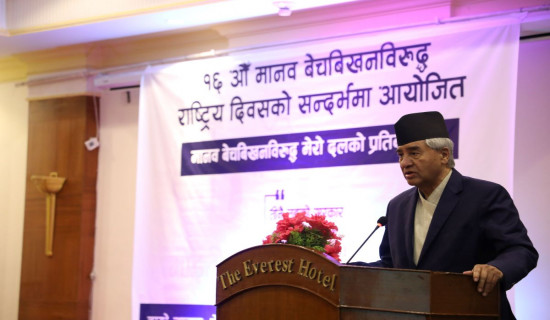
Human trafficking, a disgrace to civilized society: PM
At a programme on 'My party's commitment against human trafficking' organized by Maiti Nepal here Thursday, Prime Minister Deuba said that the government was committed to fulfilling the commitments made by the country at the national and international forum in the fight against human trafficking and transportation.