- Thursday, 21 May 2026

Need For School Education Revamp

Education is undeniably the backbone of nation-building and, hence, a nation’s prime concern. The government ought to ensure that children go to schools that lay the foundations for higher studies and help produce skilled manpower. Until about four decades ago, all and sundry had equal access to education in Nepal: the rich and the poor, the high-born and the low-born, the high-class and the low-class all went to the same school.
Teachers did not take to politics, focusing instead on their educational responsibilities. Their sole motto was to mind their students’ schooling and enhance education. They had an adequate command of their respective subjects and also knew English without having gone through the travails of expensive boarding schools, which was inconceivable then. Teachers’ dedication to their profession earned them respect and placed them in high esteem. Teachers rarely skipped their classes, and they were passionate about teaching.
Politics
The present-day school education has gone awry, with its norm plummeting. Teachers are attracted more to politics than to their vocation. Generally, they are members of the sister organisations of their political parties. They do not take much care of their students’ future. Their degrees, qualifications, and class performance are less significant than their political allegiance to their party.
Several politically indoctrinated teachers are appointed with the connivance of mayors and chairs who are not even SLC/SEE graduates. Besides this, some head teachers manage to appoint their near and dear ones through the back door. Some such appointees succeed in staying at the schools for as many as 20 years, if not more, and retire with handsome gratuity. Nonetheless, it is not too late to bring about reforms in school education. Some suggestions are made below:
First, striking a balance between the number of students and teachers is a must. A class consisting of about a hundred students or more is a common sight in government schools. In that situation, how can a teacher handle the class properly? The class is sure to be noisy, uproarious, and messy. Teachers cannot assign homework and pay attention to all, nor can they go through their assignments.
Teaching, therefore, can be far from being effective, and teachers can easily wash their hands of quality teaching. The guardians on the lookout for better education are compelled by such a predicament to send their wards to boarding schools, most of which were started with the goal of addressing the weaknesses of government schools. A class must not accommodate more than 30 students or so. The good news for the present government is that it can cut unemployment problems to a great extent by creating more and more teaching jobs and employing more and more teachers.
Secondly, only those who pass the Teachers’ Service Commission and display special aptitude for teaching should be employed as teachers. Nepal does not lack qualified nationals who can make successful teachers. Let them be provided with all the amenities that a government employee enjoys. They need to have training from time to time, and their morale can be held high by cracking down on the corrupt, dishonest government officials.
Third, backdoor entry, and politically motivated people must be kept in check as they vitiate the teaching and learning atmosphere of the school. Such teachers come to school only to pass the time and pocket easy money. Fourth, public and private schools should teach similar texts, so that children in either school shall not develop any complexes. A developing country like Nepal, where all political parties boast of adhering to socialism, ought to ensure that all children, whether haves and have-nots, receive education with equal dignity.
Women teachers
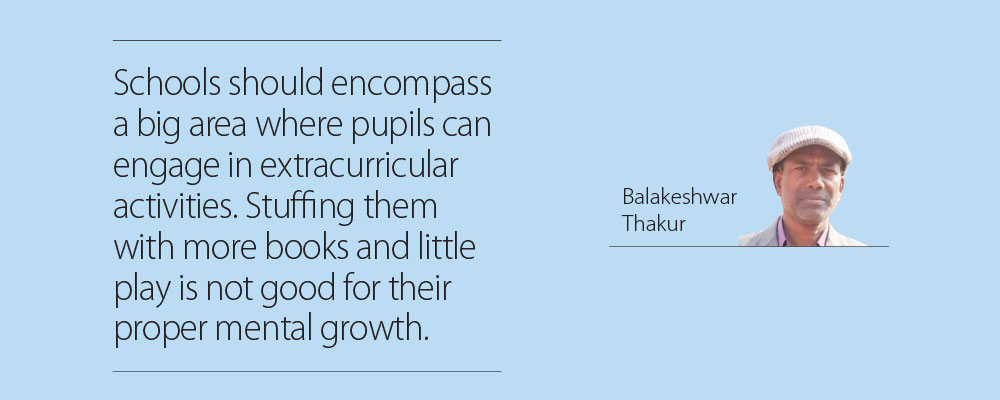
Fifth, employ as many women teachers as possible at the primary level because they are far better at caring for little learners than their male counterparts. This will also open up vistas for employing more and more women whose potential has so far been overlooked. Sixth, schools should encompass a big area where pupils can engage in extracurricular activities. Stuffing them with more books and little play is not good for their proper mental growth.
Seventh, make school education compulsory and free of any tuition fee. Eighth, let the children be sent to their schools only after they are five years old, since the years before this are crucial for their emotional and physical growth. During these initial years, they should be allowed to experience their parents’ cuddle and care. Gambolling, playing, quarrelling and fighting with their fellow friends are their fundamental rights during this period of their life.
This way, they develop their mind, limbs and muscles. It has been noted that children going to school before 5 do not grow up emotionally. Nor do they build up their hand muscles for good handwriting. Bringing about reforms in education ought to be initiated as soon as possible. Hopes have now been raised that this will happen under the leadership of Prime Minister Balendra Shah.
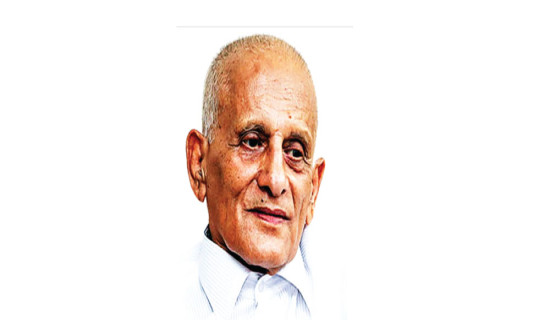
(The author is a retired associate professor of English at RRM Campus, Janakpurdham.)