- Saturday, 23 May 2026

Upper Mustang locals want area removed from semi-restricted list
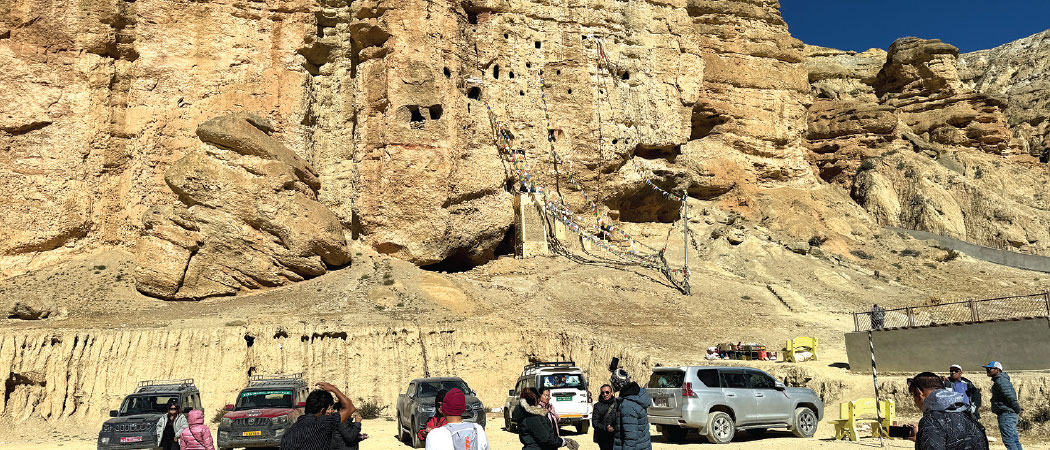
Photo: Harikrishna Sharma\TRN Tourists observe the man-made “Sija Dzong” cave in Chhoser, Ward No. 1 of Lomanthang Rural Municipality in Upper Mustang.

By Harikrishna Sharma,Muktinath (Mustang), Apr. 5: Local representatives from Upper Mustang have submitted a memorandum to outgoing Prime Minister Sushila Karki, urging the government to remove the region from the semi-restricted area list.
Citing decades of restrictions that have limited foreign tourist arrivals, representatives said they had repeatedly submitted memorandums to former Prime Ministers Pushpa
Kamal Dahal, Sher Bahadur Deuba and KP Sharma Oli over the past
three decades, but received only assurances.
This time, they said, they are waiting for concrete results.
After receiving little more than promises from both federal and provincial governments for over 15 years, locals are now hopeful that Prime Minister Balendra Shah will address the longstanding issues and help elevate tourism in Upper Mustang.
In the past, the Cabinet led by Karki introduced provisions allowing even solo trekkers to visit the
semi-restricted area, provided they hire a guide. Earlier, only groups of two or more foreign tourists were permitted.
The previous rule required visitors to pay USD 500 per person for 10 days, with an additional USD 50 per day thereafter.
The revised rule sets a flat fee of USD 50 per day, which locals say has offered some relief.
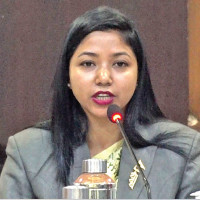
However, Tashi Nhervu Gurung, Chairperson of Lomanthang Rural Municipality, said further facilitation is needed.
He called for a flat USD 50 fee regardless of the duration of stay and urged the government to remove Upper Mustang entirely from the semi-restricted list.
“Efforts to attract foreign tourists to Upper Mustang have not been fully successful so far. We are confident the new government will resolve these issues,” Gurung said.
He added that tourism could significantly boost the local economy if visitors were charged a reasonable fee of USD 50 to 100 for a minimum 10-day visit, infrastructure at the Korala border point was improved, and easier cross-border movement to religious sites in Tibet was facilitated through immigration services.
Federal lawmaker Yogesh Gauchan Thakali also stressed the need to end what he described as discriminatory rules that prevent both Indian and third-country tourists visiting Mustang from fully experiencing Upper Mustang.
“The improvements so far are the result of our efforts, but many issues remain. I will continue to press the federal parliament and the government for solutions,” he said.
He added that the semi-restricted status has forced locals and tourism entrepreneurs to migrate elsewhere, and that the situation could improve given that Gandaki Province also oversees tourism policies. Gauchan compared the current restrictions to “keeping Mustang’s tourism in a zoo”, arguing that only the complete removal of the semi-restricted status would solve the problem.
While Mustang receives more than 100,000 foreign tourists annually, only around 4,000 manage to visit the restricted Upper Mustang region.
Raju Lalchan, President of the Mustang Chamber of Commerce and Industry, said the restrictions are a major barrier, despite the fact that the Korala border route offers a shorter and more affordable path to Kailash Mansarovar, a major pilgrimage site for Hindu and Buddhist devotees worldwide.
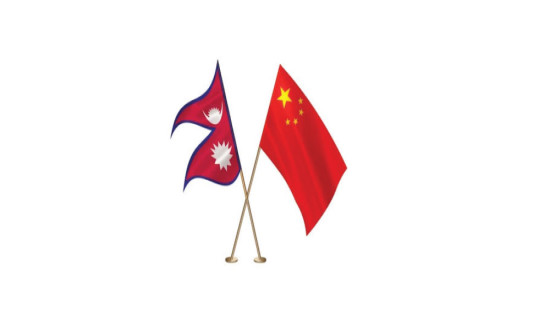
The Government has designated several areas, including Chhusang in Baragung Muktikshetra Rural Municipality-3 of Lower Mustang, and all wards of Lomanthang and Lo-Ghekar Damodarkunda rural municipalities in Upper Mustang bordering the Tibet Autonomous Region of China, as restricted zones due to security sensitivities.
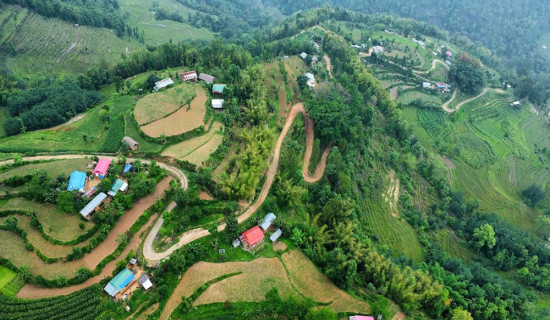
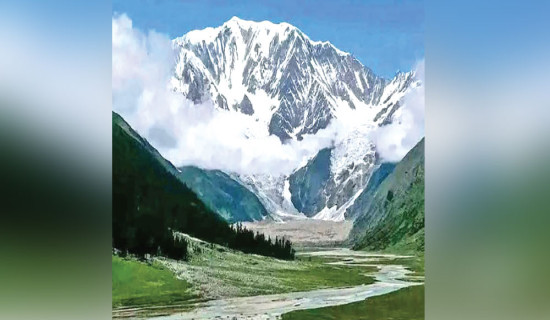
Nepal opened Upper Mustang to foreign tourists in 1992. The main tourism seasons -- spring and autumn -- see visitors travelling to the region by trekking, helicopter, and road networks.
Tourists visiting Upper Mustang are drawn not only to the Korala border area but also to its ancient human settlements, caves, monasteries, the Lomanthang palace, traditional mud houses, and its unique culture and way of life.