- Monday, 25 May 2026

Dalit Women Denied Leadership Role

In the blue-grey light of a Kathmandu morning, the city is reclaimed by the rhythmic sweep of a broom. Long before the digital class wakes to scroll through the curated successes of the March 5 general election, thousands of Dalit women have already mapped the city's visceral truth. They are the invisible engineers of our public health. Yet, as the sun climbs, the society they have just sanitised treats their presence like a smudge on a window- an obstruction to be cleared, never a force to be consulted.
For the Dalit woman, the threshold of social judgment is not a line she crosses; it is the oxygen she breathes. But as the heavy doors of the Cabinet room prepare to swing shut following the election results, her chair is not merely empty. It is as if the floor itself were never engineered to hold her weight. The tragedy of the Dalit woman in Nepali politics is a study in Triple Locking - a systemic immobilisation by caste, gender, and class. Our Proportional Representation (PR) system, constitutionally designed as a master key for these locks, has been weaponised by political parties into a high-end waiting room.
Exclusion
In the first-past-the-post (FPTP) races - the true arena of direct mandate - Dalit women remain statistically invisible. Of the 165 direct seats, the number won by Dalit women remains a haunting zero. This is not a failure of merit; it is a deliberate architectural exclusion. When a Dalit woman is excluded from the Cabinet, it tells every Dalit schoolgirl that her merit has a permanent ceiling. The March 5 election campaign was no longer a contest of ideas; it is a war of muscle and money. With a federal campaign now costing upwards of Rs. 50 million, a woman from a community where 41 per cent live below the poverty line is defeated before the first ballot is printed.
Behind the closed doors of party headquarters, the leadership calculates winnability by weighing bank balances against social capital, effectively subtracting the Dalit woman from the equation. This cold arithmetic ensures that the FPTP ballots are reserved for those who can afford the entry fee, while the Dalit woman is relegated to the PR list- a strategic rounding error used to satisfy constitutional quotas without sharing real power.
For the Dalit community, the lack of a lalpurja (land ownership certificates) is the legacy of state-sanctioned landlessness. The land title is the ghost of our history; it is the paper evidence of who the state considers a citizen and who it considers a tenant. Without a title to offer as collateral, the Dalit woman cannot access the credit required to buy the digital saturation that reformers use to drown out her voice. Furthermore, the digital revolution has birthed a new form of virtual lynching. Social media harassment hits Dalit women with a unique, intersectional velocity- a modern-day stoning designed to shame any woman who dares to speak back into the shadows.
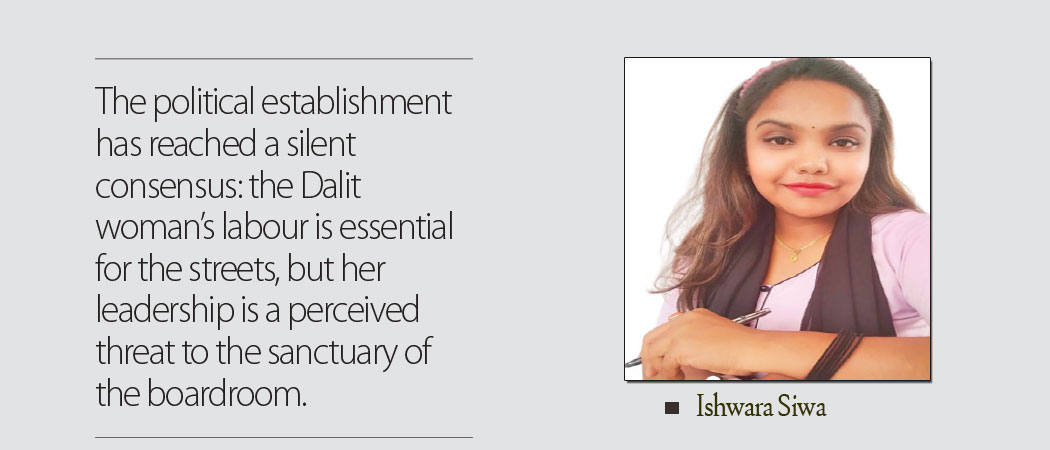
The political establishment has reached a silent consensus: the Dalit woman’s labour is essential for the streets, but her leadership is a perceived threat to the sanctuary of the boardroom. When the state does yield, it often offers ornamental inclusion- decorative portfolios designed to fulfil a quota without granting influence. We must move beyond the periphery and claim mainstream ministries. A Dalit woman’s place belongs in the Ministry of Finance, the Ministry of Law, or the Ministry of Energy. The woman who knows how to manage the survival of a household on no budget is the most qualified to manage a nation.
Those who have survived the arithmetic of poverty are the only ones fit to master the arithmetic of the national budget. If the incoming government wishes to prove its alternative politics is more than just the old injustice wearing a digital mask, it must move toward institutional surgery. At least one Dalit woman must hold a full Cabinet-level portfolio in a hard power ministry- Finance, Law, Home, or Energy- to end the cycle of ornamental inclusion.
Funding for landless candidates
We must establish reserved direct-election seats for Dalit women and implement a cooling-off period for PR to force parties to invest in Dalit women as direct, autonomous leaders.
State-funded campaign grants must be established for landless and marginalised candidates to ensure that ideas, not SUVs, win elections. By law, core party committees must reflect the demographic reality of the nation, and the Election Commission must categorise caste-based digital harassment as a disqualifying offense. Every ministry must undergo a mandatory audit to ensure national resources actually reach the Dalit woman at the threshold.
Keeping the Dalit woman at the threshold amounts to starving Nepal of its most resilient talent. The Dalit woman does not need upliftment or charity. She needs the doors taken off their hinges. A New Nepal that keeps its most courageous daughters in the waiting room while the sons of privilege feast at the high table is not a revolution- it is merely a renovation of the same old hierarchy. For decades, my mother reclaimed the city streets with the rhythmic sweep of her broom. Today, I reclaim this narrative with the rhythmic sweep of my pen. Her silence was her shield; my silence would be a betrayal. The threshold is no longer a place of waiting; it is a front line. And that silence is about to become a roar.
(The author is a columnist and social activist.)