- Sunday, 24 May 2026

The Shadow War Reshaping The World

The growing confrontation between the United States, Israel, and Iran reflects more than a regional rivalry; it signals a shift in how modern power struggles unfold. Increasingly, conflicts are fought through covert operations, economic pressure, cyber warfare, and strategic diplomacy rather than conventional battlefields. As major powers such as Russia and China quietly calculate their positions, this shadow confrontation illustrates how contemporary geopolitics is reshaping the global balance of power far beyond the immediate region.
Iran’s strategy is a concept that military experts term “victory denial.” The method is quite straightforward. Instead of a weak nation trying to overpower a superpower directly, it chooses to frustrate the more potent opponent’s efforts to score a decisive win. The weaker side changes the military imbalance into political influence by dragging the war on, increasing the costs, and making the strategic situation more complicated.
Low-cost weapons
Iran’s use of drones and ballistic missiles is an ideal illustration of this reasoning. These low-cost weapons systems can cause heavy losses to advanced militaries, which have to rely on expensive anti-missile technologies. Thus, the focus shifts from winning battles to sustaining oneself and applying political pressure. We can find some instructive examples in the past, similar to Guerrilla groups, which also used the same kind of tactics in Afghanistan and Vietnam, where their goal was not necessarily a military victory but a gradual breakdown of the opponent’s political will.
Russia views this confrontation as a strategic opening. The war in Ukraine has already required a combination of Western military tools and political capital. If a new crisis with Iran prolongs, that will make it even harder for the US and its allies to stay on top of the situation. In the past, major powers had taken advantage of their rivals getting stretched thin, because they knew that even the strongest armies get weakened if they are scattered. Besides, energy markets add a new layer to this situation. Turmoil in the Middle East (ME) naturally leads to higher world oil prices.
For years, the Chinese leadership has clung to the very wise strategy of the late Deng Xiaoping: “Hide your strength and wait for your opportunity.” In short, this means steering clear of direct military fighting, and at the same time, subtly reaching out through economic, technological, and diplomatic channels. China’s strong energy partnership with Iran, along with its grand plan to build a gigantic network of trade and infrastructure links through the Belt and Road Initiative, means it is eager to see stability in Iran as part of its economic chain. Meanwhile, the US getting stuck in the ME wars might mean less focus on other areas of the world, especially the Indo-Pacific.
Diplomacy has also become an essential tool. Iran’s diplomacy towards the Gulf States is a part of a well-thought-out strategy to break the regional coalition that sided with the US by giving the neighbouring countries difficult choices: a security partnership with the US or a lower risk of retaliation. Iran intends to disrupt the unity of America’s alliances. These diplomatic moves illustrate how war nowadays is not only about fighting. Words, bargaining, and trade can be just as powerful as weapons and drones.
The US had been the major global power for most of the post-Cold War period. However, today’s geopolitical setting is more similar to a multipolar system with various major powers having overlapping and sometimes conflicting strategies. Hence, the secret war around Iran could be more than a passing crisis.
It could be a sign of the world’s politics turning to a point where local conflicts are the ground for confrontation between major powers. It is unclear whether diplomacy can keep the situation from worsening or if the conflict will draw in new players. The whole world sees this as more than just a fight between two countries; it is the reshaping of power for the twenty-first century.
Strategic balance
As connections tighten across nations, countries like Nepal can go through unseen pressures born far away. Nepal stands at a crossroads where change could focus on advantage. In this evolving geopolitical environment, maintaining strategic balance and protecting national independence remain essential. At the same time, Nepal’s long-term strength may lie not only in diplomacy but also in economic resilience by strengthening domestic agriculture, reducing dependence on imports, and expanding regional trade.
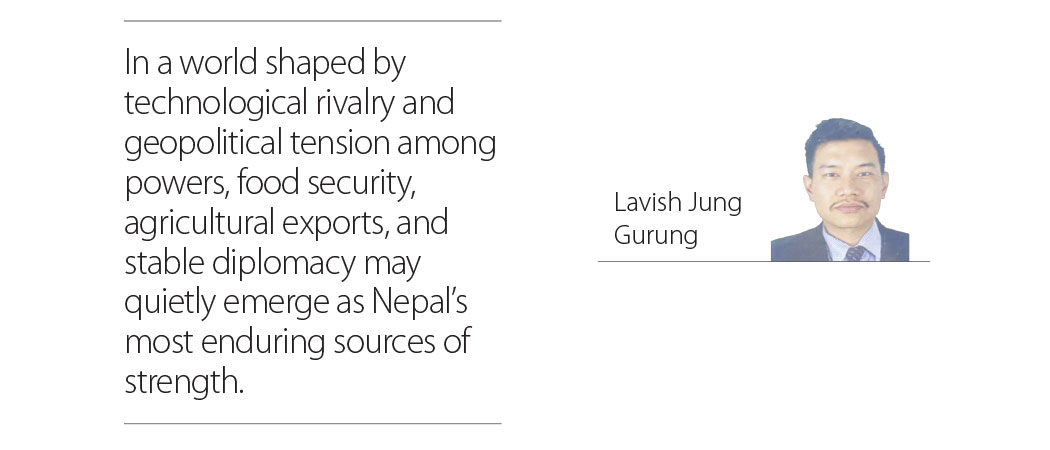
Developing the capacity to export food and agricultural products could also become a strategic advantage. In a world shaped by technological rivalry and geopolitical tension among powers, food security, agricultural exports, and stable diplomacy may quietly emerge as Nepal’s most enduring sources of strength. The country's new leaders need to build smart conversations on world affairs. Rivalries at home should never weaken national standing abroad.
Nepal should speak up for calm talks and shared solutions, much like it has done by serving faraway peace missions for decades. When powerful countries clash, countries like Nepal can stay strong by thinking carefully about talks between nations and keeping their system steady. Nepal must safeguard the stability and diplomatic balance it has built through prudent choices, even as global tensions intensify and the rules of international politics continue to shift unpredictably.
(The author is a freelancer.)