- Thursday, 30 April 2026

Teachers Must Adapt To Technology

Education is changing faster than ever before. The classroom of today is not the same as it was even a decade ago. Technology has entered homes, schools, and even the pockets of students. In such a rapidly transforming environment, one important question arises: Are teachers updating themselves according to the needs of the new generation? Recently, I had a conversation with my nephew who studies in Grade 8. He is academically strong and actively participates in extracurricular activities. In previous years, he was always eager to attend school. He would even say that he did not enjoy holidays because he missed his classes and friends.
However, last month when I met him, I found him at home on a regular school day. I asked him whether it was a holiday. He replied calmly that he was not interested in attending classes anymore. Instead, he preferred to stay at home and study through digital devices. His response surprised me. I reminded him of his earlier enthusiasm for school. We spoke for several minutes, and gradually he explained his reasons. According to him, many teachers simply read notes prepared from online sources and display them directly from their mobile phones. If students ask questions, teachers search for answers on digital platforms during class time. This practice, he said, is common not only in English or Science but even in subjects like Mathematics.
Academic websites
He expressed something that disturbed me deeply. “I can prepare better answers than my teacher by using different academic websites,” he said. “Why should I waste my time in class if I can learn more effectively at home?” He further explained that there were very few interactive or creative activities in the classroom. Earlier, when he was not familiar with the internet, he considered his teacher the main source of knowledge. Now, however, he has access to global academic platforms. If he finds a topic difficult, he can watch explanations from teachers in different countries. In Science, he follows lessons from British educators. For some topics, he watches Indian or Pakistani teachers. Sometimes he views videos prepared by Australian or Canadian instructors. Through platforms like YouTube, he can easily search the same topic and compare explanations from multiple sources.
Today, sources of knowledge are vast and easily accessible. In earlier times, textbooks and teachers were the primary resources. Students depended almost entirely on classroom instruction. But the present generation, especially Gen Z and Gen Alpha, are born into a digital world. They are familiar with technology from early childhood. They explore, search, compare, and question information independently. In such a context, a teacher cannot assume that students are receiving information for the first time. If a teacher thinks, “I know more than my students simply because I studied earlier,” that belief may be misleading. In some areas, particularly in Science and Technology, students may already be more updated than their teachers.
Their knowledge may not always be systematic, but it is broad and diverse. Students come to school not only to collect information but to organize, analyse, and apply knowledge. The role of a teacher is no longer limited to delivering facts. It involves guiding students to think critically, solve problems, and connect ideas with real-life situations. In the past, some teachers relied on the knowledge they gained during their university years. They repeated the same content year after year with minor changes. Continuous study was not always considered necessary. However, that era has passed. Education today demands lifelong learning from teachers. Students may spend a few hours daily on study, but teachers must remain learners throughout their lives.
Artificial intelligence
There is a common prediction that artificial intelligence will replace teachers. I do not fully agree with this statement. Technology can assist learning, but it cannot replace human guidance, empathy, and moral support. However, the teaching profession is at risk if educators refuse to adapt. An unprepared and unupdated teacher may gradually lose relevance. Teachers must develop the habit of regular reading, research, and professional development. They should be familiar with new pedagogical approaches, including student-centred learning and inquiry-based teaching. Understanding the psychology of modern learners is equally important. Concepts such as Alpha Pedagogy, which focus on the learning behavior of digitally native children, deserve serious attention.
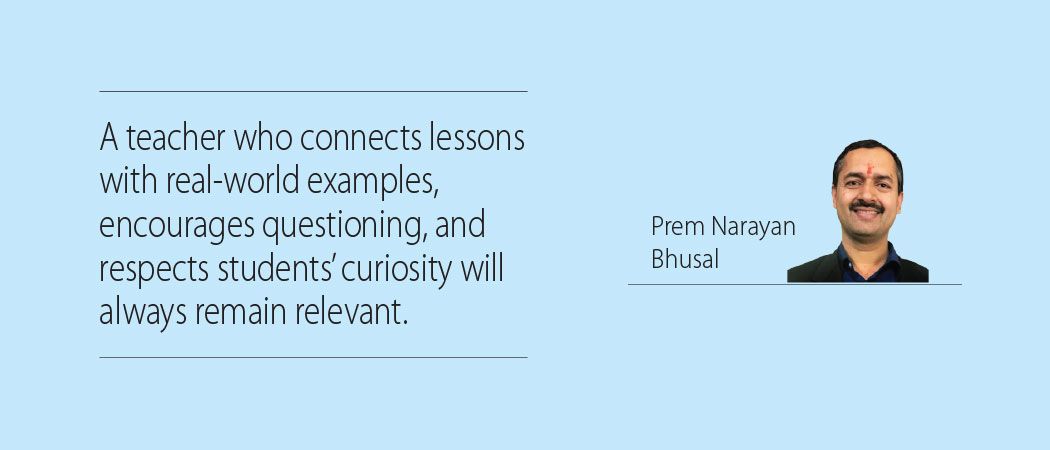
Classrooms should not be spaces where information is copied from screens to notebooks. They should be environments of discussion, collaboration, and creativity. If technology is used, it must enhance interaction rather than replace it. Instead of simply reading from prepared digital notes, teachers can design activities, case studies, group tasks, and project-based assignments that encourage participation. Students expect uniqueness and energy from their teachers. They value inspiration more than repetition. A teacher who connects lessons with real-world examples, encourages questioning, and respects students’ curiosity will always remain relevant.
(Bhusal is a psychological counsellor.)