- Saturday, 2 May 2026

Mahottari election likely to defy traditional calculations

By Ajay Sah,Mahottari, Feb. 16: As the House of Representatives election scheduled for March 5 draws closer, Mahottari’s political landscape is not only heating up but also showing signs of defying traditional electoral calculations.
With four constituencies in the district, analysts say this year’s election could produce unexpected outcomes beyond the usual win-loss arithmetic.
According to observers, factors such as party organisation, the role of money, caste dynamics and a growing voter’s interest in alternative political forces have combined to create the possibility of unexpected results in Mahottari.
The district’s diverse geographical and social composition has long made elections complex. Urban settlements along the highway, northern hill communities and southern rural Madhesi areas have differing priorities, resulting in varied voter preferences even within the same constituency. This time, candidates’ personal image, accessibility and past performance appear likely to outweigh party symbols in influencing voter decisions.
Constituency-1: Rematch draws attention
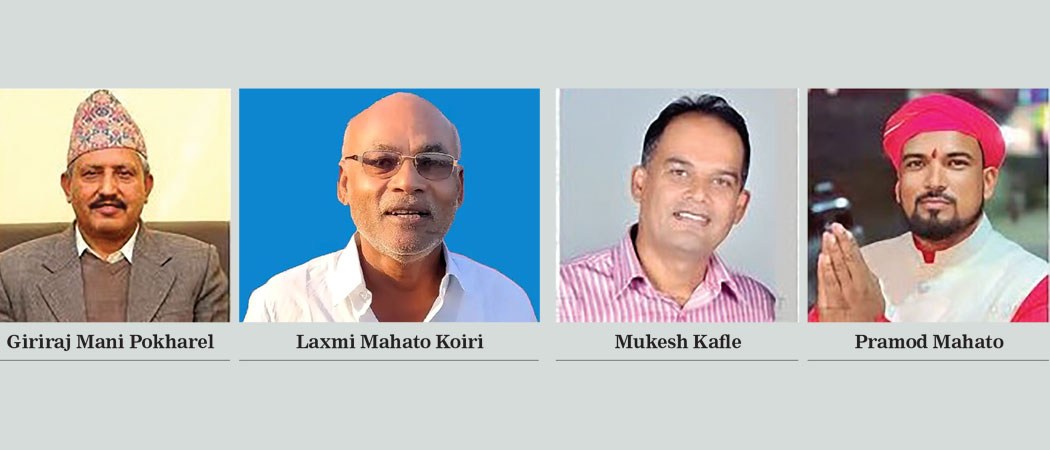
In constituency-1, which includes highway areas and the northern belt, senior Nepali Communist Party leader and former minister Giriraj Mani Pokharel is a key contender.
Widely regarded as popular in Bardibas area due to infrastructure development, the establishment of government offices and his long political career, Pokharel is contesting his fifth election from the constituency.
He won three consecutive terms after 2008 but was defeated in the 2022 election by CPN-UML’s Laxmi Mahato Koiri.
The two leaders are once again facing each other, making the contest particularly interesting. However, analysts say candidates from the Nepali Congress (NC) and the Rastriya Swatantra Party (RSP) could split votes, potentially altering the outcome.
The NC has fielded Mukesh Kafle, a former executive director of the Nepal Electricity Authority, who has entered politics with administrative experience.
The RSP’s Pramod Mahato is also in the race, with observers suggesting that his message of political change could appeal to young voters. With multiple strong contenders, constituency-1 is expected to witness heavy vote fragmentation.
Constituency-2: Experience versus shifting voter mood
In constituency-2, the contest centres on political experience and reputation. Veteran leaders Sharat Singh Bhandari and Kiran Yadav are the main contenders, both carrying deep political legacies. Voters are weighing not just individual names, but ideology, past movements and commitment to development.
Although traditional vote banks remain influential, the growing number of dissatisfied and younger voters suggests the race will not be one-sided. CPN-UML has fielded Kasif Nadaf in this constituency.
Constituency-3: Crowded and unpredictable
Mahottari constituency-3 has emerged as one of the most unpredictable races, with as many as 41 candidates in the fray.
A tough contest is expected among NC candidate Bajrang Nepali, UML’s Manoj Singh, Janata Samajwadi Party Nepal’s (JSP) Minakshi Thakur Jha, RSP’s Ujjwal Jha and independent candidate Ramadhar Kapar.
The race became even more complex after Harinarayan Yadav, a leader of JSP-Nepal entered as a rebel candidate following dissatisfaction over ticket allocation after party unification.
Constituency-4: Former ministers face off
In constituency-4, three former ministers, Mahendra Kumar Rai of the NC, Dr. Surendra Yadav of JSP-Nepal and Bharat Prasad Sah of the NCP, are contesting, intensifying competition. The presence of CPN-UML candidate Nilam Adhikari has further complicated the race, creating a multi-cornered contest rather than a simple triangular fight.
While experience remains a major asset in this constituency, voters are increasingly demanding clear visions for the future rather than relying solely on past records.
Overall, Mahottari’s election dynamics appear to be shifting away from party-centric calculations towards voter psychology.
The contest between experience and new thinking, tradition and change, is expected to produce unexpected results.
Analysts conclude that no single candidate enjoys an undisputed
advantage in any of the four constituencies, making Mahottari one of the most unpredictable districts in this election.
-original-thumb.jpg)