- Tuesday, 9 June 2026

Martyrs' Day: Dignity And Responsibility

Today, as we all see Martyrs' Day or Sahid Diwas, we do not stand here merely to repeat names, garland statues, or follow a calendar tradition. Martyrs' day in Nepal is not just a reminder- it is a question. A question that asks us: What has democracy done that was paid for with martyrdom? Martyrs' Day is often understood as a moment to pay tribute to those who sacrificed their lives for democracy. And indeed, we must bow to our brave fighters- Shukraraj Shastri, Dharma Bhakta Mathema, Dashrath Chand, Gangalal Shrestha and countless others who dared to challenge tyranny when silence was safer than speech. But today must be more than remembrance; it must be reflection.
Martyrs Day in Nepal is often seen with garlands, speeches and formal tributes. Names are recited, statues are cleaned and history is briefly recalled. Yet, if Martyrs' Day is reduced to a ceremonial pause in the calendar, it risks losing its deeper meaning. In truth, Martyrs day is not merely a reminder to honour those who sacrificed their lives for democracy; it is a moment to interrogate whether the nation has remained faithful to the ideals for which they gave their lives.
Living practice
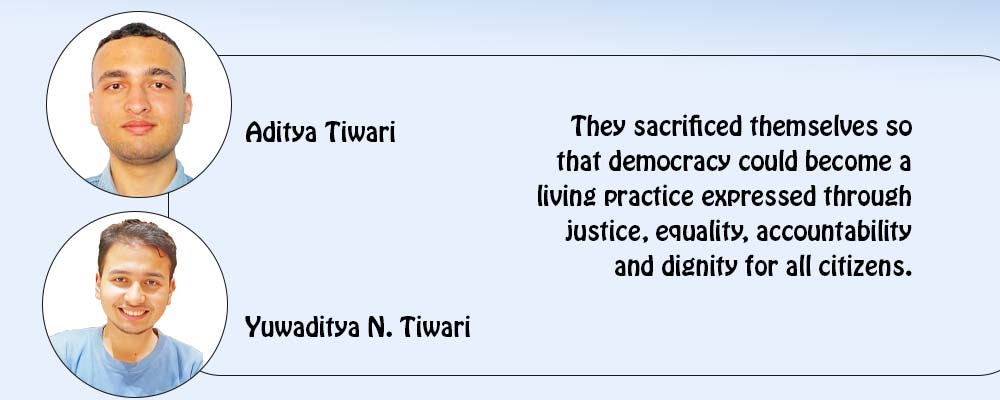
Nepal’s martyrs did not offer their lives so that democracy could become a word spoken on stages or written in constitutions alone. They sacrificed themselves so that democracy could become a living practice expressed through justice, equality, accountability and dignity for all citizens. To remember them intellectually is to ask the uncomfortable questions: What kind of democracy did they envision? And what kind of democracy have we built?
Nepal’s struggle for democracy is not a single event, nor is the martyrdom confined to a few names engraved on stone. It is a long historical continuum marked by resistance against the autocratic rule, system, exclusion and injustices from people’s movements to constitutional struggles. Nepal’s democratic system was shaped not only by those who fell, but by those who endured. Endured prisons, exile, censorship, humiliation and loss. Many lived long lives marked by quiet suffering, unseen sacrifices, and moral courage. Their contribution was not written in monuments, yet it is etched into the fragile freedom we inherit today.
A thought-provoking remembrance does not define martyrs as finished stories but as unresolved questions. Their sacrifice asks us: Has democracy in Nepal translated into development that is just, inclusive and humane? Development is not just roads, buildings or economic statistics. It is the development of institutions that respect citizens of systems that reward merit, and of leadership that serves rather than rules. If democracy fails to meet the requirements for the country and citizens, if it produces corruption instead of accountability, exclusion instead of participation then martyrdom risks being romanticised rather than respected. The true insult to martyrs is not forgetfulness, but complacency.
Elections in the air, Nepal’s martyrs did not sacrifice for the right to vote, but for the right to live with dignity. Democracy is not only a political system but an ethical commitment: a promise that power will be accountable, that citizens will not be treated as subjects and that disagreement will not be punished as disloyalty. When democracy becomes procedural rather than principled, it betrays its origins. When politics becomes detached from morality, Martyrs' Day becomes a hollow ritual. The most troubling threat to Nepal’s democracy today is not authoritarianism imposed from above, but indifference practiced from below.
Democracy erodes quietly when citizens grow accustomed to broken promises and normalised dysfunction. Nepal's development needs today is not only economic growth but democratic progress: - the ability to self-correct, to listen and to place the public good above partisan gain. When citizens become indifferent, democracy weakens. When injustice becomes normalised, sacrifice is betrayed. The erosion of democracy rarely announces itself loudly; it happens quietly, through apathy and compromise.
There is a subtle danger in commemorations: they can create the illusion of gratitude without demanding responsibility. Martyrs' Day should not allow society to feel morally satisfied simply because it remembers. True Martyrs' Day is not merely a date on the calendar to be seen with usual rituals, but a destination we have yet to reach. Our martyrs did not sacrifice not only their lives for the glitz of skyscrapers or the rot of systemic corruption; they bled for a vision where every citizen’s basic needs, food, health, and dignity are treated as sacred rights rather than distant luxuries.
While we have secured the architecture of democracy, we have failed in its soul, watching our brightest youth flee to foreign lands because their own soil offers them no path to prosperity. Yes, democracy has arrived. But we must have the courage to ask a hard question: was this all democracy meant to deliver? We cannot claim to honour the fallen while the citizens continue to struggle for survival in a cycle of lack of peace and uncertainty. To truly fulfill the martyrs' dreams, both our leaders and our citizens must shift to purposeful action, ensuring that the progress of our nation is measured not by the power of the elite but by the security and well-being of the common citizen.
Ritual of remembrance
Their sacrifice was not an ending; it was an invitation. An invitation to build a nation where democracy is not merely remembered but practiced; not merely spoken of, but lived. Martyrs' day is not only about the past; it is a mirror held up to the present. It asks whether Nepal’s democratic system has honoured the cost at which it was earned. To remember martyrs intellectually is to recognise that their sacrifice was not an endpoint, but a beginning.
The Martyrs Day shall remain only a ritual of remembrance, but a renewal of responsibility: a day when we recommit ourselves to the values for which lives were lost for freedom, justice, equality, progressive development and national dignity. So today, the real tribute is not silence- it is sincerity. Not flowers- it is fairness. Not speeches- it is service
(Aditya Tiwari is a Kathmandu-based writer and Yuwaditya N. Tiwari is a media professional.)



-original-thumb.jpg)