- Tuesday, 9 June 2026

Development Thru Ethical Governance

Governance, culture and development are deeply intertwined everywhere. The cultural and ethical framework rooted in ancient texts continues to influence political thought, governance philosophies and public discourse. While modern politics operates through democratic institutions, electoral competition and data-driven policy, its moral and ethical foundations still echo ancient ideas like integrity, public welfare and ethical leadership. This article is an attempt to explore how these timeless values interact with contemporary political realities and how their principled application can help accelerate Nepal's development.
In Sanskrit, rajaniti or rajdharma refers to the ethical principles of governance. Unlike modern politics, which often centres on power struggles, competition, and short-term gains, classical political thought emphasises the moral responsibilities of rulers and the welfare of all people. Texts like Arthasastra, the Mahabharat and Dharmasasra describe governance as a moral enterprise in which the leader must uphold justice, ensure public welfare and protect societal harmony. The leadership philosophy here is that the ruler becomes a servant of society and prioritises the common good over individual or elite interests. The leader is bound by integrity, transparent, accountable for justice and committed to peace and prosperity for all.
Chronic instability
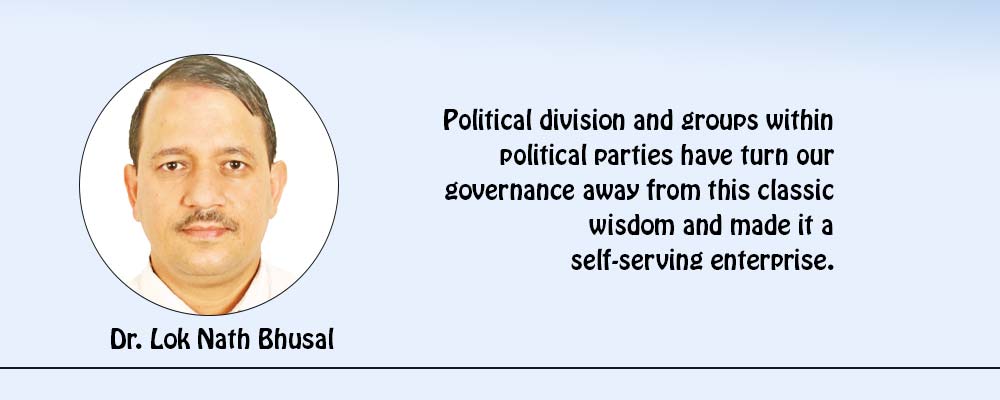
While Nepal has endeavoured to ensure these values through constitutions, electoral systems and institutional checks and balances, political division and groups within political parties have turn our governance away from this classic wisdom and made it a self-serving enterprise. The country has experienced chronic political instability. Since 2008 alone, the country has seen more than 14 prime ministers, with frequent coalition collapses and shifting alliances that stall policy continuity and good governance. Most of the coalitions were strange and unethical. Elections and reelections could not ensure principled politics and improvements in people’s living standards.
This invited the massive Gen Z-led protests demanding ethically good governance. This discontent underscores the existing gap between political rhetoric and actual development delivery due to the gradual degradation of our cultural values of governance. Unachieved development targets and under-implemented election manifestos of political parties reflect this integrity problem. Nepal’s economy grapples with never-ending structural challenges. Growth has hovered below the potential needed to rapidly transform living standards, while remittances remain a double-edged sword, supporting consumption but not long-term productive investment.
While some progress in poverty reduction has been made, there is an urgent need of reforms to unlock stronger growth, boost exports, leverage hydropower potential and expand digitalisation. Governance weaknesses, inefficiencies, procurement delays and political instability remain key constraints. Capital spending is only 12 per cent by the halfway point of this fiscal year, undermining growth and development. We still cannot punish the officials for this underperformance. Lack of ethical governance is the main reason behind this mess. There is a call for ethical leadership and culturally rooted governance. Debates around governance, identity and public expectations reflect a yearning for trustworthy leadership that places public welfare above personal gains and facilitates faster growth and development.
While cultural rhetoric alone cannot solve complex structural problems, its ethical emphasis can inspire citizens and leaders to embrace more accountable and development-oriented governance. One of Nepal’s most stubborn barriers to development is bad governance. Ethical governance principles emphasise dharma, ethical duty and discourage abuse of power for personal gains. If public authorities embraced ethical accountability and placed public welfare at the centre of their agenda, it would help rebuild public trust, attract investment, increase capital spending and reduce resource leakages. Embedding ethical norms can strengthen institutions like anti-corruption bodies and judicial processes, making governance more predictable, judicious and transparent.
The frequent changes in government have disrupted long-term development planning and execution. A governance culture shaped by principled leadership and moral duty encourages a focus on policy goals rather than political survival. Leaders guided by ethical duty may be more willing to commit to multi-year plans, reduce factional infighting and pursue reforms that extend beyond electoral cycles. With large youth unemployment and ongoing migration for work abroad, welfare-oriented policies that invest in education, skill development, and industry diversification can reduce dependence on remittances and expand productive domestic economic activities.
For instance, creating jobs in hydropower, clean energy, agriculture, tourism and IT services can harness Nepal’s natural and human potential while providing stable employment at home. The existing low industrial capacity of 44.5 per cent will also go up and help reduce growing trade deficits. Nepal’s social diversity can be made development-friendly with the application of ethical values, which can foster mutual respect, social harmony and inclusive democracy.
A governance ethos rooted in respecting diverse voices can help bridge divides and create policies that reflect the aspirations of all, enhancing national cohesion. This is a prerequisite for national development. Ethical governance stresses the role of institutions in maintaining justice and order. Robust institutions are essential for reliable governance. If guided by ethical standards and merit-based practices rather than the existing political patronage, these institutions could deliver public services more efficiently, enforce laws consistently, sustain investor confidence and thereby help achieve various development goals.
Budgeting transparency
Broadening digital services, public budgeting transparency and citizen access to information can align with traditional values of accountability, collective welfare and thereby help accelerate development outcomes. Moreover, Nepal’s vulnerability to natural disasters requires long-term planning and ethical stewardship of resources. Ethical values of foresight, dharma and duty can underpin robust disaster management, resilient infrastructure planning and policies that safeguard vulnerable populations. This will save our development gains.
In sum, meaningful reforms inspired by ethical governance are not about reviving old feudal systems. They are about reaffirming timeless values of justice, duty, service and collective welfare in contemporary governance and development institutions. These values are eroding gradually resulting in bad governance and underdevelopment. By combining data-driven policies, transparent governance and ethical leadership, Nepal can foster faster development as demanded by its citizens.
(Dr. Bhusal is a development expert.)


-original-thumb.jpg)