- Friday, 1 May 2026

Dialogue held to reduce human-elephant conflict
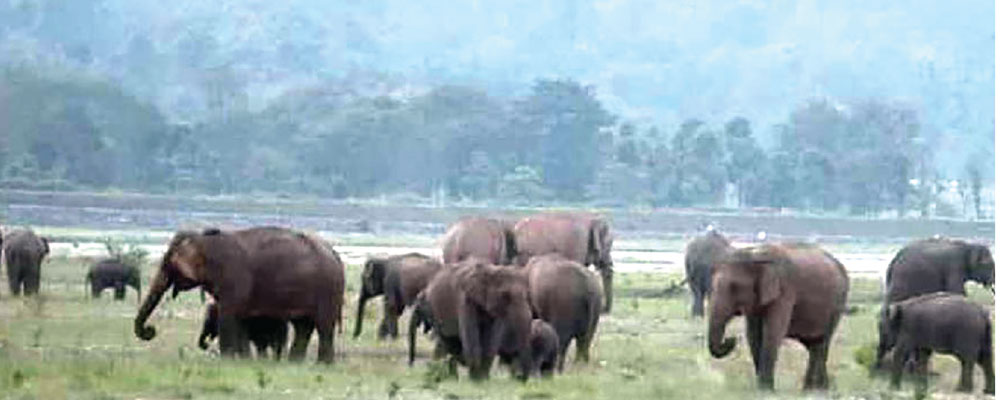

By Our Correspondent,Urlabari (Morang), Feb. 21: With human-elephant conflict increasing in Morang over the past three years, the Belbari Sub-Division Forest Office and the Belbari-Chisang Partnership Forest User Group organised an interaction programme with elephant experts and students.
The discussion was held during the Second Belbari Festival organised by the Belbari Chamber of Commerce and Industry. Students were briefed on human-elephant relations, elephant behaviour and movement patterns, safety measures, and practical ways to reduce conflict.
Birendra Gautam, Chief of Koshi Tappu Wildlife Reserve under the National Trust for Nature Conservation, said the destruction of elephant habitats, loss of food sources and construction of new structures along traditional movement routes have increased conflict.
According to him, elephants often enter human settlements in search of food and water. As forest vegetation preferred by elephants continues to decline, elephants are being forced closer to human settlements, Gautam said.
"An elephant consumes around 200 kilograms of grass and grain and drinks about 200 litres of water a day. As their digestive system is weak, they do not eat a large amount at once but keep eating continuously,” he explained.
He said elephants have used the same routes for generations, but recent development activities have led to roads and bridges being built along these corridors. In some places, elephant routes have been converted into farmland, leaving elephants confused and unable to return.
Elephants are particularly attracted to alcohol, salt and sugar. Gautam said houses storing home-brewed liquor, salt, molasses or animal feed are more likely to be attacked due to the smell. He also shared that elephants that lose fights with other elephants often become aggressive and violent.
Although elephants do not attack humans without provocation, actions such as stonning, using fire or making loud noises further provoke them, he said. “Such activities do not scare elephants. Instead, they recall and may attack those responsible sooner or later,” he warned.
Gautam said that elephants have closely studied most deterrent methods used by humans. Barbed wire, trenches, gas explosions and walls have proved largely ineffective.
Studies show that while elephants were initially frightened by gas explosions, drones and helicopters, over time they began ignoring them. Solar-powered electric fencing has been found to be the most effective measure, as ordinary fencing is often destroyed by elephants due to the absence of a strong electric shock on their tusks.
Highlighting elephant behaviour, Gautam said elephants are highly patient animals and herds are usually led by a grandmother. He clarified that elephants cause more damage while moving than while feeding.
He also said elephants attach great importance to places where their calves have died and often return every year to locations where elephants or humans were killed. Each member within an elephant herd has a distinct role, he added.
To reduce human-elephant conflict, Gautam stressed the need to plant trees favoured by elephants inside forests and to construct water ponds. He warned that growing human dependence on forests could further increase risks.
Dinesh Prasad Giri, Chairperson of the Belbari-Chisang Partnership Forest User Group, said the programme was organised to sensitise students to reduce rising human-elephant conflict.
Meanwhile, Bibek Mishra, General Secretary of the Belbari Chamber of Commerce and Industry, said that experts are being invited daily during the festival to interact with students on issues related to environment, industry, agriculture, education, technology and literature.