- Sunday, 3 May 2026

Speakers urge energy self-reliance on Independent Power Producers' Day
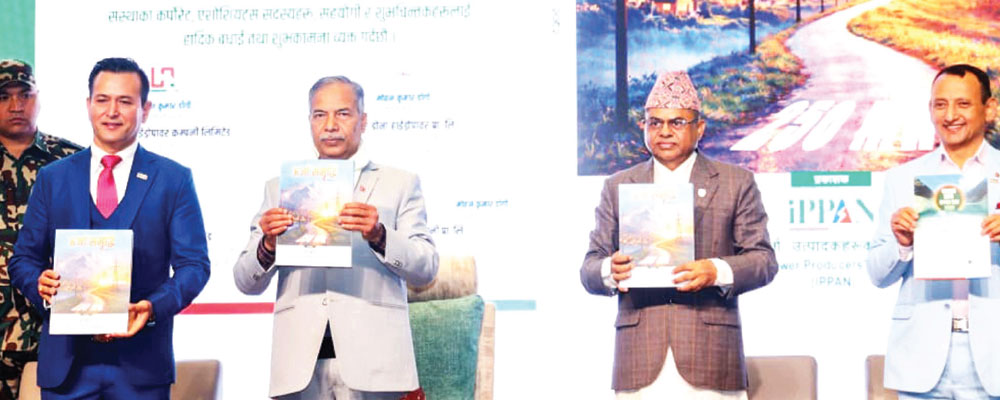
Vice-President Ramsahay Prasad Yadav, Energy Minister Anil Kumar Sinha and IPPAN President Ganesh Karki unveils "Urja Samriddhi" during a program in Kathmandu.Photo: TRN

By A Staff Reporter.Kathmandu, Jan. 19: Vice President Ramsahay Prasad Yadav has said that the country’s development is not possible without adequate energy, as energy self-reliance is directly linked to economic independence and national security.
Addressing the 26th Independent Power Producers’ Association Nepal (IPPAN) Day on Sunday, Vice President Yadav said that the availability of cheap and sufficient energy would ensure rapid development in industries, agriculture, tourism, information technology and other sectors, creating employment opportunities and promoting economic prosperity.
Stating that the role played by IPPAN in the development of Nepal’s energy sector is commendable, he said the association’s contribution over more than two decades—from strengthening the energy sector to self-reliance - has become a cornerstone of national development and economic prosperity. Emphasising that Nepal is rich in hydropower and renewable energy resources, he said the country should reduce its dependence on energy imports by utilising these invaluable assets.
He added that the expansion of renewable energy would help maintain environmental balance by reducing carbon emissions and addressing the challenges of climate change. Vice President Yadav also said that expanding energy access to rural and remote areas is a means of ensuring social justice and equal opportunities.
He noted that Nepal has the potential to play a leading role in regional energy trade by increasing investment in renewable energy and exporting electricity to neighbouring countries, including India and Bangladesh.
He stressed the need to prioritise quality, transparency and accountability in energy production, adding that modern technology, research and innovation should be embraced.
He further pointed out that a long-term strategy—from production to distribution, storage and export—is needed to ensure that communities affected by energy projects also benefit.
On the occasion, Minister for Energy, Water Resources and Irrigation Anil Kumar Sinha said that the active participation of the private sector has made Nepal free from load shedding and has brought it to a position to export electricity.
Noting that Nepal's total electricity generation has reached about 4,000 MW at present, and out of this, the private sector has contributed more than 3,300 MW, he said that it is a matter of appreciation. According to Minister Sinha, the journey of the private sector, which started with small projects of 5-10 MW, has today reached projects larger than 100 MW.
However, he admitted that challenges such as legal and policy reforms, power purchase agreements, expansion of transmission lines, and complexities in forest and land acquisition still persist.
Minister Sinha emphasised that the private sector should invest in research, legal expertise, and human resource development along with physical infrastructure. He also suggested electing people's representatives who are development-minded and understand the importance of the energy sector in the upcoming election.
President of the Confederation of Nepalese Industries Birendra Raj Pandey said that the situation in which it takes 10-12 years from survey license to PPA and completion of construction in the development of a hydropower project is the result of complex legal and procedural problems.
Stating that the situation of having to visit 16 ministries for a single project has discouraged investors, he demanded the government to immediately implement the 'single window system'.
"In today's situation, hydropower has become the safest and most attractive sector even more than agriculture and tourism," he said. "Banks' investment is also mainly going to this sector."
Deepak Malhotra, acting president of the Nepal Chamber of Commerce, emphasised the need to increase domestic electricity consumption for proper utilisation of the increasing hydropower production in Nepal.
IPPAN President Ganesh Karki has said that the contribution of the private sector in the development of hydropower in Nepal is highly commendable.
He said that without active participation of the private sector, the country would still be in the grip of load shedding. He said that more than 900 hydropower projects have been licensed and work started across the country.
According to him, projects with a capacity of 11,600 MW are in various stages, while power purchase agreements (PPA) worth about 16,000 MW have been signed. Out of this, 4,000 MW of electricity has been connected to the national grid, while 5,000 MW is under construction. Stating that there was extensive investment of the people in the hydropower sector, Karki said that about 11.3 million Nepalis have invested directly or indirectly in this sector. He said that so far, an investment of Rs. 1,310 billion has been made in the hydropower sector.
Welcoming the government’s energy roadmap targeting the production of 28,500 megawatts of electricity, Karki said the plan to consume 13,500 megawatts domestically and export 15,000 megawatts to neighbouring countries was a positive and forward-looking initiative.
However, he expressed concern over the ‘take-and-pay’ policy introduced through the budget, saying it had discouraged investors.
He also stressed the need to allow private sector participation in electricity trading, noting that a lack of transmission lines has resulted in the wastage of generated power.
Karki further complained that the Environmental Impact Assessment (EIA) and Initial Environmental Examination (IEE) processes have become excessively cumbersome, calling for reforms to make the procedures more investor-friendly while maintaining environmental safeguards.
On the occasion, the Energy Prosperity Souvenir and a report on private sector investments were released. In addition, various personalities who have contributed to the energy sector were honoured.