- Saturday, 23 May 2026

2nd National Economic Census from March
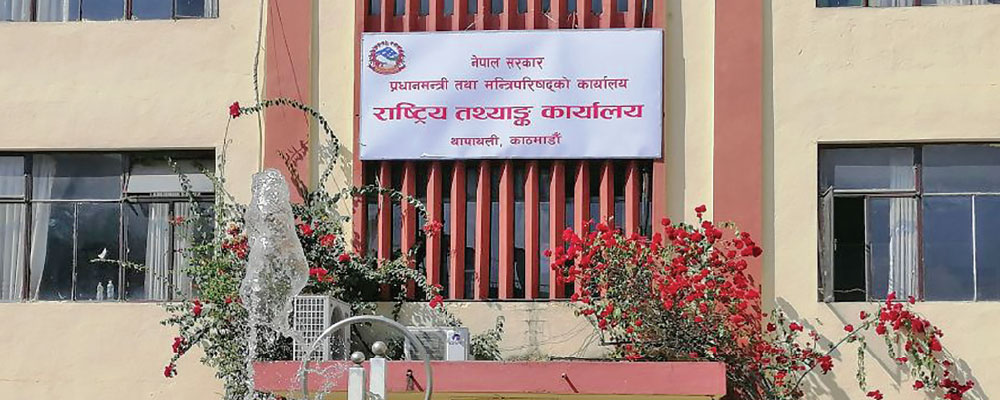
The National Statistics Office, Thapathali, Kathmandu

By A Staff Reporter,Kathmandu, Jan. 18: The National Statistics Office (NSO), under the Office of the Prime Minister and Council of Ministers, has announced that it will conduct the Second National Economic Census 2026, with the slogan 'Economic Census for Measuring the Economy'.
The census aims to obtain a realistic and comprehensive statistical picture of the country’s overall economic condition through district-level data collection, according to NSO.
To carry out the census, District Economic Census Offices will be established across the country. The data collection will be carried out nationwide from March 15 to July 16, 2026.
Based on the data obtained from the census, the results will be released gradually starting from the beginning of the fiscal year 2026/27, according to the NSO.
The NSO said that the economic census is a crucial exercise that will provide basic and reliable data necessary for the formulation of national economic policies, development plans, and long-term development strategies.
Nepal conducted its first National Economic Census in 2018. According to its findings, 923,356 establishments and businesses were counted nationwide, employing a total of 3,228,457 people.
The census revealed that 29.6 per cent of establishments were managed by women, and that the number of formal and informal establishments was nearly equal.
The main objective of the Second National Economic Census is to collect detailed information on the number, type, investment, employment, production, and service delivery of industries, trade and business enterprises, service sectors, cooperatives, and public and private institutions, said the NSO.
In addition, the census will help strengthen estimates of Gross Domestic Product (GDP), generate the data required for changing the base year of national accounts, and support government policy formulation, planning, and the measurement of targets set through public policies.
The NSO emphasised that the census plays a vital role in building a strong institutional foundation for economic statistics.
It is expected to contribute significantly to short-term and long-term economic planning, investment promotion, and employment generation.
The NSO said that this census is taken as a cornerstone for the development of a reliable system of economic statistics in the country.
The census will also support the development of a business register, the preparation of sampling frames for various surveys, and the strengthening of inter-agency statistical coordination in line with the Statistics Act and Regulations.
For the purpose of determining the size of the national economy, economic activities are classified into 29 categories based on international industrial classification standards.
Under this census, basic data from 18 major sectors will be collected.
The census will cover both registered and unregistered establishments of all sizes, including industries, factories, trade and business enterprises, non-governmental organiSations, public enterprises, government and private schools, hospitals, and other economically active units.
However, international organisations, diplomatic missions, government offices performing administrative or regulatory functions, security agencies, and purely household economic activities will not be included in the census.
All preparatory work for the census will be completed within mid-March and start the census from March 15, 2026.
A total of 84 District Economic Census Offices—covering all 77 districts along with seven additional offices—will be established nationwide. All district offices will be closed by July 16, 2026, the office said.
With government approval already obtained, the NSO has finalised the schedule for major activities. Preparation of key census materials, including main questionnaires, instruction manuals, and census booklets, is already underway.
Human resource management at the central level will be completed by March 14, 2026.
At the district level, permanent staff will be deployed at district census offices, while supervisors and enumerators will be recruited on a contract basis for field operations. Following the training, field-level data collection will be carried out by trained supervisors and enumerators from April 15, 2026 to June 21, 2026.
Describing the National Economic Census 2026 as a major national campaign, the NSO emphasised the need for active participation, coordination, cooperation, and facilitation from all stakeholders to ensure its successful implementation.