- Monday, 8 June 2026

Democracy Faces Trust Deficit

It has been widely recognised that democracy is the rule of the people, by the people, and for the people. Sadly, we have been experiencing Nepali multi-party democracy as deceptive and profane in the name of the people and the country. Party leaders and even intellectual analysts use the word 'people' to mean only the supporters of their respective parties or the leaders. Even the Prime Minister is not treated as the representative of all parties but of his cronies because he is selected by the majority of more than fifty percent in parliament. The leaders of this country reach power either by technicality or by the consent of the majority, and not by being elected all the seasons they face elections.
Therefore, the will of the majority of the voters and even the people is not reflected in our democracy. The promoters of democracy have not truly addressed the needs and aspirations of the common folks, particularly of the far-flung areas. The leaders win, but the country and people are always losers. Ironically, Nepal's politics is becoming more messy, and unpredictable than before. Every few years, a new government takes office with loud promises of stability, development, transparency, and good governance. Overnight, governments fall; alliances collapse, and political blame games begin again.
Coalition culture
Dissatisfied and frustrated youths in masses have left the country seeking good education and employment opportunities. The coalition culture is fostered due to inter-party conflicts, mistrusts, betrayal, and feuds plaguing the politics, holding neither a centre nor a connection with development and people. Along with various political odds and social ills and high rates of corruption at the local and national level, Nepal's western-style multi-party democracy has become a guinea pig.
The phrase, “to upset the apple cart,” meaning to disturb an existing arrangement or stability or someone's secret plans, fits Nepal’s political experience. It is like 'things fall apart; centre cannot hold' of W.B. Yeats and 'full of sounds and fury signifying nothing' of Shakespeare; dreams deferred of Langston Hughes. Leaders are like Hamlet and Iago and Dr. Faustus, selling their souls to many Mephistopheles and fulfilling their Renaissance dreams, and people are like mythical Sisyphus and Didi and Gogo of Samuel Beckett.
From the fall of the monarchy to the declaration of a republic, the writing of a new constitution to the introduction of federalism, Nepal has experienced dramatic political changes. However, many years have gone by in vain, mud splashing each other and squandering the historical opportunity of nation-building. The political instability is like the London weather. Prime ministers and lawmakers come and go, sometimes within months. Political parties fiercely criticising each other during elections and parliamentary debates suddenly form alliances to stay in power, only to break them when it suits.
Politics here is more about power than principle, empty rhetoric than action. Leaders give cacophony, blaming opponents for every failure, while avoiding responsibility for their own. Social media is flooded with grand manifestos, slogans, and accusations, but solutions are rare. They make foreign junkets from the state coffers with cadres and cronies, but to no avail. When leaders change, policies also change, creating uncertainty and doubts. Similarly, high-profile corruption cases and scandals of the party leaders and ministers undergo a prolonged dillydallying due to unhealthy settings. The bureaucracy and judiciary, which should function independently and corruption-free, are often pressured by politics. If it continues, people begin to lose faith not just in politicians but in the system itself.
This loss of trust and moral decline is dangerous because democracy cannot survive without public confidence. Corruption has become so common that many people see it as normal. Promises are rituals, and politics has become an enterprise of private benefits and extravaganza. Scandals involving procurement, nepotism, bribery, extortion, land deals, blanket impunity, or misuse of public funds make headlines, but accountability is rare. Leaders accused of wrongdoing often return to power without shame and remorse and without facing serious consequences. The politics of the banana republic has increasingly become a pathway to wealth and influence rather than a platform for public service and the nation's welfare.
Today, public frustration finds expression within hours through protests, civic campaigns, and digital platforms to question authority, expose rampant corruption and irregularities and mobilise national attention and people's moral support. Online outrage is often intense but short-lived, like the recent Zen G protest. Misinformation and political discussion become polarised so fast. It is not only a challenge but an opportunity too. Many are frustrated with traditional politics and leadership and are demanding transparency, meritocracy, honesty, alternative political voices and transformation of politics to a new generation.
Approach and mindset
Real democratic change requires sustained involvement, not just viral posts and talking shop. People and party leaders must change their approach and mindset. Nepal needs honesty, consistency, morality and will power of the leaders to put national interest and people above party loyalty and personal gain. Laws and justice of the legal eagles must be applied equally. Democracy is not just about voting every few years; but for public services, good governance, discipline, rule of law, fair justice, employment opportunities, accountability and dignity for all citizens.
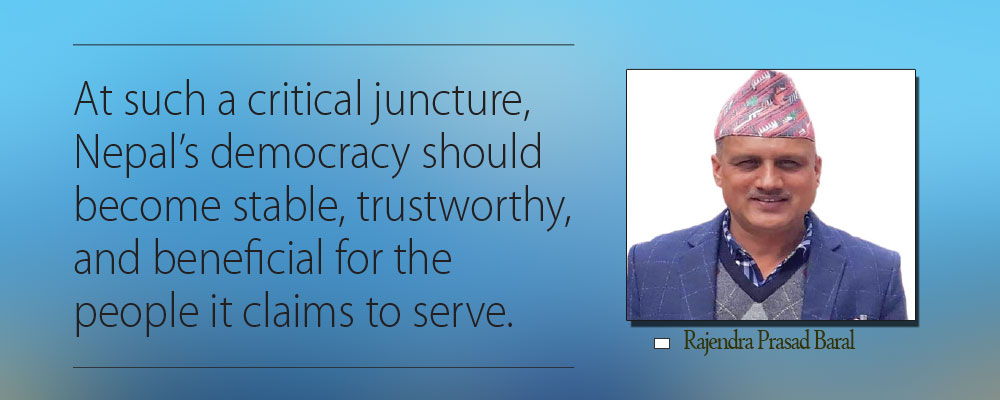
As Shakespeare wrote, 'what a terrible era in which idiots govern the blind' and 'hell is empty as all devils are here on earth', and in Nepal too, the rot and folly lie not only in the system but in the moral fabric of its politics and people’s continued submission to hollow political assurances. At such a critical juncture, Nepal’s democracy should become stable, trustworthy, and beneficial for the people it claims to serve. All history is not black and shrouded in mystery; it has bright and white spots as well. Democracy as a system is not just a riddle, a perpetual rehearsal and a sheer mockery with the illusion of peace, progress and prosperity.
(The author is an associate professor at the Mahendra Ratna Multiple Campus, Ilam)