- Sunday, 3 May 2026

Ambassador Singh: Brilliant But Controversial

I had the privilege to know and interact with the second Indian Ambassador to Nepal, Sir Chandreshwar Prasad Narayan Singh (April 18, 1901 -November 29, 1994), for the first time in New Delhi during my stay there (1989-1990). He frankly told me that he was a bit older than the age shown on his academic certificates.
A gold medalist from Calcutta University and a brilliant scholar, he served as Vice-Chancellor of Patna University from 1945 onwards, which helped him in knowing Nepal as he interacted with many Nepali students. Besides, he was from Bihar and had served during relief operations following the mega earthquake of 1934 that badly hit Nepal and the Bihar region of India.
Tough administrator
Singh was seen as a tough administrator, introducing various reforms and other measures to strengthen Patna University, with some major academic faculties added during his tenure. As Governor of Punjab, he was instrumental in undertaking two major projects, Chandigarh and Bhakra Dam, and the commissioning of Kurukshetra University.
It was Kireet Joshi (1931-2014), a veteran scholar, educationist and prolific writer, who first introduced me to Singh. Joshi was included in a rare list of people who passed the Indian Administrative Service examinations and resigned from the service within a short period. He was later appointed by the government of India as educational adviser and special secretary in recognition of his contributions.
Two other factors helped me to be closer to the ambassador who had served in Nepal from 1949 to 1952. These included Singh's association with and ardent belief in astrology as our top astrologer Professor Mangal Raj Joshi used to frequent Delhi. Joshi had very good working relations with Singh and used to request me to accompany him to the residence of Singh.
Singh nurtured close personal relations with both Prime Minister Jawaharlal Nehru and Deputy Prime Minister Sardar Patel. When Patel was ill, the ambassador then in Nepal, used his connections in Delhi and procured the help of his chosen astrologer to check his health status. As the astrologer was, in the meantime, seriously hurt in a fall and could not visit him, Patel gave a cryptic reply to Singh that he did not want the advice of a godman who could not predict his own accident. The Indian leader died after some time.
After returning from Nepal, Singh first served as Governor of undivided Punjab and later as India's ambassador to Japan for a year (1959-1960). After a considerable gap, he was appointed Governor of undivided Uttar Pradesh in 1980, serving for more than five years. The other reason for our closeness was the proximity of his residence from our Embassy as he lived at Hailey Road, almost like a next-door neighbour. Singh used to invite for luncheon many people beyond his relations almost every Sunday and I used to be there regularly.
In a sad commentary on our institutional memory and record-keeping, I used to be amazed in finding that Singh had in his possession many official letters relating to Nepal's internal administration and concise details about our country and leadership. This status also speaks volumes of the extent of sheer accessibility of our people with diplomats accredited to Nepal.
Singh was knighted by the British Emperor in 1935 and was proud of this honour and refused to relinquish the title as done by Dr Sarvepalli Radhakrishnan, later President of India. His view was that as he was granted the honour in recognition of his selfless service, there was absolutely no ground to be ashamed of or relinquish it despite the honour having been granted by the colonial power.
From the perspective of the Indian side, Singh had phenomenal accomplishments. These included the official visit of Mohan Shumshere to India in 1950, the conclusion of the Treaty of Peace and Friendship, the political change in Nepal in the form of King Tribhuvan's political asylum, and the so-called Delhi settlement terminating the century-old hereditary rule of Ranas.
However, all these perceived success stories became irritants and controversial developments in Nepal, impacting bilateral relations. Singh was taken as more of a pro-consul than an ambassador from a friendly country, as Nepali leadership resented his intrusive nature and outright interventions. Even in terms of the 1950 Treaty of Peace and Friendship, there are allegations that he manipulated at the last moment to add a new clause to make it more or less permanent with no renewal provisions.
As he became quite controversial and carried negative publicity, Nehru tried to mollify Nepali sentiments, stating that the ambassador was doing good work and was to be transferred to some suitable duty as the term of the envoy was around three years. Despite a clear message that Singh would be asked to wind up his mission very soon, nothing was done for quite some time. Such a posture led Prime Minister Matrika Prasad Koirala to write to his Indian counterpart requesting for Singh's recall.
Nepal's protest
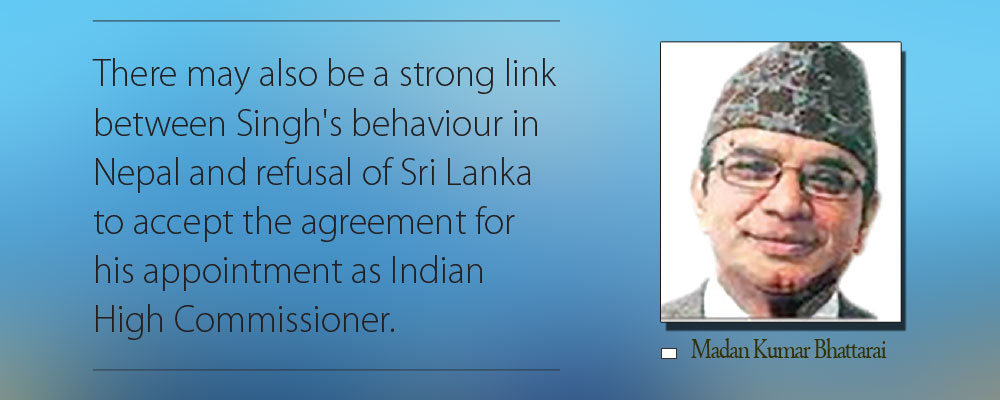
On June 24, 1952, Koirala wrote to Nehru that Singh be transferred from Kathmandu. Nehru replied on July 31, 1952, indirectly acknowledging Nepal's protest, with emphasis that the ambassador had been instructed not to intervene in Nepal's domestic situation. Nehru also seemed unhappy at his ambassador's frequent visits to Delhi on the pretext of consultations, using the personal aircraft of the King of Nepal. There may also be a strong link between Singh's behaviour in Nepal and refusal of Sri Lanka to accept the agreement for his appointment as Indian High Commissioner.
On the family front, Singh's daughter Pratibha Singh became a parliamentarian. His daughter-in-law, Nalini Singh, is an award-winning writer, journalist, and television anchor. His granddaughter, Ratna Vira, is a bright student, talented writer, and artist. As ambassador, he stayed at Ranga Mahal, Thamel, where he celebrated India's first Republic Day before shifting to Shital Niwas in March 1950. In a nutshell, Singh seemed to relish his life, which was a mixture of brilliance and controversy. My tributes to Chandreshwar Prasad Narayan Singh.
(Bhattarai is a former Foreign Secretary, Ambassador, and writer.)

-square-thumb.jpg)