- Sunday, 3 May 2026

The Resonance Of Unspoken Words
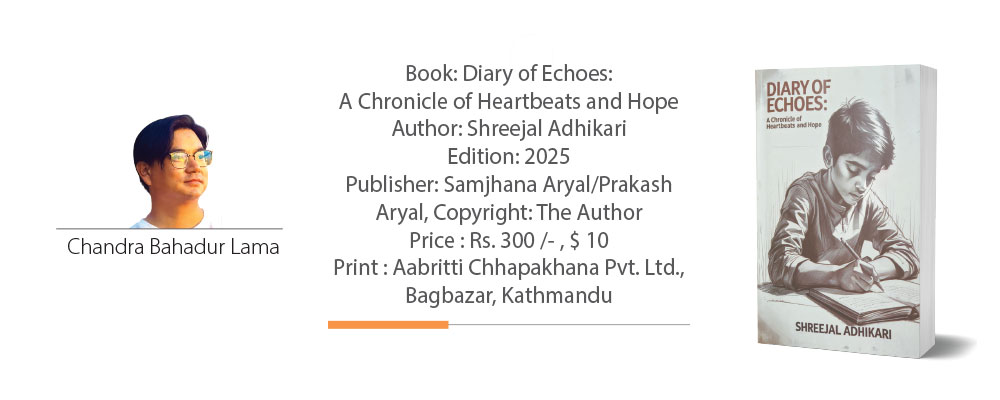

In the cacophony of modern life, we often mistake silence for an absence of thought. We assume the quietest person in the room has nothing to say. Novice writer Shreejal Adhikari’s novel, 'Diary of Echoes: A Chronicle of Heartbeats and Hope', is a poignant lyrical rebuttal to that assumption. It is also an intimate exploration of the 'invisible' years of adolescence, reminding us that for some, the most intense battles are fought in total silence.
Against the lively if unforgiving landscape of Kathmandu, we meet fourteen-year-old Shreejal. To his classmates and teachers, he is the 'boy who listens' – a back-of-the-room figure that blends into the school’s chipped walls. But his diary reveals a different reality. Haunted by the 'echoes' of a past tragedy, the sudden death of his friend Kritagya and the current trauma of a fracturing home life, Shreejal is a boy struggling to stay clear of what he calculates are dangerous influences. As his parents’ marriage collapses into shouting matches and the silence of their alcoholic numbness, Shreejal moves through those treacherous junior high waters of 8th-9th grade to find a way to be 'seen' without getting shredded.
Adhikari’s central theme is the weight of the unspoken. The novel is a study in invisibility – not that of a superpower but rather of its inverse: survival by other means that ultimately becomes its own kind of prison. His life, as expressed by Shreejal, is 'a fog' that he carries with him everywhere, a metaphor for the depression and anxiety people are inclined not to give names to in their traditional homes. The book captures, with pitch-perfect accuracy, that loneliness of the sensitive child in a world that prizes ‘toughness’, particularly in terms of young Nepalese masculinity.
The character work is subtle and grounded. Shreejal is a deeply sympathetic main character, and the internal monologue that reveals his raw fragility and a wisdom surpassing his own years (he’s endured enough life to learn it) demands that the reader stay glued to the page. The supporting cast, too, is rendered with skill. The girl in the end who really 'sees' him – Shristi – is not a love interest but a mirror to Shreejal and most definitely more than just his romantic interest that encourages him to step out of his shadow. Far and away the novel’s most effective part is a tender portrait of his kid brother, Riwaj. Shreejal's futile struggles to save Riwaj from their parents’ war zone bring a sense of bittersweet responsibility to his character arc.
Narratively, Adhikari employs an accessible style that sits somewhere between the epistolary intimacy of Stephen Chbosky’s 'The Perks of Being a Wallflower' and the cultural groundedness of Khaled Hosseini. Throughout the prose, short, punchy poems and 'secret' notes cut into the diary format, giving the reading experience the nostalgic sensation of rummaging through a shoebox of private memories.
One of the novel’s striking strengths is its attention to sensory detail. Adhikari doesn’t merely inform us we are in Kathmandu; he makes us smell the 'dried sweat and Khukuri Rum', taste the 'orange candy' given as treats, and experience the claustrophobia of a home where loud, harsh fights are made to 'bounce off the tin ceiling'. The way the author is able to root his heavy thematic ground in these quotidian details, though, gives gritty, lived-in weight to the story.
At its strongest, the novel portrays Shreejal’s internal battles. One standout moment is the panic attack in a math test (Chapter 12, 'Crossroads'). Adhikari does an uncanny job encapsulating the physical terror of anxiety: “the room spinning as if I was falling through space … paralysed by a fear I couldn’t name”. It is a necessary part of this story about youth that these characters have mental health issues that we as an audience do not dismiss with terms like 'moodiness'.
However, the novel is not without its flaws. Because it is the diary of a fourteen-year-old soul. So, the writing, at times, tilts towards mawkish or cliched. Though the phrases like “scars are stars to light the path” or “cracks let the light in” are beautiful, they risk being what we refer to as 'on-the-nose' for a seasoned reader. If the story has a flaw, it’s that these middle chapters can drag; as the silence gets going, we return to school and home time and again (fittingly for someone in Shreejal’s position on personal growth), meaning when not much actually takes place, it can take a while before our final dynamic 'bridge-building' segment.
With all those little niggles out the way, 'Diary of Echoes' is something of a triumph. It is a highly readable and emotionally resonant book that fills a gap in contemporary South Asian young adult literature. It is delicate in handling the 'taboo' themes of domestic violence, alcoholism and childhood grief; it never falls into melodrama.
At a time when social media expects constant 'noise' and performance – chatty really is less alone; if there's no one around to respond, are you even speaking? Adhikari’s celebration of the 'quiet courage' of being oneself has never felt more pertinent. This is a book for any teenager who ever felt like a ghost in their own life, but it may be even more important for parents and educators. It’s a reminder that the children who 'don’t cause trouble' are often those bearing the heaviest loads.
'Diary of Echoes' is a testimony to love and a poignant roadmap for healing. It holds out hope that we cannot fix our damaged world, but we can still somehow bridge it – in an artwork, in a piece of writing, in the scary and exhilarating act of telling someone what is true about ourselves. Shreejal Adhikari has written a tale that not just resonates but sings.