- Sunday, 3 May 2026

Ilam farmers hit by insurance gap

By Kokila Dhakal,Ilam, Jan. 9: Although the government has prioritised agricultural insurance, there is virtually no crop insurance in Ilam.
Despite the cultivation of cash crops such as cardamom, ginger, tea, fruits, and food grains, none of these crops are covered by agricultural insurance.
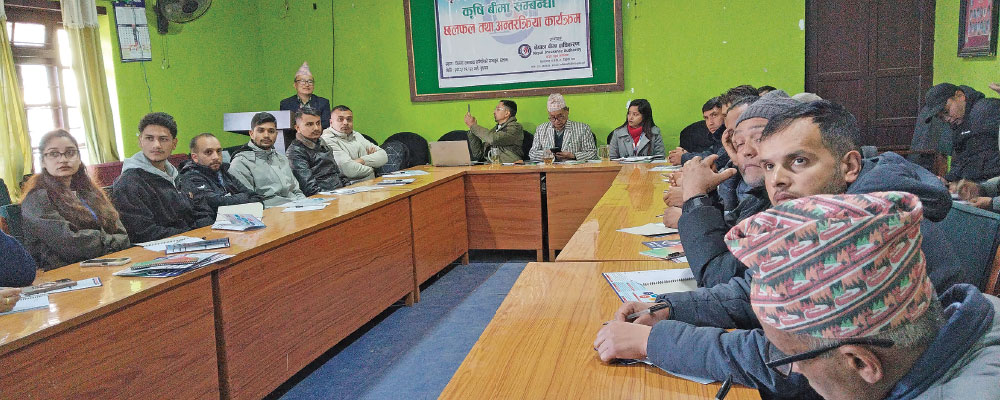
Participants at an interaction on agricultural insurance organised by the Nepal Insurance Authority (NIA), Koshi Province, said that most farmers in the district have been unable to access the government’s agricultural insurance scheme.
Ram Magar of the National Farmers’ Federation said that non-life insurance companies are not willing to provide crop insurance. “The floods and landslides that occurred in October last year caused damage worth nearly Rs. 250 million to Ilam’s agricultural sector. Hundreds of farmers suffered crop losses.
However, neither the state provided any support nor was there any insurance coverage for farmers,” Magar said. He added that tea, cardamom and food crops were damaged at the time, and even cultivated land was washed away.
Farmer Sambed Chapagain of Ilam Municipality–5, who participated in the programme, said that insurance was unavailable even when he tried to insure his orange orchard.
“Farmers face great difficulties in protecting orange crops. Oranges are affected by diseases and pests, resulting in heavy losses. When trees die and entire orchards are destroyed, farmers lose investments worth millions of rupees,” Chapagain said. “Farmers invest through their own hard work, but when crops are destroyed, there is no support from anywhere.”
Similarly, Upendra Neuupane, Chief of the Agriculture Section of Ilam Municipality, said that a study conducted on 800 farmers affected by the recent disaster found that not a single farmer had agricultural insurance.
“There is livestock insurance here, but there are problems with crop insurance. It needs to be determined whether this is due to difficulties in agricultural assessment or flaws in the insurance policy itself,” he said.
Tikaram Puri, Branch Chief of United Ajod Insurance in Ilam, who has provided insurance to a small number of kiwi and tea farmers, said that insurance companies face difficulties in reaching farmers.
“Tea insurance has been relatively easier as it is based on land area, but this has not been the case for other crops. Even though the government provides an 80 per cent premium subsidy, it is still not convenient for insurance companies,” Puri said, adding that the government needs to revise its insurance policy.
He also said that insured farmers often do not know how to claim insurance, and usually approach insurance companies only after evidence of crop damage has already been lost.
Rabi Kiran Adhikari, Chief of the Agriculture Knowledge Centre, said that although the Procedure for Providing Premium Subsidies on Crop and Livestock Insurance, 2024, has been implemented, it has not been very effective. “Agricultural insurance is important, but it has not reached farmers effectively,” he said.
According to Adhikari, there is now a need for awareness programmes on crop insurance in villages. Had farmers participated in crop insurance, they would not have lost their entire investment during disasters like the recent one.
Speaking at the programme, Priti Dev, Chief of the Koshi Province Office of the NIA, said that as the agricultural insurance programme has only recently been implemented, the aim is to cover as many farmers as possible.
She added that the province aims to implement insurance programmes across all districts of Koshi Province.