- Sunday, 3 May 2026

No work at home, Rishidevs head to India
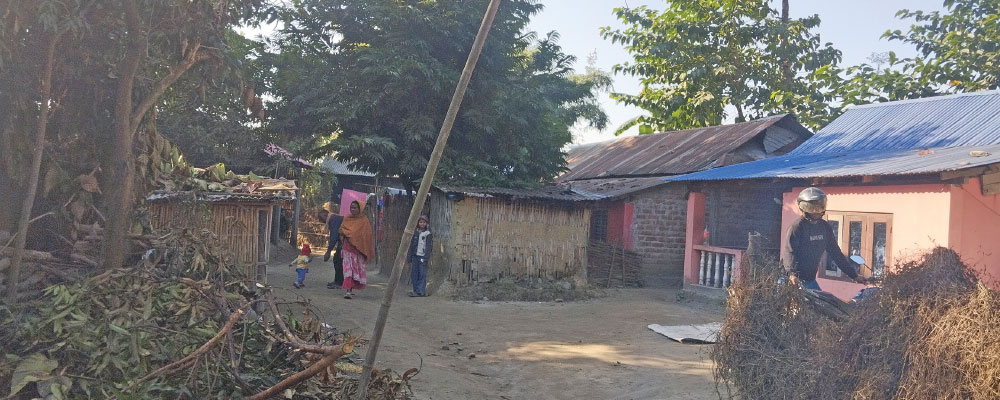
Photo: Hari Koirala\ TRN A settlement of Rishidev (Musahar) community in Morang.

By Hari Prasad Koirala,Urlabari, Jan. 7: Mechanisation in agriculture has stripped the minority Rishidev (Musahar) community of its traditional livelihoods, forcing many families into poverty and migration.
For generations, they survived on earthwork such as digging ponds and preparing farmland, but as machines replace manual labour, jobs have vanished.
With little land, no alternative skills and few local opportunities, many are now migrating to India in search of work -- often disappearing without trace.
Most Rishidev families live on small plots of government land, often just five or six dhur, where they have built simple houses to shelter from sun and rain. Although local governments have provided houses under the People’s Housing Programme, the loss of traditional work due to modern technology has left many without income. As a result, they migrate to India in search of work, and many never return.
Achhelal Rishidev, 45, from Bhaunsabari in Kanepokhari Rural Municipality-5, Morang, said there is no work left in the village. “Tractors plough the fields. Excavators and JCBs are everywhere. We no longer get work digging ponds or filling soil for roads. I do not know any other work,” he said.
“When forests were open, we survived by selling firewood. Now community forests do not allow it. With no work, young men go to India as farm labourers. Even elderly people leave the village in frustration.”
Ram Rishidev said many young and able-bodied men from the Musahar settlement have migrated to India due to unemployment. “Instead of staying home hungry, they go to India dreaming of earning some money. They go without any plan or knowledge of the place,” he said.
“Two persons who went to India have still not returned.” He added that he himself returned to the country after eight months of hardship, living homeless on the streets.
Rajesh Rishidev left the village 17 years ago. He returned once and took his family with him but has not contacted any relatives since.
Similarly, 38-year-old Chandra Rishidev left home six years ago to work in a coal mine in India and has never been in touch. His daughter, Chanda, said, “He never calls and has never sent money.”
Achhelal, who entered India with Chandra, said Chandra was forced off a train by railway police in Howrah. “I survived, but Chandra has been out of contact since then,” he said. Achhelal managed to return home by selling bananas at a railway station to pay his fare.
Ramprasad Rishidev said, “I am not educated enough for a job, and the work I know no longer exists in the village. Land has been plotted and sold. Whatever little land remains is tilled by tractors and excavators. What option do we have except going abroad?”
He said young people would stay in Nepal if they had employment. He also sent his daughter to Saudi Arabia but said he does not know how she reached there. “Agents came to the village saying they would send people abroad. I trusted them,” he said.
Many young people who manage to return from abroad come back seriously ill. Rudni Rishidev, 66, said his son Shyam returned home after being missing for eight years but died just four months later. I was happy when he came back,” he said.
“But even after selling our pigs, chickens and ducks for treatment, we could not save him.”
Rudni’s story is just one example of the suffering faced by the community.
Residents also recall past tragedies. In 2001, cholera and kala-azar claimed 16 lives in Bhaunsabari, devastating the village. Jayakumar Rishidev said no one helped them at the time.
“Now things are somewhat better. We are surviving, somehow eating our meals,” he said, adding that no government has truly understood the pain of the poor.
Not only the young, but elderly people have also gone missing. Upendra Rishidev, once well-known and respected in the village for his strength, disappeared after growing old. He used to receive the elderly allowance, but it has been four years since he went missing, and no one knows whether he is alive or dead.