- Sunday, 24 May 2026

The Year 2025
Global Order Fractures, Brutal Conflicts Escalate
 Pallav Bhusal
Pallav Bhusal
Pallav Bhusal
The year 2025 saw tumultuous geopolitical disruptions that have shaken the global order. The year was characterised by trade wars, military conflicts, natural disasters, mesmerising development of AI (artificial intelligence) and impressive cultural and sports events. Many conflicts escalated and were brought to an end before they caused large-scale casualties. Some military confrontations are still ongoing.
Extreme weather events tested the limits of nature. Global diplomacy faces challenges in the form of wars and bilateral tensions between nations. From the return of Donald Trump as US President to widespread protests, the events of 2025 have left a significant impact on international relations, security dynamics, and societal structures on a global scale.
Trump's return to White House
Donald Trump was inaugurated as the 47th president of the United States on January 20, 2025. His return to the White House also brought major policy shifts in trade, climate, and foreign policy. On February 23, the German federal elections were held, impacting EU power dynamics and coalition politics. The second of March saw the London Summit on Ukraine, where the UK hosted NATO and EU leaders to discuss frameworks and security guarantees. On the Asian front, China’s National People’s Congress session concluded, setting economic and foreign policy priorities from March 15 to 17.
Meanwhile, the summit of Bay of Bengal Initiative for Multi-sectoral Technical and Economic Cooperation (BIMSTEC) took place in Bangkok, Thailand, from April 2 to 4, where leaders met to discuss regional integration, trade, connectivity, security cooperation and sustainable development among South and Southeast Asian nations. On April 4, South Korea’s Constitutional Court upheld the impeachment of President Yoon Suk Yeol. This year saw lots of protests globally. On May 3, Hefazat-e-Islam held a massive political demonstration in Dhaka, focusing on justice for the 2013 protests and constitutional change demands. Similarly, from May 3 to 15, anti-government and pro-democracy protests erupted in Mali.
The G7 Summit took place in Italy from June 15 to 17, which discussed agendas aligned with aid to Ukraine, AI regulation and global economic stability. Right after, from June 24 to 25 North Atlantic Treaty Organisation (NATO) held its summit at The Hague, Netherlands, to discuss Defence spending commitments, Ukraine support reaffirmation and Indo-Pacific partners engaged.
The Sixth and Seventh July saw the Summit for the 17th BRICS Summit held in Rio de Janeiro, Brazil, calling for UN reforms, global south coordination and AI and development financing. There were very few political movements in August except for escalations in Gaza and the Red Sea, which impacted regional security and global shipping and diplomacy.
The 80th UN General Assembly took place in New York from September 17 to 23, which discussed the Ukraine war, the Gaza crisis, climate finance and global south debt.
Gen Z movements
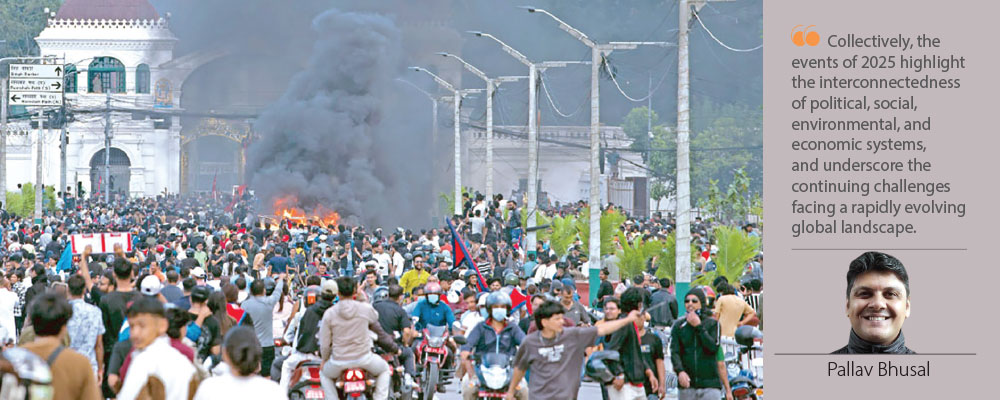
The year 2025 saw the sparks of Gen Z movements that rocked many countries, including Nepal, Madagascar, Morocco, Indonesia, the Philippines, Bangladesh, Sri Lanka, Mexico and Peru. The youth took to the streets, demanding an end to corruption, unemployment and inequality. Using the social media platforms, they called for political reforms and accountability. On September 7 and 8, the Gen Z movement in Nepal overthrew the government. September 27 also saw the beginning of the Morocco Gen Z protest, which was a youth-led demonstration over unemployment and governance.
The Shanghai Cooperation Organisation (SCO) Summit took place from October 2 to 4, which discussed Security cooperation among China, Russia, and Central and South Asia. The G20 Summit was held in Johannesburg, South Africa, from November 22 to 23, which was the first-ever G20 summit on the African continent. It discussed debt relief, development, and Global South leadership.
Trump and Zelenskyy met at the white House on December 28 to discuss a peace framework for the Ukraine war. They had previously also met at the sidelines of the UN General Assembly on September 23 and on February 28 at White House to discuss the same issue.
This year saw the deaths of prominent political leaders, including former Nigerian president Muhammadu Buhari on December 13 and the first female Prime Minister of Bangladesh, Khaleda Zia, on December 30.
War and conflicts
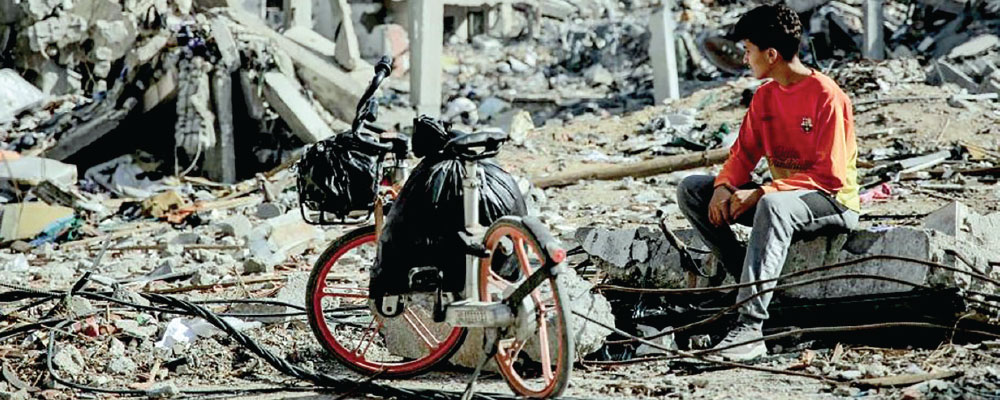
Heavy fighting continued between Ukraine and Russia, although US President Donald Trump has been continuously working to find a solution to end the war. It is the largest European war since WWII, testing the strength of NATO, EU security and global energy markets. Throughout 2025, the Israel-Gaza conflict continues with its military operation, as the humanitarian crisis deepens. January 8 saw Israel's further expansion of ground operations in central Gaza. A ceasefire and hostage exchange deal between Israel and Hamas took effect on January 19. But Israel ended the January ceasefire with a major attack, resuming full hostilities on March 18. A US-brokered ceasefire went into effect on October 10, pausing major fighting again. Hamas released the remaining living hostages on October 13. The Israel-Gaza war that started in 2023 claimed over 72,500 people, mostly Palestinians, as of November.
In 2025, Sudan is also experiencing an ongoing civil war. Sudanese Armed Forces and Rapid Support Forces are continuing following the 2021 army coup. The reported casualties are estimated to be from 10,000 to 15,000 in 2025. Heavy fighting took place in Omdurman and Khartoum on February 7. On April 3, Al-Shabaab attacked government targets in Mogadishu.
This year also saw the Myanmar civil war ongoing between the Military junta and resistance forces for political and ethnic control. On February 14, resistance offensives took place in Sagaing Region.
This year saw a brief armed conflict between India and Pakistan. A four-day military crisis from May 7 to 10 occurred between India and Pakistan, the most serious in decades, involving cross-border strikes and shelling. The escalation was triggered following a deadly terror attack in Pahalgam, Jammu and Kashmir, on April 22 that killed about 26 civilians. India and Pakistan agreed to a ceasefire after diplomatic efforts on May 10 and 11, ending active hostilities. The ceasefire was mediated with international diplomatic engagement, including the US and Saudi Arabia, among others.
On July 24, Thailand and Cambodian forces exchanged gunfire, artillery and rockets, and Thailand used air strikes against Cambodian positions. Martial law was declared in Thai border districts during this flare-up. Many International news outlets pointed out that at least 48 people were killed, and 300,000 plus civilians were evacuated from border areas. Thousands of residents were displaced, and education and medical facilities were disrupted by fighting. After ASEAN-mediated talks in Kuala Lumpur, Thailand and Cambodia agreed to an immediate and unconditional ceasefire on July 29, it was diplomatically supported by the US and China.
But the fighting renewed on November 11, Thailand reported that it had halted parts of the July ceasefire agreement after its troops were injured in a landmine explosion along the border. Fighting resumed in some sectors. On December 8, hostilities reignited sharply, with Thai air strikes targeting Cambodian border positions and artillery/rocket exchanges along multiple fronts. After weeks of renewed violence, Thailand and Cambodia signed a new ceasefire agreement on December 27, 2025. There was a mass shooting at Bondi Beach, Sydney, Australia, killing 15 civilians. Australia, considered one of the safest cities, witnessed a deadly mass shooting in nearly 30 years. Two gunmen opened fire on a beach, and it was declared a terrorist incident.
Natural disasters hit
Large wildfires swept through Southern California, driven by extreme dry conditions, causing significant economic damage and a deadly impact from smoke in January and February. Similarly, from January 17 to 21, a tropical cyclone travelled through the South-West Indian Ocean, affecting Madagascar, Mozambique and Mayotte. On March 28, a 7.9 earthquake struck near Mandalay, Myanmar. One of the deadliest quakes of the year killed 5,456 and injured 11,000. Meanwhile, on August 5, there were flash floods and heavy rain in northern India after a cloudburst struck Dharali, India, washing out roads and buildings.
Similarly, a powerful storm caused flash flooding and mudslides in Kishtwar, Jammu and Kashmir. On August 26, Hanoi and the surrounding regions were hit by heavy rains/floods from Typhoon Kajiki, widespread disruption. Another earthquake struck eastern Afghanistan, with tens of thousands affected, on September 1. On September 20, Heavy rainfall caused flooding in Lomsak District, Phetchabun Province, Thailand.
November saw monsoon-linked extreme rainfall in India and Pakistan, causing widespread floods with 1,860 plus deaths in the region; many were affected. Also in November, Cyclonic Storm Ditwah formed on November 26 – December 4, bringing heavy rains, flooding and destruction across Sri Lanka & southern India. 647 fatalities were reported. Magnitude 7.6 offshore quake struck near Aomori Prefecture (Japan) on December 8, triggering tsunamis and causing structural damage & injuries in December 8. Ending November into December, catastrophic floods & landslides affected Aceh, North and West Sumatra. Nearly 969 people were reported dead, millions were displaced, and extensive property loss.
The rise of AI and climate crisis
Leaders from over 100 countries and 1000 participants gathered to discuss global AI governance, regulation, and investment strategies in Paris, France, at the AI Action Summit on February 10 and 11. Policymakers, scientists, and business leaders met in New Delhi from February 25 to 27 to attend the World Sustainable Development Summit. In March, China announced expanded support for AI, quantum technology, biotechnology, and next-generation communications at its National People’s Congress. Scientists reported 2025 as one of the three hottest years on record, with the three-year average exceeding the 1.5-degree Celsius target set by the Paris Agreement. Extreme weather events surged, testing global climate response frameworks.
Amidst the chaos, the year saw some positive developments as well. New scientific and medical innovations, including gene-editing success, show progress toward curing rare genetic diseases and mutations. AI-powered early disease detection tools were developed that can detect 50-plus different cancers at early stages.
On environmental aspects, for the first time, renewable energy became the largest global electricity source, helped by massive solar deployment. There was an ozone layer recovery progress this year as well. Over 16,000 new species were discovered this year. Throughout 2025, the World Health Organisation announced multiple disease eradication and elimination victories, including the certification of countries such as Georgia, Suriname, and Timor-Leste as malaria-free.
Passing away of superstars
The International Indian Film Academy Awards (IIFA Awards) 2025 were held in Jaipur on February 12, celebrating achievements in Indian cinema. Many anticipated Hollywood and Bollywood cinemas made an impact at the Box office. A Minecraft Movie, from Hollywood, earned the highest amount of $8,561,590,891 in 2025. Anora won the best picture for an Oscar award on March 2.
This year also witnessed the passing away of influential celebrities. Hollywood actor Val Kilmer, known for Top Gun and Batman Forever, died on April 1. Bollywood legend Manoj Kumar passed away on April 4. Rock icon Ozzy Osbourne died on July 22 at the age of 76, and Bollywood 'he-man' Dharmendra breathed his last on November 24, marking a year of significant loss in global entertainment.
India lift ICC trophy
The Australian Open tennis tournament took place in Melbourne from January 12 to 26, with Jannik Sinner winning the men’s final and Madison Keys claiming the women’s title. In cricket, India defeated New Zealand by four wickets in the ICC Champions Trophy final on March 9. In football, Paris Saint-Germain defeated Inter Milan 5–0 in the UEFA Champions League final on May 31. The World Athletics Championships were held from September 13 to 21, featuring 49 events across multiple disciplines.
Liverpool won the English Premier League on April 27, securing their 20th league title, while Barcelona claimed the La Liga championship on May 15, their 28th in history. In cricket, the Indian Premier League was won by the Royal Challengers Bengaluru on June 3, defeating Punjab Kings by six runs in a closely contested final at the Narendra Modi Stadium.
Many governments fell, and many resisted throughout the global turmoil. Political transitions, ongoing wars, and diplomatic efforts reshaped international relations, while natural disasters and climate extremes highlighted the urgent need for preparedness and resilience. Technological and scientific advancements progressed alongside challenges in governance, conflict resolution, and environmental management. Collectively, the events of 2025 highlight the interconnectedness of political, social, environmental, and economic systems, and underscore the continuing challenges facing a rapidly evolving global landscape.
Photo sources- Internet
(Bhusal is a journalist at this daily.)
Pallav Bhusal
How did you feel after reading this news?



-square-thumb.jpg)