- Sunday, 3 May 2026

Unequal wages for equal work: The struggle of female workers in Nepal

By Anil Parajuli, Hetaunda, Dec. 31: Nepal’s 2015 Constitution guarantees every citizen the right to employment and ensures the right of every worker to fair labour practices.
Article 33 of the Constitution enshrines the right to employment, while Article 34 ensures the right to fair wages, benefits, and social security based on contributions.
Furthermore, Clause (4) of Article 18 explicitly states that there shall be no discrimination based on gender in wages or social security for equal work. However, these constitutional provisions have yet to be effectively implemented in practice.
Women, especially those from economically disadvantaged backgrounds, continue to face gender-based wage discrimination. In Bijouna, a rural settlement in the Manahari Municipality-7 of the western Makwanpur , many women are dependent on daily wage labour to support their families. Despite performing the same tasks as men, these women are often paid far less.
Susmita Thing, 43, a daily wage worker in the construction sector, supports a family of nine. She works on tasks such as mixing cement, breaking stones and carrying bricks. Although she works alongside male labourers throughout the day, she is paid significantly less.
“Men working with me get between Rs. 1,000 to 1,200 per day, while I only receive Rs. 500 to 800,” Thing says. “The contractor says that women cannot work like men, so they pay us less.”
Women like Thing are also forced to work in hazardous conditions without proper safety equipment like gloves or helmets.
“The contractor asks us to bring our own safety gear, and provides nothing for us,” she added. In addition to construction work, Thing sometimes works in agriculture, particularly when construction jobs are scarce. Despite working the same hours as men, her pay in agricultural work is also significantly lower. Similarly, Laxmi Thing from the same region shares her experience. “It’s very hard to find work. They don’t hire women for tasks like bricklaying or fence setting,” she says.
Laxmi has been weaving carpets since the age of 15 in Kathmandu. Now, she works both as a daily wage labourer and continues weaving carpets at home. In seasonal agricultural work, she receives only Rs. 500 a day, much less than the pay received by men for similar tasks.
Struggle on for equal pay
Anjana Tamang, 39, has been working in daily wage labour since she was nine years old. She and her husband, who also works as a daily labourer, manage to feed their four-member family with their earnings.
“When we get work, things are fine, but when we don’t, it’s a constant struggle,” she says. Although she now earns Rs. 500 a day for agricultural labour, she recalls earning only Rs. 400 in the past. “We don't own land and live in a small hut on rented land,” Tamang explains.
Another worker, Shobha Pahari, who lost her parents at an early age, was married off at 14. She began daily wage labour right after her marriage and remembers earning only Rs. 25 a day in the beginning. “Now, I earn up to Rs. 500 a day, but still, men earn Rs. 800 to 1,000 for the same work,” she says.
Most of the women in Bijouna, a village located near the East-West Highway in Manahari, rely heavily on daily wage labour. The majority of them are from economically disadvantaged indigenous communities and live on leased land.
Despite constitutional and legal provisions, gender-based wage discrimination persists, leaving these women in a state of labour exploitation and economic insecurity.
The legal framework and lack of enforcement
While constitutional and legal protections are in place, the practical application of equal pay for equal work remains lacking. In the formal sector, workers also face challenges, including low wages, job insecurity and a lack of social security benefits.
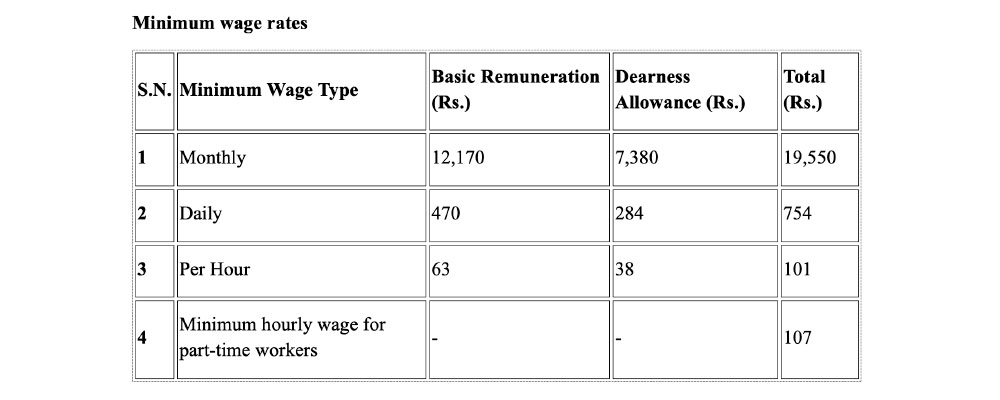
The Ministry of Labour, Employment and Social Security has, however, set a minimum wage for workers under the Labour Act of 2074, effective from July 17, 2025.
According to the new regulation, the minimum monthly wage for most workers, excluding those in tea gardens, is set at Rs. 19,550, including basic pay and a living allowance. The daily wage is set at Rs. 754, with hourly wages for part-time work at Rs. 101.
For workers in the tea industry, the monthly wage is slightly lower at Rs. 13,893, with a daily wage of Rs. 500. However, despite these legal provisions, gender-based wage inequality persists, with female workers continuing to receive lower pay for similar tasks.
According to Pitambar Ghimire, the spokesperson and deputy secretary at the Ministry of Labour, Employment, and Social Security, there should be no wage disparity between male and female workers.
“As per the law, every worker is entitled to the wage fixed by the government. There should be no gender-based pay discrimination,” Ghimire said.
He also clarified that workers who do not receive the designated wage have the right to file a formal complaint with the relevant labour office.
Despite the legal provisions, the situation for female workers, particularly in rural and informal sectors like agriculture and construction, remains difficult. They continue to face not only lower wages but also unsafe working conditions and lack of basic amenities.
The fight for equal pay for equal work is far from over in Nepal, and much remains to be done to bridge the gap between law and practice.

-square-thumb.jpg)