- Sunday, 3 May 2026

Repercussions Of Nepal's Gen-Z Uprising

In the aftermath of the September 8-9 uprising, it is expected that the interim Prime Minister, Sushila Karki, should perform at least two significant tasks. First, she has to reassure people that the interim government will establish good governance in the country, something that has often been discussed but never realised. Second, it has to create a congenial environment for the general election to be held on March 5, 2026.
Both tasks, however, are not as easy as one might suppose. They are as complex as climbing a high mountain to reach the summit or going down to the sea fathom to pick a pearl. The Gen Z leaders consistently claim that they have not sought an alternative system to multiparty democracy. Their most explicit slogan is zero tolerance for corruption and the full implementation of good governance. To achieve this goal, the state apparatuses such as the police, army, and judiciary are not adequate. Instead, a state needs even ideological state apparatuses, such as schools, universities, religious and political institutions that can inculcate values and ethical principles into citizens' minds.
Lingering danger
But the problem is that if the interim government adopts the first measure, it will be unpopular, as previous governments have been. On the other hand, if it chooses the second measure, it will take a long time, which is not possible for a short-term government like this one. Since this initiative takes a considerable amount of time, the government, with a six-month mandate, may not accomplish it to the rebels' complete satisfaction. Therefore, a lingering danger that good governance may not happen still hangs over the newly appointed Prime Minister's head. People have such a high opinion about the government that if it fails to deliver on the people’s expectations, it will be unpopular again.
In such a context, the interim government is scheduled to hold a general election for the House of Representatives. This task is just as complicated as the first one, specifically because the two major political parties, CPN (UML) and Nepali Congress, have challenged the dissolution of the House of Representatives by filing a legal complaint in the court. It is not without political gravity and constitutional legitimacy that the complaint is lodged, given that the political parties that have long worked within democratic and socialist political doctrines, even though some of their top leaders are allegedly decadent in democratic values and principles.
The chief responsibility of the interim government, therefore, is to cooperate with the political parties for the upcoming election. If it fails to do so, it will lose the legitimate validity of the interim government. Even if it can hold the election, people still fear that, if the conventional political parties win, they will not be able to alter the existing situation, which is supposedly rife with corruption and poor governance. Recently, the ousted Prime Minister has begun to defend his government's actions, claiming them as valid, genuine, and sound for the nation’s prosperity and the people’s happiness, which were unfortunately disturbed by the destruction caused by the September 9 incidents of burning, sabotage, and looting by criminal hooligans, while speaking little about the shooting of innocent youths on the previous day.
Two political groups are making contradictory claims in this connection. Whereas the current interim government blames the ousted government, especially the Prime Minister and the Minister for Home Affairs, for killing the innocent youths, which resulted in the ensuing day’s violence, it is a bit silent about the September 9 incidents. The erstwhile government, on the contrary, claims that it did not issue an order to shoot. Since the investigation team has not issued its findings on the issues, nothing can be said with certainty; however, we can argue, with valid reasoning, that this is one of the challenging issues the current government is facing. Unless it is satisfactorily dealt with, the upcoming election may not be held with the full cooperation of the conventional political forces.
Even after a few days of the uprising that caused unfortunate death and destruction, different reactions from various sectors are still floating on the political pond. It cannot be easily predicted what will happen if the interim government fails to hold the election without violence; whether this government can guarantee that officials of the state machinery will be able to work fairly and independently, being impartial and non-partisan in all cases. These issues should not be overlooked, any more than the genuine voices of Gen Z youths should go unheard. However, it is unclear whether the interim government can function successfully, given these issues. Herein lies the crux of the problem.
Goals
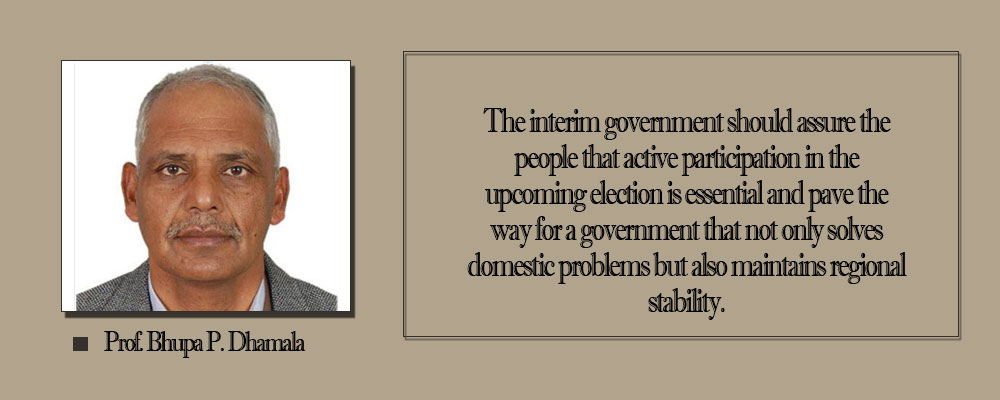
To accomplish these goals, the interim government should assure the people that active participation in the upcoming election is essential and pave the way for a government that not only solves domestic problems but also maintains regional stability. Also, it can seek the international community's cooperation in conducting the election process in a free and fair manner, without a tilt toward any regional power, while maintaining national integrity and diplomatic competence.
By the same token, the international community, comprising the governments of neighbouring and culturally close countries, as well as diplomats, should cooperate with the interim government without bias or tilt toward any specific Nepali political group. More importantly, Nepali diaspora communities living in countries around the world can play a crucial role in ensuring the election's success. There is no denying that periodic elections are essential to securing a fresh mandate to govern. The significance of the newly elected government lies in restoring peace and order and returning the country to the regular rhythm of governance, balancing all stakeholders while taking initiatives to address the country's turbulent situation.
(The author is the chairman of Molung Foundation. bhupadhamala@gmail.com)

-square-thumb.jpg)