- Sunday, 3 May 2026

When Decisions Go Wrong
 Carlos Alós-Ferrer
Carlos Alós-Ferrer
Carlos Alós-Ferrer
Suppose you're standing at the top of a high ladder, fixing a roof. Suddenly, a tool slips from your grasp, threatening to fall. Before you can think about it, you stretch awkwardly to grab it, slip, and fall to your death. What happened? Your brain reacted to a specific cue (a slipping object) and made a split-second decision that has worked a million times in your life: grab it before it falls. A natural, intuitive impulse. But it was the wrong move, because it ignored the particular situation you were in. Perched at the top of a ladder, you should have let the tool fall.
Making good decisions takes work and time. But sometimes we don't have the luxury of time. We need to decide right away. This is nothing new. It's a problem our brains, and our ancestors' brains, have been solving for millennia. This is why your brain constantly searches for fast associations and routines that work.
As children, we learn to avoid fire and step away from cliffs without thinking. As adults, we recognise what we like or dislike without much deliberation. We become fast judges of character. We learn to read a room. We even programme ourselves to drive cars, operate machinery, or cook complex dishes without checking every step.
Laymen call such acquired skills “intuition.” Psychologists use other names, like “automatic processes.” Nobel Prize winner Daniel Kahneman famously described two ways of thinking in his book Thinking, Fast and Slow. We might also call those intuition and deliberation. But if something sounds too good to be true, it usually is. There is no perfect way to make good decisions while avoiding hard work. You should be skeptical of people who tell you to blindly “trust your intuition.”
Intuition is often wrong. It tells you to keep repeating what worked in the past long after it stopped working. It tells you to jump on the bandwagon and buy stocks that just went up, or panic and sell those that just went down. It might even kill you when you grab for a slipping tool while perched on a ladder.
Fast decisions can be useful when they follow well-tuned routines that apply to the problem at hand. They can also lead to catastrophic consequences. How can you tell whether to trust a fast decision?
Sometimes intuition and deliberation are aligned. You shouldn't put your hand on fire. You should move out of the way if you hear an approaching car. If you're an experienced art collector and a piece feels off, you should be wary, even if you can't articulate why. If you've put thousands of hours into a computer game, you can probably react quickly while playing. In all those cases, intuition is just a well-tuned skill your brain uses to save time. Your fast decisions tend to be correct, and many errors are slow (because they come from somewhere else, not intuition).
Other times, your intuition is off and works against deliberation. Unless you're an experienced stockbroker, your instincts in the stock market will be to buy high and sell low (don't). Unless you've been trained in psychology, you'll find con artists likeable and fall for their scams (or vote for them). And you should definitely avoid sudden movements while perched on a ladder. In all those cases, intuition tries to apply the wrong routines to the wrong situation. Your fast decisions tend to be wrong, and many errors are fast (because they're intuitive).
First, if a decision is important, make time for it. Never rush. Your intuition might be right, but why risk it if you have the time? And if it's important, you should always try to have the time. Conversely, if it's not important, go with your gut. Don't sweat the small decisions. Be intuitive when playing computer games, but not when investing your life savings. Avoid the intuition trap.
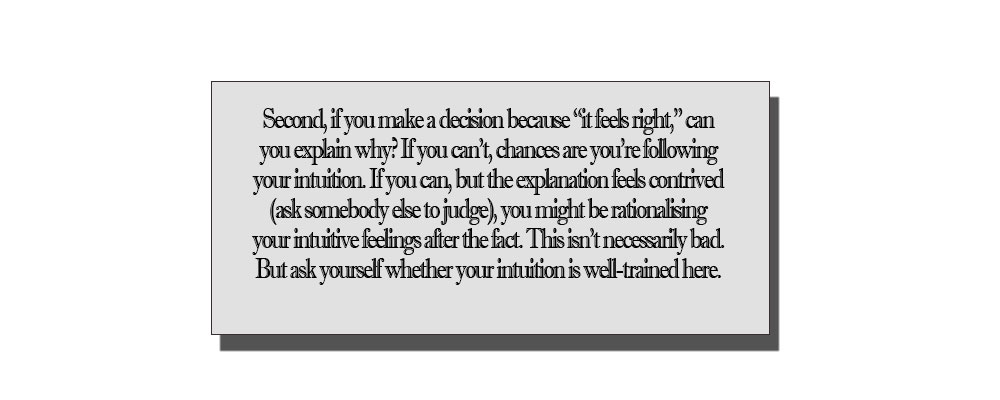
Second, if you make a decision because “it feels right,” can you explain why? If you can't, chances are you're following your intuition. If you can, but the explanation feels contrived (ask somebody else to judge), you might be rationalising your intuitive feelings after the fact. This isn't necessarily bad. But ask yourself whether your intuition is well-trained here.
Is this a decision you're an expert at, something you've done often and well in the past? Then you're probably safe. Is this a new decision, involving something you are not familiar with? Don’t go with your gut. Stop and think, inform yourself, seek advice.
Third, consider retraining your intuition. If you make the same mistakes again and again, ask yourself which routine you're using and try to replace it. Personally, I've trained myself to freeze in place whenever an object slips or falls while I'm on ladders, stairs, or even slightly uneven surfaces. And last, remember that making good decisions is a skill that can be trained.
-Psychology Today




-square-thumb.jpg)