- Friday, 29 May 2026

E-waste Management Challenges In Nepal

E-waste is an abandoned electronic goods or electronic products improperly disposed or discarded in the environment. In modern era, e-waste represents a byproduct of technological advancement. E-waste comes from Electrical and Electronic Equipment (EEEs), which is a growing concern of developing countries. E-waste is world’s rapidly growing solid waste stream in the global level because every year, millions of electronic goods are discarded or dumped at landfills which poses a threat to human health and environment.
EEEs include but are not limited to old computers, TV sets, gazettes, household appliances like microwave, washing machine, and medical equipment, etc. The useless electronic goods are subject of discussion because they are either stored improperly at home, store, warehouse or transported to the developing countries assembling them as second-hand or refurbished items. In developing countries, where government and people are less sensitive to e-waste, women and children often collect it for valuable metals like gold, copper, silver or other parts that can be used later.
In order to find solution to the e-waste related problems, this article has been prepared reviewing secondary sources and the conclusion drawn about the environmental challenge, health impact and policy reform.
Toxic substances contained in e-waste
E-waste contains a wide range of materials, including 69 naturally occurring elements and over 1,000 different substances. EEEs commonly includes toxic metals such as lead, mercury, beryllium, thallium, cadmium, arsenic, as well as brominated flame retardants and polychlorinated biphenyls. Meanwhile, e-waste holds valuable metals such as gold, silver, platinum, palladium, etc., making it a potential source of income for waste hawkers. It further contains critical raw materials including cobalt, germanium, bismuth, and antimony. Iron and aluminum are also widely used in electronic devices. Notably, it is estimated that one tonne of mobile phones and personal laptops can yield approximately 140 grams of gold.
Impact on human health
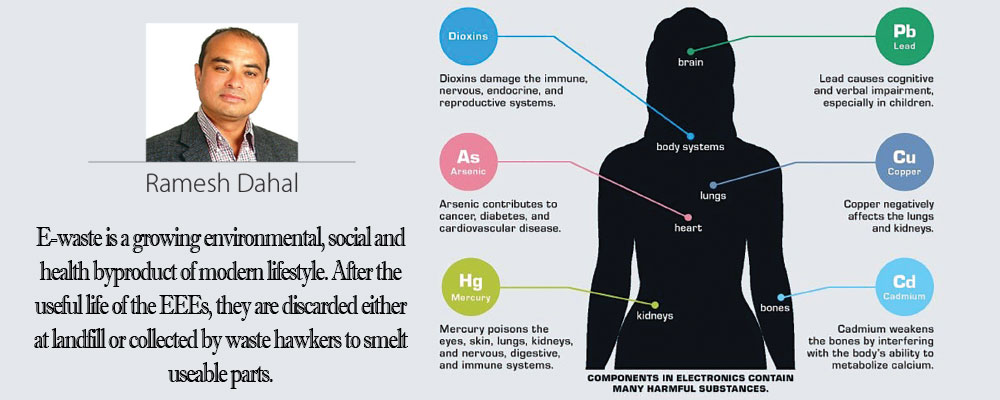
Discarded EEEs containing batteries or plugs often include toxic and hazardous substances, such as mercury, which pose serious risks to human health. Mercury is found in LCD screens, fluorescent lamps, computer monitors, and laptops. Exposure through inhalation of mercury vapour or consumption of contaminated foods can damage brain, heart, kidneys, and lungs. It is also associated with abnormal births, miscarriages, delayed brain development, neurological and cognitive impairments, making it particularly dangerous for women and children.
Lead is a harmful material widely used in smartphones, TV screens, printers, batteries, and other personal electronics. Lead can damage human health in multiple ways, including damage of nervous system, impairing cognitive function, and causing long-term challenges. Human exposure to lead can lead muscle weakness, brain damage, hearing and speech problems, behavioural problems of developing children, anemia, nerve damage, and death.
Exposure to toxic substances commonly found in EEEs results in cardiovascular disease. Unnecessary exposure to heavy metals such as arsenic, lead, and cadmium can disrupt heart rhythm, elevate blood pressure, and impair lipid profiles. Long-term exposure to these metals is associated with a higher likelihood of major adverse cardiovascular events, cancer, heart failure, stroke, angina, and death.
People expose to the chlorofluorocarbons (CFCs) while screening valuable metals through e-waste. CFCs slow down the Central Nervous System (CNS) which impacts brain and spinal cord. They experience respiratory problem, and lung congestion which put people from simple health complications to life threatening condition. Therefore, improper disposal of e-waste poses significant health risks, particularly for women and children who are on the frontline of e-waste recycling.
E-waste as a social problem
Generating over 62 million tonnes of e-waste annually has become a significant social issue and an environmental challenge. Many developed countries export second-hand EEEs—often illegally, or under the guise of donations—to developing nations where environmental regulations are less stringent. As a result, developing countries are compelled to manage already-used e-waste dumped into their fragile environments which exposes marginalized people to both social and environmental burdens.
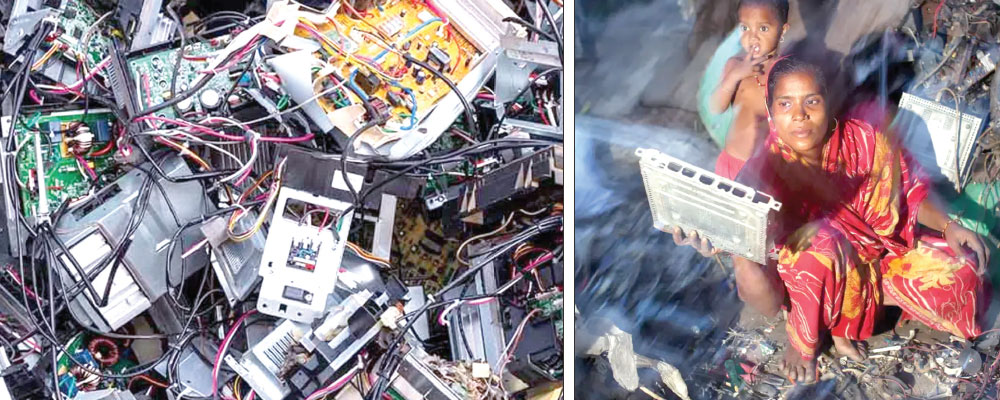
Although women are trained in using technology and awareness to use Personal Protective Equipment (PPE) in developed countries, their Occupational Health and Safety (OHS) is poor in Nepal. In other words, working in e-waste recycling is 'informal' and a low-paid work in Nepal while it is a 'formal' occupation in developed countries. According to UNU report, women sort through e-waste manually without PPEs and limited skills for low payments, expose themselves to toxic chemical including but not limited to Chlorofluorocarbon (CFCs), hydrochlorofluorocarbons (HCFCs) and others.
According to a report, very few African countries are practicing e-waste legislation. We too are equipped in waste management policy, but it is silent about e-wastes. In Nepal, e-waste management belongs to informal sector which means that labour law, Acts and regulations are bypassed. This creates insecure work environment and exploitation. It is a serious social issue that women and children are at health risk due to their exposure to e-waste for their hand-to-mouth. But the good point is that women's role in green economy through e-waste recycling is praiseworthy and substantial.
Impact on environment
People dismantle discarded EEEs for expensive metals releasing mercury, lead, cadmium, arsenic, beryllium, thallium, antimony, brominated flame retardants, polychlorinated biphenyls, aluminum, bismuth, chromium, nickel, CFCs, HFFCs, and others that contaminate soil, water and air. The leaching of toxic substances from landfill degrades soil, water and air irreversibly. When e-waste is burnt openly, it releases toxic fumes.
E-waste policy gap
Nepal lacks e-waste policies. Despite increasing volume of e-waste with negative impact on health and environment, policies remain silent, indicating that e-waste is not a concern. For example, Solid Waste Management Act, 2011 of Nepal is quiet about e-waste. The absence of e-waste legislation discourages private-sector investment. Likewise, Nepal is weak in e-waste facility and technology due to resource constraint. Despite Nepal being a signatory to Basel Convention which regulates the transboundary movement of hazardous materials, tonnes of e-waste is sent to other countries through illegal routes. The mentioned scenario necessitates the extensive discussion for comprehensive e-waste policies in Nepal.
Key solutions and recommendations
None can imagine modern life without EEEs but it is our responsibility to use them cautiously. On the other hand, experts emphasize that strong legislation grounded in the ‘polluter pays principle’ can hold producers accountable for the safe management of their e-waste.
A crucial part of e-waste management is transitioning from the 'informal' sector to a formal and regulated system that eliminates unregulated, undocumented, and haphazard handling of e-waste by poorly paid women. It is recommended to establish an e-lab with hazard-safe recycling and refurbishing facilities outside Kathmandu—ideally in the Tarai region—at an appropriate distance from residential areas to allow for the safe dismantling of equipment, recovery of valuable materials, and proper handling of toxic substances. Additionally, it is advised to establish and operate specialized machinery, and manage by trained personnel based on protocols.
We can apply 3R principles to reduce e-waste: first, by minimizing the purchase of unnecessary EEEs; second, by reusing devices through repair and maintenance; and third, by sending them for recycling. Nepal can address existing capacity gaps by learning from international best practices and by formally encouraging private-sector participation to systematize e-waste recycling and strengthen an e-waste-based economy. The country can also prevent the loss of valuable resources—such as gold, silver, copper, and other materials—currently being sold off as e-waste. Furthermore, the development and promotion of a second-hand electronic market can contribute to waste reduction and support economic growth in e-waste sector. Implementing extended producer responsibility can help establish a reliable economic stream and foster a robust local second-hand market.
The private sector plays an important role in e-waste management; however, meaningful progress will remain limited without involvement of the government.
Therefore, the Government of Nepal is advised to explicitly address e-waste issues through an additional amendment to existing acts, or by introducing a separate, dedicated regulations. Provincial and local governments are encouraged to address e-waste challenges within their respective jurisdictions.
Nepal can address existing capacity gap by adopting international best practices and formally encouraging private-sector participation to systematize e-waste recycling and strengthen an e-waste-based economy. Public awareness about e-waste remains limited in Nepal, making education and advocacy essential.
Stakeholders—including the general public, waste hawkers, and government employees—should be trained to handle e-waste properly, recognizing that it is not merely waste but also a source of employment and valuable materials for a circular economy.
E-waste is a growing environmental, social and health byproduct of modern lifestyle. After the useful life of the EEEs, they are discarded either at landfill or collected by waste hawkers to smelt useable parts.
People, especially women and children from marginalised communities, expose themselves senselessly to the e-waste for a little amount of earning in extracting valuable materials and toxic substances. The discarded equipment when dismantled, can leak 1,000 types of substances including mercury, lead, cadmium, CFCs, HCFCs and others. In countries like Nepal, such substances damage human health and environment irreparably, so it has social consequences on several levels. The article hence advises the governments at all levels to address e-waste problem by means of proper policy reformation, awareness and advocacy.
(Dahal is a freelancer)