- Tuesday, 26 May 2026

Policy Stability, Public Spending Unlocks Excess Liquidity

At a time when Nepal’s economy is grappling with a slowdown largely driven by sluggish capital mobilisation despite excess liquidity in the banking sector, economists and stakeholders have stressed the urgent need to channel surplus funds into productive sectors.
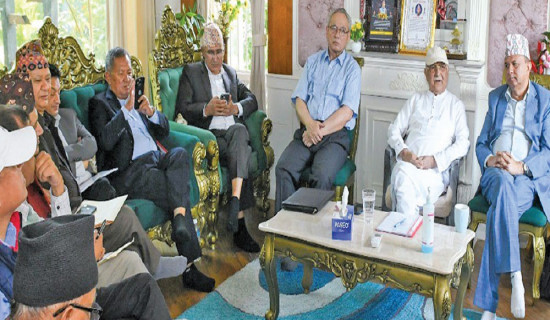
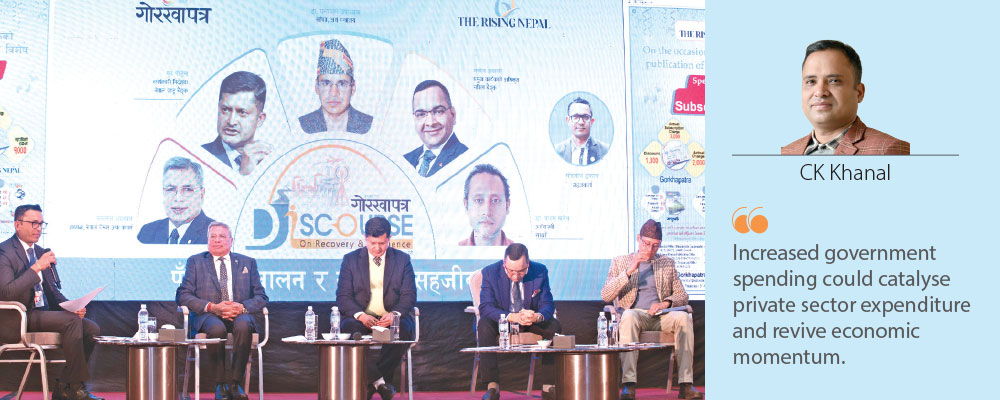
Speaking at the Gorkhapatra Discourse on Recovery and Resilience, organised by Gorkhapatra Corporation on the occasion of the 60th anniversary of The Rising Nepal in Kathmandu on Thursday, participants said the economy could rebound if idle liquidity in banks is effectively mobilised through both public and private sector investments.
Delivering the keynote address on the thematic session “Capital Mobilisation and Policy Facilitation,” Finance Secretary Dr. Ghanashyam Upadhyaya said the central challenge facing the economy is converting accumulated cash in the financial system into productive capital.
He emphasised that restoring private sector confidence is key to mobilising excess liquidity. Political instability, frequent policy shifts, natural disasters, supply chain
disruptions, and incidents of arson and vandalism targeting business properties have collectively weakened business confidence, he said, calling for constructive support from all segments of society.
Secretary Upadhyaya also underlined the need to enhance the government’s spending capacity to stimulate private investment. Unnecessary political interference in budget formulation and inadequate preparation of development projects have delayed implementation, thereby suppressing overall economic activity, he noted.
“The time has come for politicians, bureaucrats, the private sector, and experts to reassess their roles in restoring business confidence and mobilising idle liquidity,” he said.
Although policy measures have been introduced by the government and Nepal Rastra Bank (NRB) in line with private sector demands, investment sentiment has yet to improve, he said, stressing the need to create a respectful and enabling environment for entrepreneurs.
He, however, maintained that most macroeconomic indicators—except excess liquidity—remain comfortable and that Nepal’s economy has demonstrated strong resilience by recovering swiftly from past political, natural, and external shocks.
Kamalesh Kumar Agrawal, President of the Nepal Chamber of Commerce, said weak private sector credit demand stems mainly from restrictive policies adopted by the government and the central bank.
He attributed the contraction in credit to post-COVID interest rate hikes, working capital guidelines, and curbs on lending to
real estate and share markets. Political instability, policy inconsistency, import restrictions, natural disasters, and recent political movements causing damage to private property have further dampened investor confidence, he added.
Agrawal urged the government to ensure political stability, maintain policy consistency, and create a favourable business climate, while also calling for implementation of recommendations made by the High-Level Economic Reform Commission led by Finance Minister Rameshwore Khanal.
Economist Dr. Paras Kharel said declining gross capital formation in recent years has been a major factor behind the economic slowdown.
He pointed out that low development spending and poor returns from public enterprises have significantly affected capital formation, noting that the government still accounts for a substantial share of total investment. According to him, reduced involvement of the National Planning Commission in project selection and budget allocation has contributed to falling capital expenditure.
Dr. Kharel stressed effective implementation of the Mid-Term Expenditure Framework to address delays in project execution. While private sector credit accounts for 92 per cent of total bank lending—higher than in other South Asian countries—its contribution to economic growth remains questionable, he said, suspecting misallocation toward unproductive sectors and calling for a thorough portfolio review.
Guru Paudel, Executive Director of Nepal Rastra Bank, said fiscal stimulus is essential to encourage private investment and absorb excess liquidity.
Despite abundant liquidity and lower borrowing costs, the private sector remains reluctant to invest, he said, adding that increased government spending could catalyse private sector expenditure and revive economic momentum.
Chief Executive Officer of Nabil Bank, Manoj Gyawali, said the decline in credit demand is the cumulative outcome of past policy and sectoral weaknesses.
Excessive lending to unproductive sectors such as real estate and the share market, inadequate portfolio reviews, implementation of working capital guidelines, and problems in the cooperative sector have collectively weakened business confidence, he said.
However, Gyawali expressed optimism that the economy could rebound within six months if a favourable investment climate is restored. He suggested utilising excess banking sector liquidity—available at low cost—for developing a reservoir-based hydropower project.
(Khanal is a journalist at this daily.)