- Monday, 25 May 2026

VP Yadav applauds Gorkhapatra’s century-long role as nation’s voice
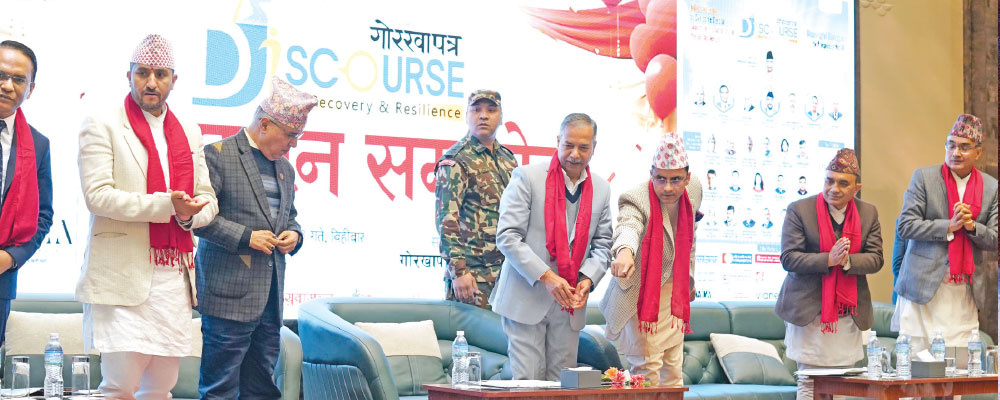
Photo: Sagar Basnet/TRN Vice President Ramsahay Prasad Yadav inaugurating the Gorkhapatra Discourse organised on the occasion of the 60th anniversary of The Rising Nepal, in the capital, on Thursday.

By Pallav Bhusal,Lalitpur, Dec. 19: Vice President Ramsahay Prasad Yadav has called for close cooperation between the government and the private sector, saying economic revival would not be possible unless both sides moved forward in unison with mutual trust and clear policies.
Inaugurating the ‘Gorkhapatra Discourse on Recovery and Resilience’ organised by Gorkhapatra Corporation on the occasion of 60th anniversary of The Rising Nepal in Lalitpur, on Thursday, the Vice President said the programme had created an important common platform for government officials, policy-makers, industrialists, experts and the media. “We have gathered here to discuss Nepal’s economic revival, investment environment and future development strategies at a critical time,” he said, expressing confidence that the discourse would reach concrete and meaningful conclusions by analysing the country’s economic challenges and prospects, particularly in the context of recent political developments and the aspirations of the Gen-Z movement.
Highlighting the historic contribution of Gorkhapatra, Vice President Yadav said the institution had served as the nation’s official voice for more than a century. “Gorkhapatra is not just a media house, it is a living heritage of Nepali society, culture, history and change,” he said. Vice President Yadav recalled Gorkhapatra’s role from the Rana era to the federal democratic republic. “Gorkhapatra has continuously raised the voice, rights and aspirations of the common citizens and has played a vital role in promoting democratic values, social justice and national unity,” he added. VP Yadav also noted that publishing Naya Nepal pages in 46 national languages had helped strengthen inclusion in Nepal’s multilingual and multicultural society.
Referring to the digital transformation of the media, the Vice President said credibility and factual accuracy must remain paramount. “This is the digital age, but speed should never come at the cost of truth,” he said, describing the launch of the Gorkhapatra Academy as a visionary step to strengthen academic and professional journalism and to respond to the demand for transparency, good governance and employment opportunities raised by the younger generation.
On the economic front, Vice President Yadav said the interim government faced the challenge of advancing development works while prioritising elections. “Creating an environment of trust between the government and the private sector to mobilise capital accumulated in banks and financial institutions is the need of the day,” he said. “If we increase investment in agriculture, water resources, tourism and infrastructure, it will create jobs, raise income and give momentum to the overall economy,” he added.
Stressing the role of the media in economic recovery, he said that the private sector is the engine of the economy, and journalism should encourage it by ensuring transparency, accountability and policy clarity. Expressing confidence in the outcome of the discourse, the Vice President said the debate would help chart a roadmap for sustainable revival of the economy and strengthen the federal democratic republic through inclusive, responsible and forward-looking journalism.
Similarly, Finance Minister Rameshore Prasad Khanal said Nepal’s economy had entered a phase of recovery and resilience over the past three months, contrary to earlier predictions of collapse. “The economy has not collapsed as some had predicted; it is moving towards reconstruction and renewed hope,” he said. He informed that economic activity had increased by around 10 per cent, driven by growth in tourism, remittance inflows, production and consumption.
Minister Khanal said October recorded the highest tourist arrivals in Nepal’s history. “The highest tourist arrival occurred in October, and as the year ends, it appears that this year will see the highest number of tourists,” he said, adding that the data showed Nepal’s capacity to recover from crises. He said imports of raw materials and intermediate goods had increased, indicating production growth, while consumption had also improved.
Minister Khanal said interest from Chinese investors reflected growing confidence in Nepal’s economy. “I recently participated in a Chinese investors’ conference, and investors are optimistic about Nepal due to the reforms introduced by the interim government,” he said. However, he acknowledged that productive activities still needed to be strengthened. “We have realised that more work is required to increase productive investment, and we are working towards solutions,” he added.
Governor of Nepal Rastra Bank, Prof Dr. Biswo Nath Poudel, said Nepal’s economy was sufficiently robust to attract foreign investors. “The inflow of bilateral loans at low interest rates indicates our economic strength,” he said. He added that Nepal’s banking system was strong and capable of mobilising capital effectively, provided sound policies and confidence were maintained.
Governor Paudel said the country was facing unusual economic challenges but had repeatedly demonstrated resilience. “We have overcome many conflicts in the past and always managed to come back stronger,” he said. He stressed the importance of long-term infrastructure investment, particularly in roads, highways and expressways. “The government needs to be bold in making large investments, especially in infrastructure,” he said, noting Nepal’s significant potential in the transport sector.
Earlier, welcoming the participants, General Manager of the Gorkhapatra Corporation Lal Bahadur Airi said the discourse was the first of its kind organised by the institution. “There is currently a trend of disappointment in the economy, but we also have ample potential and opportunity,” he said. “We have organised the Gorkhapatra Discourse to convey hope and to discuss how to face these challenges constructively,” he added.
Airi said Nepal was passing through a political, social and economic transition following recent movements and instability. “Politics directly impacts the economy, and themes of the discourse have been selected to highlight opportunities for recovery and resilience,” he said. He added that Gorkhapatra saw itself as a mediator between the state, the private sector and citizens. “Our responsibility is to bridge the gap between the government and the business community through responsible journalism,” he said.
He also announced the establishment of the Gorkhapatra Academy to promote quality journalism and strengthen professional standards. “The Academy will carry out academic work in journalism and help improve the overall quality of reporting,” he said, adding that the discourse would now be organised annually. He further informed that internal administrative reforms, staff recruitment, promotions and expansion of Social Security Fund coverage were underway at the institution.
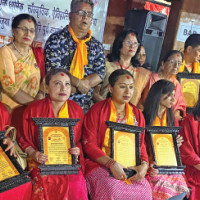
During the programme, Vice President Yadav presented letters of appreciation to former chief editors Ajay Shamsher Rana, Yuba Nath Lamsal and Bijaylal Shrestha, recognising their contribution to Nepali journalism. Similarly, Minister for Communication and Information Technology presented The Rising Nepal awards to reporters Modnath Dhakal, Manjima Dhakal and copy editor Kishor Basyal.
Chief Editor of The Rising Nepal Bishnu Prasad Gautam, delivering the closing remarks, thanked all dignitaries and participants for making the discourse lively. “We are grateful to everyone who supported us in making this programme meaningful,” he said.