- Sunday, 3 May 2026

Deep bond between people and wildlife in northern Gorkha
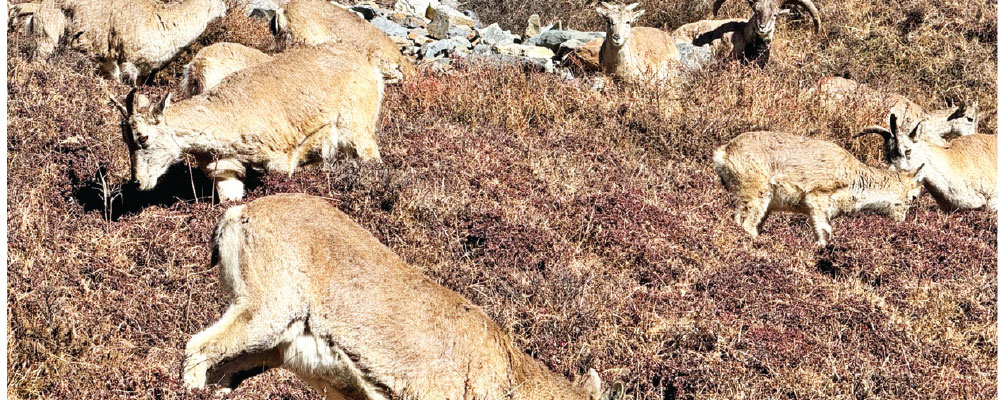
Blue sheep seen in large numbers in Samdo, northern Gorkha. Photo: Suren Gurung

By Gun Bahadur Roka,Sulikot, Dec. 18: The Himalayan region of northern Gorkha, including areas around Chumchet, Larke, Samdo and Dharamshala in the Manaslu Conservation Area, has become a living example of coexistence between people and wildlife.
Dense forests, rivers, streams and grazing lands in this high mountain landscape have bound local communities and wild animals into a single natural system.
According to Santosh Serchan, chief of the Manaslu Conservation Area Project (MCAP), Gorkha, the daily lives of local communities from Samdo to Dharamshala depend on farming, hotel businesses, livestock rearing and the collection of medicinal herbs. As a result, direct contact with wildlife has become almost unavoidable.
The Himalayan belt of northern Gorkha is home to snow leopards, especially blue sheep (naur), Himalayan tahr (jharal), musk deer, deer, bears and various bird species. The relationship between blue sheep and snow leopards, in particular, has a direct impact on human life.
As blue sheep are the main prey of snow leopards, their conservation helps maintain ecological balance. When this balance is disturbed, snow leopards sometimes move closer to settlements and cause losses to livestock.
As northern Gorkha has been declared a non-violence zone, people have long respected wildlife. Even today, in some villages, snow leopards are regarded as the “guardians of the mountains,” said local Phurung Dorje Lama of Chumnubri Rural Municipality-1.
Practices such as community forest management, grazing management and night-time protection of livestock have contributed to reducing human-wildlife conflict, said Nima Lama, chairperson of Chumnubri Rural Municipality.
It has also been reported that, in coordination with MCAP and local governments, compensation schemes, awareness programmes and alternative livelihood options have been introduced.
The rural municipality said these efforts have raised hope that the relationship between people and wildlife can be transformed from conflict to coexistence, sending a message that conservation and development can go hand in hand in northern Gorkha.
Domestic tourist Suren Gurung said visitors to the Manaslu region often enjoy watching blue sheep and take photographs with them.