- Saturday, 6 June 2026

TRN's Sixty Years And The Path Ahead

As The Rising Nepal completes 60 years of its publication, it is time to think about work plans to make it shine brighter ahead in the changed context while keeping up with its proud legacy. Its legacy is not just about being the oldest English broadsheet daily but a mass educator of keeping its readers informed by disseminating factual and useful information nationally and globally. The original aim was to share Nepal's voice with the world directly, without the involvement of any middle player.
What brings this newspaper to this point, litmus-tested through the vicissitudes of history since its birth on Thursday, December 16, 1965, is the distinct and uncompromising professional norms it has consistently adhered to. At this crucial juncture of history, it is very important for its editorial team members to coolly reflect and renew their commitment to work with extra dedication to keep up with the lofty vision of the founders and feel prouder by making the paper's readability rise higher.
Dedication
Dedicating this publication to the esteemed readers, 60 years ago, the founders had said that a nation and its voice stand above any vested desires of interest groups. But the rich cultural and ethnic diversity of the nation always deserves rights and due respect. In the launching editorial, they said, "We shall give expression to those views that are national rather than sectional. But the national views will not be expressed through suppression of sectional elements but through their harmonisation." This stance should indeed remain a consistent mantra for this nation for everlasting unity and peace.
TRN's culture is to stand with uncompromising firmness on the side of fairness and justice, sacrificing all the biases that often crop up in power politics and office politics. This paper abided by this unflinching principle during the National Referendum of 1980, giving a fair and impartial coverage on both sides of the choice offered to the people. TRN Chief Editor of that time, Mana Ranjan Josse, says, "As the paper's chief editor, I decided to go for a fair treatment to both sides." But above all, there was the backing of King Birendra, who unveiled and signed three launching copies of this paper as Crown Prince, for neutral and equal coverage of referendum news. There was a royal proclamation regarding this and even the attempt of the then communication and foreign affairs minister to change the chief editor had failed.
"TRN was often criticised for what it did, whereas Gorkhapatra came under attack for what it did not do," says Professor P Kharel, who worked with The Rising Nepal for 20 years and served for two more years as its Editor-in-Chief from December 1994 to December 1996.
Here is a small piece from a lengthy commentary written about The Rising Nepal by the late Kamal Prakash Malla when this newspaper was observing its third anniversary on December 15 1968, "Even in their own news stories, commentaries and editorials, The Rising Nepal staff have not always maintained a sense of standards. When I say standards, I mean the professional standards of the content and the language. …The page make-up of The Rising Nepal is based on no logic. It satisfies neither the canon of the convenience of the reader, nor the canon of aesthetic pleasure of a quick glancing reader."
Vitriolic comments
Regarding Kamal Prakash Malla's vitriolic comments on this newspaper, which then had the second largest circulation after Gorkhapatra, Professor Kharel says, "For its anniversary in December 1968, TRN approached Kamal Prakash Malla, a Tribhuvan University lecturer in English literature, to do a critique on the paper's performance. Malla obliged with a blistering criticism from start to finish. He flayed "the lop-sided" working style of the paper's editorial staff members and questioned the relevance of its very existence."
TRN founding Editor Barun Shumsher Rana had requested Malla to write the evaluation commentary and published it without making any changes in the anniversary issue. According to Professor Kharel, there is no precedent in the last half-century by any newspaper in Nepal having ever invited such a critical commentary on itself. This newspaper was known and coveted for its rarity value and professional prestige, and the editors, then, enjoyed a salary higher than any first-class officers in civil service and security agencies, shared Professor Kharel.
One of the founding editors, Aditya Man Shrestha, says that in those days someone aspiring to become a Nepali ambassador abroad had to get his article published in The Rising Nepal. As the King read the paper every day, the prospective candidate had to come into notice through the published article. The editors were naturally under pressure to publish such articles.
In terms of inclusiveness, TRN has an encouraging historical track record of employing female journalists. A significantly higher number of women journalists have worked at TRN than at its sister publication Gorkhapatra. Since the very beginning, the involvement of women journalists in this English daily has been outstanding and leading.
To date, two and a half dozen women journalists have worked in this daily, starting with the pioneering stint of Madhuri Amatya, who joined this paper as a Sub-editor in 1973 and worked here for a little more than one year before leaving. The first generation women journalists following Madhuri Amatya include Punam Thapa, Subhadra Belbase, Rani Raj Gurung, Sumita Rai, Seema Sharma, Namrata Sharma, Barbara Sarkar, Ila Sharma and Rajashree Shrestha. Ila Sharma later became an Election Commissioner of Nepal. She passed away on July 12 this year at the age of 59.
The following generation of female journalists who worked, and some still working at this daily, include Anju Pokhrel, Sushma Amatya, Hemlata Rai, Eliza Rana, Tanchoma Phombo, Prabalta Rijal, Indira Aryal, Gita Sapkota, Suraksha Adhikari, Arpana Adhikari, Pragya Lamsal, Manjima Dhakal, Binu Shrestha, Ajita Rijal, Sampada Khatiwada, Ranju Kafle, Renuka Dhakal, Sushma Maharjan and Nilima Adhikari.
Tracking and compiling these names demanded some research work along with conversations with informed colleagues and seniors, especially former Editor-in-Chief Prof. P Kharel. After reading my compilation, ready to be published in the Yugsakshi journal published by Gorkhapatra Corporation on May 7, 2025 (Baisakh 24, 2082), Bishnu Prasad Gautam suggested including one missing name. Since then, two more names have been suggested from different sources and added, totaling female journalists working at TRN to 29.
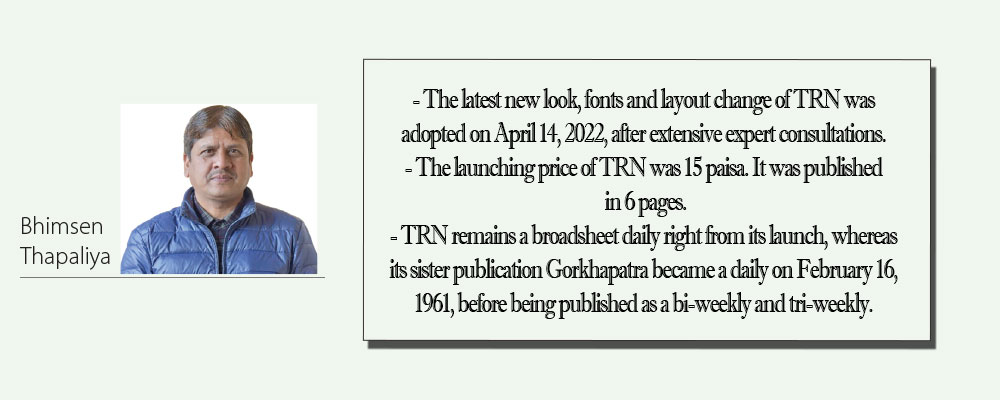
One and a half years of research were also needed to do an archive search and compile the detailed tenure chronology of 15 TRN chief editors from founding chief editor Barun Shumsher Rana up to the 19th Editor-in-Chief Bhimsen Thapaliya who served from 17 August 2020 to 10 August 2025, before he was succeeded by the current Editor-in-Chief, Bishnu Prasad Gautam.
Heightened relevance
This newspaper has heightened relevance at present to foil the confusion and misinformation being spread by some untrained and ethically bankrupt species of new media practitioners. We need to go digital at the same time, embracing the essential ethics of journalism. But this is more easily said than done for TRN, at a time when human resource issues are biting with all their severity more than ever before, as the regular process of hiring competent hands has hit a snag for years.
As someone who has been closely familiar with the core problems affecting the daily output of news and opinions in this paper, this scribe thinks that walking confidently ahead of the pride-filled six-decade milestone demands a revamped plan and managerial mechanism through which journalists are hired, trained, facilitated and made to put out the best in the profession.
TRN has passed the historical survival tests in crisis times when other papers folded up or suspended publications or even laid off journalists. On this day of turning 61, we should see a clear path ahead with confidence and the guiding vision of the founders should ward off confusion and doubts, if any.
(The author is the former Editor-in-Chief of The Rising Nepal.)