- Sunday, 3 May 2026

SANDEE marks 25 years of environmental leadership
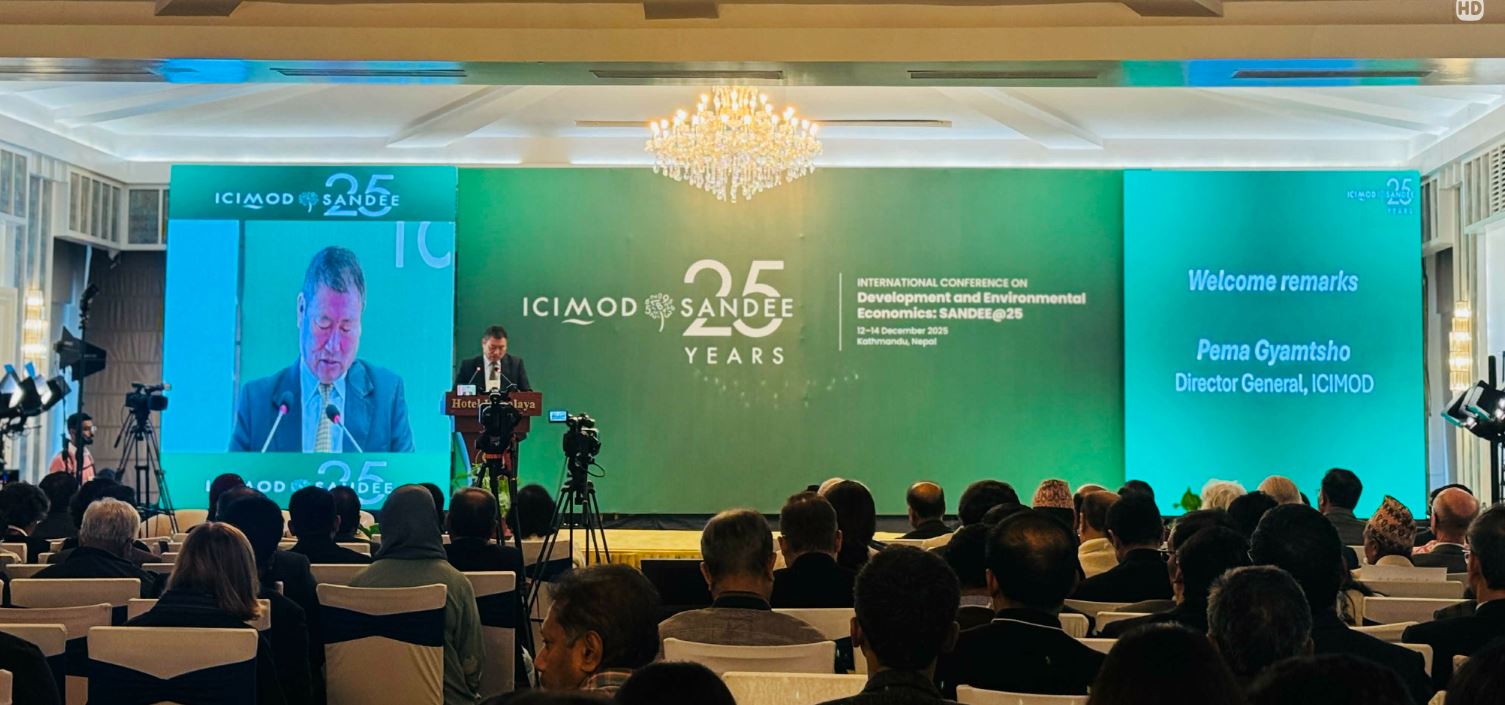

By A Staff Reporter,Kathmandu, Dec. 13: The South Asian Network for Development and Environmental Economics (SANDEE) marked its 25th anniversary this week.
On the occasion, a three-day international conference began on Friday, bringing together global thought leaders on the economic challenges of climate change, biodiversity loss, and sustainable development in one of the planet’s most critical regions -- the Hindu Kush Himalaya (HKH).
For a quarter century, SANDEE, a flagship network of the International Centre for Integrated Mountain Development (ICIMOD), has methodically built a generation of scholars and policymakers across in countries in South Asia and the HKH.
“SANDEE has grown into a vibrant, indispensable community,” said Pema Gyamtsho, Director General of ICIMOD. “Its work has fundamentally advanced how we understand and respond to the nexus of poverty, development, and environmental sustainability in South Asia. This foundation is non-negotiable for our future.”
The conference featured keynote addresses from global luminaries, including Sir Partha Dasgupta, the renowned economist from Cambridge University, UK, known for his ground-breaking review of the economics of biodiversity.
Reflecting on SANDEE’s unique model, Sir Partha said, “It has created friendships and collaborations across national borders that led to research which would be unthinkable elsewhere. That is its lasting achievement.”
The network’s impact is quantified by its people. SANDEE has cultivated over 2,000 alumni, who now serve as university vice-chancellors, deans, government advisors, and lead researchers, directly translating evidence into policy and practice across Afghanistan, Bangladesh, Bhutan, China, India, Maldives, Myanmar, Nepal, Pakistan, and Sri Lanka.
“This represents an investment with extraordinarily high social returns,” said Mani Nepal, SANDEE’s Senior Programme Coordinator at ICIMOD.
“For 25 years, we have equipped researchers with economic tools to analyse environmental problems. Today, that community is the backbone of informed policy in the region.”
The conference focused on the theme, “Development, environment, and mountains,” with discussion spanning biodiversity finance, forest restoration, climate adaptation, and sustainable livelihoods.