- Thursday, 4 June 2026

Tripura Sundari At Risk Of Displacement
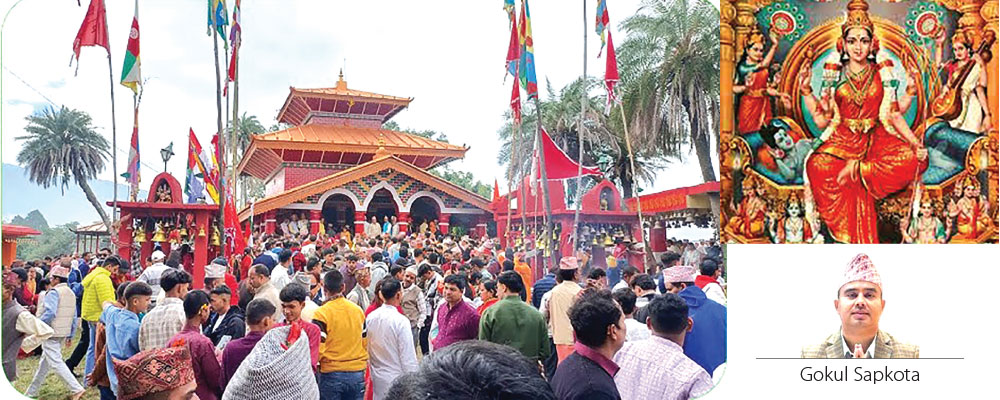

Many tourists travel to Rubi Valley, located in the Dhading district. But a beautiful tourist destination, Tripura Sundari, has remained in the shadows despite its mythical stories and mysterious rituals at Salyankot, surrounding the Budhigandaki River. For centuries, the Hindu mythical goddess Tripura Sundari has been worshipped and regarded as a bride. Locals, especially selected priests from the Ranamagar, Sapkota, and Timalsena castes, have continued the special rituals and belief system of Tripura Sundari for generations.
Every year, from mid-November to mid-December (the month of Mangshir), the festival is celebrated on a grand scale with thousands of devotees. However, no one is allowed to see the statue of Tripura Sundari, which is kept protected inside a box. Neither can a devotee see, nor do they touch this. Even Priests are not allowed to touch the statue of the goddess. While entering the temple, selected priests from the Rana Magar, Sapkota, and Timalsena cast need to promise that they won’t reveal the structure of the goddess.
Protected inside a box
And this ritual is considered unique, as the devotees worship the goddess from a bit away from the statue inside a box. Local devotees believe that Tripura Sundari resides in three different temples at different times throughout the year. The goddess is believed to travel to her maternal uncle’s house (Mamaghar) in Salyankot during the Dashain festival to celebrate Fulpati.
She then travels to her maternal house in Salyanbeshi to eat Nwagi (the first rice of the season) from mid-November to mid-December (the month of Mangshir). Only after the goddess eats the Nwagi do locals begin to eat the new rice of the season. Local farmers consider this ritual an offering of the new rice to the goddess each year.
Similarly, the goddess returns to her own house in Salyankot before the festival of Chaite Dashain. These three schedules are set by local priests according to their ritual beliefs and the lunar position, which may change the dates every year. Only selected priests from the Ranamagar, Sapkota, and Timalsena castes are responsible for carrying the goddess inside a box from temple to temple.
It is also believed that during the unification of the nation, Prithvi Narayan Shah visited Salyankot to receive blessings from the goddess Tripura Sundari. Since then, former kings used to visit Salyankot by helicopter during the Dashain festival to worship the goddess. This festival appears to be a cultural tradition that connects agriculture with the belief system of local farmers.
Tripura Sundari is popular not only in the Dhading district but also in Gorkha, Nuwakot, Rasuwa, Tanahun, Chitwan, Kathmandu, and surrounding areas. More than 10,000 people travel to Salyankot to worship the goddess Tripura Sundari. Despite its popularity, many residents are unaware of how the name Tripura Sundari originated or when it first began to be celebrated as a festival. There are also several Tripura Sundari temples in districts located in the far-western region of the country, which resemble the Tripura Sundari temple in Dhading. Even in Kathmandu, there is a temple dedicated to Tripura Bhagawati.
But many historians and priests claim that Tripura Bhagawati in Kathmandu and Tripura Sundari in Dhading are, in fact, completely different aesthetics and rituals except for the similar name. We can simply consider that the rituals and worship practices evolved based on their own belief, environments, and languages, resulting in the Dhading Tripura Sundari temple and its ritual being unique and mysterious among all goddesses.
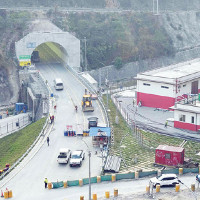
While talking about the Tripura Bhagawati temple, located in Tripureshwor, Kathmandu, was originally a monument built by a former Malla King in memory of a queen during the Malla period. In recent years, the Tripura Sundari festival has faced the risk of disappearing due to the Budhigandaki Hydropower Project, which is being constructed by the government.
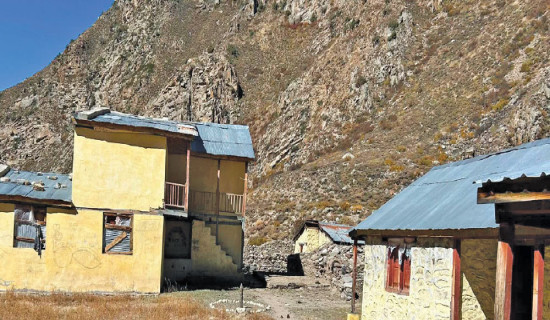
Once the project is completed, residents of the area will be displaced, and the Tripura Sundari Temple in Salyanbeshi, on the bank of the Akhu Khola, is certain to be submerged.
Religious significance
Nevertheless, local, provincial, and federal governments have not made adequate efforts to save this historical and mythical temple. As a tourism entrepreneur and a resident of Dhading, I am concerned that we must identify alternative locations where Tripura Sundari can be shifted in the future. The important point is that simply relocating Tripura Sundari is not the solution. The new location must also hold historical and religious significance and be able to accommodate at least 10,000 devotees.
For this reason, the Nepal Tourism Board can also support identifying a suitable location for Tripura Sundari to promote religious tourism, except for promoting only Trekking in Nepal. It is most important that the local government, some experts from government bodies, including residents, need to conduct a serious public dialogue aiming to find a new location for the goddess. Though the local government has allocated a budget for the Tripura Sundari, a small portion of the budget is not enough for the overall development of the area and tourism promotion as well.
(Sapkota is a tourism entrepreneur)
-original-thumb.jpg)