- Saturday, 25 April 2026

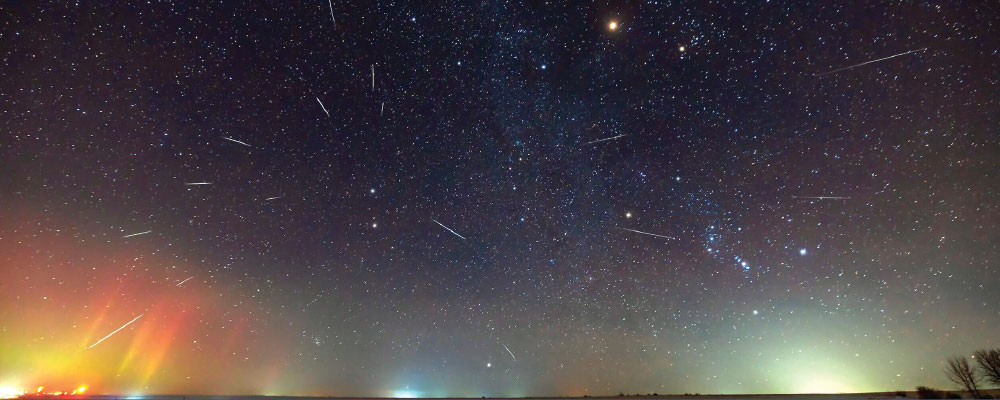
Geminid Meteor Showers Thrill Stargazers
 Dr. Rishi Shah
Dr. Rishi Shah
Dr. Rishi Shah
The night skies of this chilly winter month offer an excellent opportunity to observe and mull over the planets, stars, constellations and many other extraordinary entities spread all over the heavens. The elusive planet Mercury can be marked in the southern sky at dawn, briefly before sunrise. It is mingling merrily with stars belonging to the constellation Libra (scales) and Scorpius (scorpion). The romantic planet Venus and the ruddy planet Mars escape our applause this month. They are wandering wonderfully across the commanding constellations Scorpius (scorpion), Ophiuchus (serpent bearer) and Sagittarius (archer). They are sliding across the sky during the day. Planet Mercury reaches its greatest western elongation from the Sun on 07 December. It would provide the optimum time to view Mercury since it will be very elevated in the eastern morning sky.
NASA's Perseverance rover, still toiling on Mars, has unprecedentedly captured and confirmed electrical discharges (mini lightning) for the first time. They were recorded during weirdly whirling wild dust-devil events over two Martian years of study. One Martian solar year and day (sol) is equal to roughly 1.88 Earth years (687 Earth days) and 24.6 hours. The gigantic planet Jupiter can be admired awesomely in the eastern sky after nightfall in the constellation Gemini (twins). It would be aloft in the southern sky by midnight and jolt towards the western horizon and be evanescent by sunup. Confounding stars Castor (Kasturi) and Pollux (Punerbasu) are glimmering above Jupiter and its mysterious moons. The ringed planet Saturn can be savored in south south-southeastern sky after dusk fades to darkness. It is shining among the stars of the constellation Aquarius (the water bearer). It climbs in the southern sky before midnight.
It is out of view in south south-southwestern sky by midnight. Planet Uranus is discernible in the eastern sky from evening twilight after sunset. It ascends in the southern sky till late in the night. It would then descend towards the western horizon and be unseen. It is trudging tenderly through the constellation Taurus (bull). Red giant star Aldebaran (Rohini) can be seen plainly in Taurus. It is simply 67 light-years away. The far-flung planet Neptune can be spotted serenely in the eastern sky after sundown. It soars in the southern sky before midnight. Witnessing it by midnight is very challenging towards the south of the charming circlet asterism of the constellation Pisces (fishes). Due to their positions far from us, Uranus and Neptune look like a gorgeously gleaming dot of light sailing softly across the sky. Grayish Uranus is currently 18.51 AU (2.769 billion kilometers) from Earth. It is visible from dusk towards the west-northwest direction.
Shrouded in bluish clouds, Neptune is nonchalantly 4.97 billion kilometers (29.39 AU) from Earth. Light requires 04 hours and 04 minutes traveling from Neptune to us. One Astronomical Unit, alias AU, is approximately 150 million kilometers. It is defined as the mean distance between Earth and the Sun. On 04 December, the full moon (popular yomari purne) would mesmerize moon-lovers worldwide. It has been recognized as the cold moon because during this time of year, the frigid winter air settles in and the nights become lonesome and dismally dark. It represents the last of three so-called super-moons for 2025. The moon will be relatively near Earth and supposedly bigger and brighter than usual. The new moon would betide on 20 December. It rests in the constellation Sagittarius (archer) and is merely 403.91 thousand kilometers from us.
The full moon would basically be 359.03 thousand kilometers away from earth and nestle in the constellation Taurus. The moon allegedly appears larger than it really is when it is alongside to the horizon. This peculiar phenomenon is realized as an optical illusion. Any photograph reveals that the moon is the same size regardless of is on the horizon or overhead. As our moon marches along the elliptical path around Earth each month, its span varies by a subtle 14 percent between 356.5 thousand kilometers at perigee (most adjoining avenue to earth) and 406.7 thousand kilometers at apogee (farthest point from Earth). The average moon-earth gap is accepted as circa 385 thousand kilometers. Moon's orbital motion carries it around Earth once every four weeks. Consequently, its phase cycle from new moon, through first quarter, full moon and last quarter, back to new moon happens once every 29.5 days.
Our moon is dramatically drifting away from Earth by an astonishing 3.8 centimeters per year, roughly the rate at which fingernails grow. Its diameter measures meagerly 3474 kilometers (nominally one quarter that of Earth). One should never attempt to aim binoculars or telescopes at any object close to the Sun. Doing so may result in immediate and permanent blindness. The December solstice falls on 21 December. The South Pole of Earth will be tilted toward the Sun, which will have arrived at its southernmost position in the sky and will be directly over the Tropic of Capricorn at 23.44 degrees south latitude. This is the first day of winter (winter solstice) in the Northern Hemisphere, experiencing the shortest night and the first day of summer (summer solstice) with the longest day in the Southern Hemisphere. Christmas and Tumu Losar are cheerfully celebrated on 25 and 30 December. 31 December will sadly bid farewell to the year 2025.
The prolific Geminid meteor shower, which is hailed as the king of the meteor showers, producing up to 120 multicolored meteors per hour at its climax, is caused by debris left behind by the amazing asteroid 3200 Phaethon, which was detected in 1982. The shower runs annually from 07 to 17 December. Geminids peak this year from the night of the 13th to the morning of the 14th of December. The effulgence of the second quarter moon will wash away some fainter meteors, but the Geminids are so overwhelmingly numerous that they would still bestow a generous good show of scintillating shooting stars. Best sightings will be from locations away from disturbing city lights after midnight. Meteors emanate from the radiant dwelling comfortably in the congenial constellation of Gemini.
The Geminids’ radiant nearly coincides with the lambent star Castor in Gemini. Considered as chance alignment, Castor lies sheer 52 light-years away, while these meteors burn up in the upper atmosphere some 100 kilometers above Earth’s surface. Castor noticeably embraces its twin blazing golden star, Pollux. Castor seems singular to the naked eye, but it is actually a sextuple star system organized into three binary pairs. Pollux is an orange-hued red giant star solely 34 light-years away. Arcane asteroid 3200 Phaethon is responsible for the Geminids. Around wee hours of the night, around 02 AM local time, the radiant lies highest in the sky and the Geminids' activity will be strongest.
Elliptical trajectory
As the radiant begins to set, Geminids will decrease until the simmering dawn obscures all of them. This meteor shower is uniquely multicolored because it originates not from a conventional comet but from dregs left by asteroid 3200 Phaethon. This huge asteroid is purely 06 kilometers in diameter. It was disclosed in 1983 by the Infrared Astronomical Satellite (IRAS). Phaethon's 1.4-year track around the Sun, which is an elongated comet-resembling elliptical trajectory, has led experts to speculate that it could be designated as a dead comet. It lacks the comet-tail signature but exhibits spectra mirroring that of a rocky asteroid. The meteoroids from Phaethon are denser (2–3 grams per cubic centimeter) than typical comet’s dust flakes (0.3 gm/cm3). Phaethon is named after the Greek mythological figure who drove the Sun-god (his father) Helios' chariot.
The meteors whizz at speeds of whooping 35 kilometers per second. They disintegrate above Earth at barely 39 kilometers. The Infrared Astronomical Satellite (IRAS) was the first space telescope to survey the entire night sky at infrared wavelengths. Launched in January 1983, its mission lasted for ten months. The telescope was jointly operated by the United States (NASA), the Netherlands (NIVR), and the United Kingdom (SERC). Over 250 thousand infrared sources were peered at in 12, 25, 60 and 100 micrometer wavelengths. The Japanese spacecraft DESTINY+ (Demonstration and Experiment of Space Technology for Interplanetary Voyage with Phaethon Flyby and Dust Science) is expected to be deployed in 2028 for intensely investigate asteroid Phaethon, hopefully in 2030.
(Dr. Shah is an academician at NAST and patron of NASO.)
-original-thumb.jpg)