- Sunday, 3 May 2026

Govt prioritises soil management: Minister Pariyar
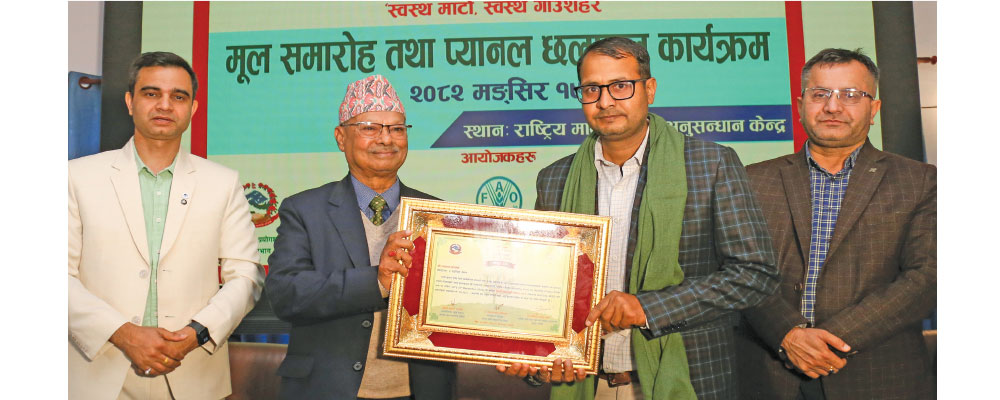
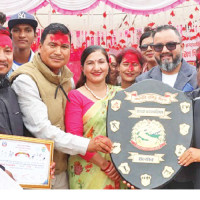
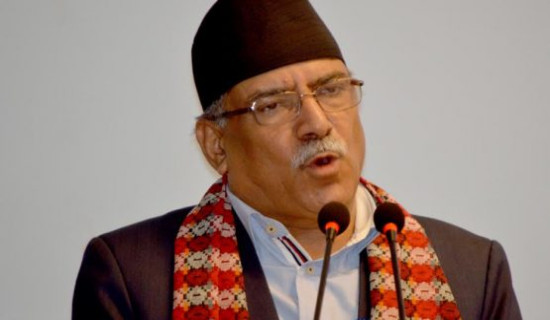
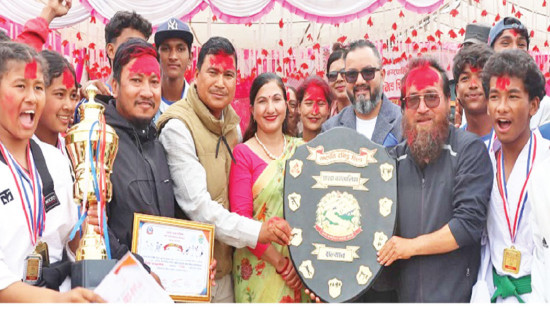
Minister for Agriculture and Livestock Development Dr. Madan Prasad Pariyar presenting award to TRN's Laxman Kafle on the occasion of the 12th World Soil Day in Lalitpur on Friday. Photo: Kabin Adhikari/TRN

By A Staff Reporter,Lalitpur, Dec. 6: With the theme 'Healthy Soils for Healthy Cities', the 12th World Soil Day was celebrated across Nepal on Friday through various programmes.
Central-level programmes were jointly organised by the Department of Agriculture, National Soil Science Research Centre, NARC, Food and Agriculture Organisation (FAO), Nepalese Society of Soil Science, and IDE Nepal at the National Soil Science Research Centre, Khumaltar in Lalitpur.
The events saw the participation of farmers, researchers, agricultural scientists, journalists, and government officials, in the presence of Minister for Agriculture and Livestock Development, Dr. Madan Prasad Pariyar.
World Soil Day is observed annually on December 5 to raise awareness and mobilise global efforts for the sustainable management of soil fertility.
The Day was first officially recognised in 2013 after the 68th United Nations General Assembly endorsed a proposal from the Food and Agriculture Organisation (FAO).
In Nepal, the Day was first celebrated in 2014 with the launch of mobile on-site soil testing services in Panchkhal, Kavrepalanchowk.
Addressing the programme, Minister Dr. Pariyar said that the government has prioritised soil management, considering its importance for sustainable agriculture and environmental balance.
He noted that the Central Agricultural Laboratory provides soil and fertiliser testing services to farmers.
“Soil is not only the foundation of agricultural production but also a crucial component in maintaining the Earth’s ecological systems,” Minister Pariyar said.
He further added, “Work is underway to update the digital soil map by conducting soil tests across the country in coordination with the Department of Agriculture, Central Agricultural Laboratory, National Soil Science Research Centre, and provincial government laboratories.”
The Minister warned that excessive use of chemical fertilisers and pesticides, unplanned urbanisation, infrastructure construction, and industrialisation have degraded the physical, chemical, and biological properties of soil.
“These challenges are reducing the soil’s water absorption capacity and increasing pollution, which ultimately affects production, productivity, and environmental balance in both rural and urban areas,” he said.
He emphasised that healthy soil in villages and cities is equally important—rural soil sustains food production, while urban soil supports greenery, reduces temperatures, and stores carbon.
Minister Pariyar stressed that improving soil quality is as vital as using it for agricultural production.
He noted that this year’s slogan underscores the need to protect urban soil as well.
“To make ‘Healthy Soils for Healthy Cities’ meaningful, it is essential to adopt sustainable farming practices in rural areas and healthier lifestyles in cities,” he added.
Minister Pariyar said that all three tiers of government are coordinating programmes such as mobile soil health camps, awareness campaigns focused on the proper use of pesticides, and initiatives to promote commercialisation of agriculture without compromising soil management and sustainable practices.
On the occasion, farmers, journalists, and experts were honoured by the government for their contributions to raising awareness about soil health from their respective fields.
The government honoured journalist Laxman Kafle of The Rising Nepal daily, recognising his contribution to disseminating awareness about the importance of soil health to the general public through news and articles.
The government honoured farmers Tika Ram Rai of Morang and Badi Maya Tamang of Okhaldhunga as this year’s Soil Champions.
Similarly, the government recognised Sadananda Jaisi from agricultural extension, Prof. Tej Bahadur KC from teaching, and Dibya Laxmi Bajracharya from research for their contributions in their respective sectors.
Minister Dr. Pariyar presented a letter of appreciation to the awardees.
Secretary at the Ministry of Agriculture and Livestock Development, Dr. Govinda Prasad Sharma, urged the public to adopt simple, everyday practices that improve soil health and support environmental sustainability.
He emphasised that collective small actions can bring significant positive changes in maintaining soil quality across the country.
Dr. Sharma highlighted the need to protect open spaces for tree plantation, encourage greenery in community areas, and ensure that rainwater percolation systems are incorporated into buildings to maintain natural water cycles.
Dr. Krishna Prasad Timsina, Executive Director of NARC, said the Day also serves as a call to action for policymakers, scientists, city leaders, and citizens to work together to ensure people and nature can thrive together in urban environments.
Director General of the Department of Agriculture, Prakash Kumar Sanjel, emphasised the need for collaborative efforts with farmers, the government, and other stakeholders to protect soil health.
"World Soil Day is an occasion to reflect, take action, and celebrate soil for all those involved in soil science soil cultivation, and soil lovers. The day emphasises how vital soil is to life on Earth," said Dr. Shree Prasad Vista, chief of National Soil Science Research Centre.