- Sunday, 3 May 2026

Human Factor Key To Poll Security


The Nepal government is busy carrying out intensive preparation for the elections to the House of Representatives scheduled for 5 March 2026, which was shortly announced after the formation of the new government on 12 September 2025. However, the regular elections for the Federal Parliament were slated for 2027, but the unprecedented Generation Z protests impelled the leadership to call for early polls. As the election date approaches, uncertainty about whether it will be held on time is looming over the voters' minds.
The primary reason behind this concern is that all the established political parties have not yet expressed their full commitment to the election process. Due to their internal contradictions, and escalating scuffles with emerging ones, serious questions about election security have been raised. Thousands of absconded prisoners from jails are freely moving in society and hundreds of weapons looted from security personnel during the demonstrations have yet to be recovered, which collectively pose serious threats to internal security. In this context, the government has shown its full commitment to conducting free and fair elections by establishing a reliable and credible security environment.
Final measure
Although the election is counted as the final measure to protect the multi-party democracy from being derailed, the human element remains the most indispensable determinant. Many people look a bit worried regarding security in the upcoming elections. While discussing election security, it is often approached from two dimensions: technology applications and human behaviours. Ballot machines, encryption, cybersecurity, online polling and digital safeguards fall under technological applications. Nepal has yet to bring into practice such sophisticated technology-based mechanisms in its electoral process. If the government provides the opportunity to non-resident Nepalis to cast their votes using advanced technologies, the risk of technological tampering may arise.
Human factors include voters, polling staff, election officials, observers, security personnel, political parties, and, more importantly, ordinary citizens. They constitute the most critical and highly vulnerable parts in ensuring free and fair elections. Each of these groups differs in role, behaviour, culture, and practices. Unless they demonstrate a strong commitment to protecting electoral integrity, the entire security of the election process remains tenuous. Wherever the human factor is involved, vulnerabilities exist. This happens because of the nature of human behaviour varying from person to person. It becomes daunting task to bring people together to work toward a common goal. The vulnerabilities that arise at the ground level must be identified in advance and should be mitigated in a timely manner.
Political parties' pressure or intimidation can influence the election and its overall management. At many polling booths, pressure groups of local individuals exist, who operate with the mindset that the area belongs to them and government officials should not interfere to their activities. This kind of attitude breaks the norms and integrity of impartial elections. In these critical situations, polling staff must remain vigilant and enforce election laws in an effective manner. If election regulations are not enforced uniformly, disturbances can arise abruptly. Simple errors, such as misreading forms, mishandling equipment, incorrectly sealing ballot boxes create allegations of irregularity. At such a critical juncture, even a single compromised act of an official can disrupt the electoral process and undermine its legitimacy.
One of the threats emerges from those persons possessing illegal arms, may block the voters' access to polling stations. If they sense that votes cast are not in favor of theirs, they may open fire and intimidate both the voters and officials. Human beings have a character to be influenced by false narratives, rumours or propaganda. Many of them lack the patience to analyse the reality behind such information. In the era of social media, these issues are visible everywhere and at all times. Both misinformation and disinformation can distort the positive electoral environment, turning into hostility. Such manipulation often provokes scuffles among party workers, discouraging the integrity of a fair election.
Nepal carries a unique election mechanism that heavily relies on manual processes due to its difficult topography, scattered population, and limited use of a technology-based voting system. Human factors play a key role in ensuring that elections are conducted in a peaceful manner with full integrity. Local volunteers and temporary staff, who are entrusted with assisting in voter identification in cases of doubt, can at times be an instrument in creating problems inside the polling area. Nepal's experience with the election security approach shows that human veracity and honesty have served as the backbone of its election security structure.
Although technology-driven elections are increasingly prevalent in the age of artificial intelligence, human factors continue to hold the highest significance in establishing a profound culture of elections. It is also a universally accepted reality that no technology can replace human responsibility. Even in Estonia, renowned for its fully digitalised elections, humans still control critical functions. Japan's election process is largely dependent on cultural norms that emphasises responsibility, discipline, and procedural adherence.
Nepal needs to establish an election culture that refers to the collective attitudes, positive human behaviour, values and practices of society and the democratic system. It addresses not only the casting of votes but also encompasses the respect and honesty in the elections by the political parties, institutions and largely the citizens. Political actors should have deep trust in institutions, the rule of law and ethics. Election culture should be established based on the values and norms rooted in Nepali society, namely discipline, social harmony, and unity among diversities.
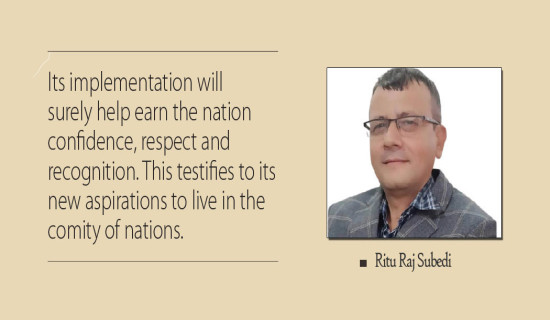
(The author is former secretary of Nepal government.)