- Sunday, 3 May 2026

Students' Woes
 Nandita Ghimire
Nandita Ghimire
Nandita Ghimire
It’s early morning, cold, but there’s no time to feel it. In my hostel room, I get ready as quietly as possible, skip breakfast because there isn’t any, and hurry to college on an empty stomach. By the time I reach my classroom, I’m already exhausted, yet the day has only begun. Classes run back-to-back. Notes pile up. The canteen food is usually not healthy but I have no choice as I can simply not afford to faint in the middle of the way. And the second the classes are over, I am racing off again, this time to work, juggling assignments, practicals, and extracurriculars all crucial for internal marks. Colleges expect us to show our “fullest potential”, be seen, but pushing ourselves to meet those expectations often means risking the one thing keeping us afloat; our jobs.
Once I reach the office after hours of rushing, any delay by a few minutes even seems to be a disaster. A full day of work begins. And like many working students in Nepal, I juggle what is essentially a full-time job, even though full-time student employment is barely recognised or protected here. The irony is that these jobs often pay less than what a part-time position should. Yet we continue, because reality leaves us no alternative. The choice is brutally simple: If you don’t work during college, you graduate with no experience. If you do work, your academics suffer.
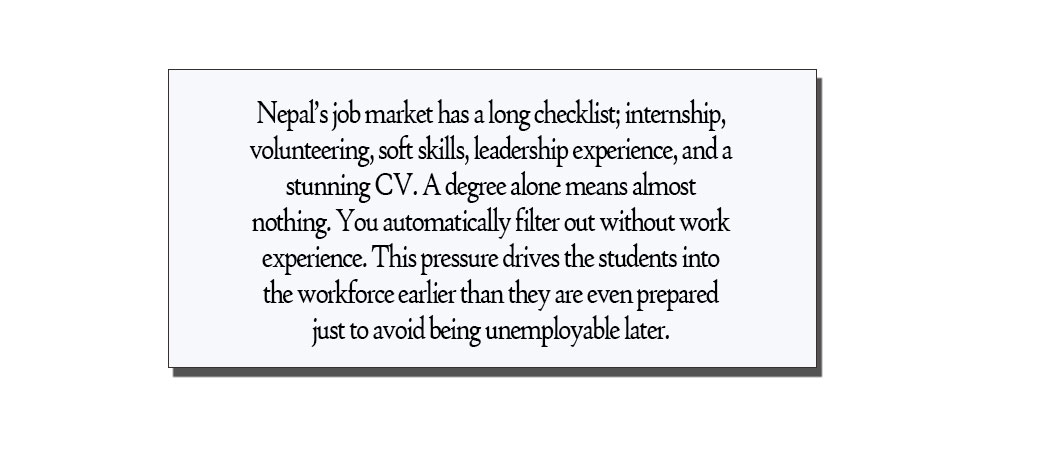
Nepal’s job market has a long checklist; internship, volunteering, soft skills, leadership experience, and a stunning CV. A degree alone means almost nothing. You automatically filter out without work experience. This pressure drives the students into the workforce earlier than they are even prepared just to avoid being unemployable later. But the cost is heavy. Attendance drops. Internal marks dip. You miss out on college life clubs, friendships, rest, even the freedom to learn at your own pace. Day’s blend into a cycle of rushing, surviving, and trying not to fall behind. Nights are for assignments you barely have the energy to finish. It feels like living two full lives at once neither of which you’re able to give your best to.
But in this chaos, a question quietly lingers: Where is our personal life? Between rushing from classes to offices, between assignments and deadlines, where do we get time to take a breath? To rest? To simply be young? At least you have weekends, people say to us, but weekends are full of laundry, cleaning, groceries, family work, outstanding assignments, tasks that we could not get done during the week. Even at that time the regret of not studying, not working, not making ourselves better never does go away.
Where can we take a pause? When do we have time to do something, do we really enjoy it without feeling like we are falling behind? Days blend into a routine of surviving instead of living. We lose friendships, hobbies, and parts of ourselves we didn’t even know were fading. So, where are the part-time jobs in Nepal that are flexible, fair, and conducive to students' education, as opposed to being competitive? Working students do not want sympathy; they just want to be given some credit and have a system that is in touch with their realities and balances work, pay, and academics accordingly. Until that day comes, thousands of students will continue racing between two worlds, trying not to collapse, and wondering where their youth went, lost somewhere in the spaces between class, work, and survival.