- Thursday, 4 June 2026

Jogi community returns to tradition amid growing respect
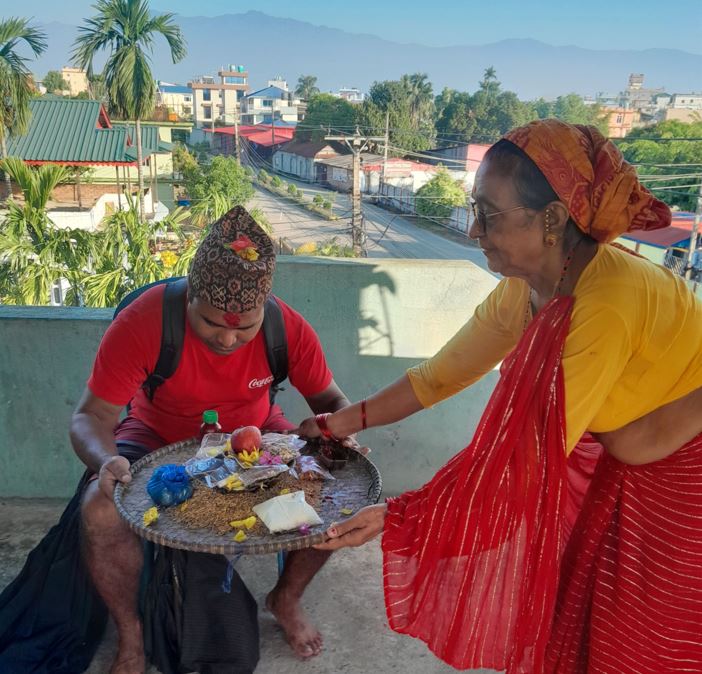
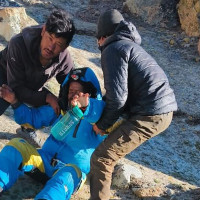
Photo: TRN A householder offering alms to a Jogi performing feri.

BY HARI PRASAD KOIRALA.Urlabari, Nov. 14: The younger generation of the minority Jogi community has begun returning to their ancestral occupation of ‘Feri’, a traditional ritual performed by roaming through villages, blowing an animal horn at each house in the night, after a long gap.
Locals said that as householders once again started offering ‘sida’ (donations in kind or cash) with open hearts, young Jogis are being drawn back to their cultural roots.
During Nepal’s Maoist insurgency, many Jogis were unable to continue their practice due to the security situation and travel restrictions at night. To preserve their ancestral tradition, they used to migrate temporarily to Nepali-speaking regions of India, such as Sikkim, Darjeeling, and Kalimpong, where they performed the ritual for a month before returning home.
Around 60 Jogi families who migrated from Siddhapokhari of Sankhuwasabha to Kanepokhari-7 in Morang used to travel to India for ‘Feri.’
Durgalal Jogi said, “Our ancestral profession is Feri. During the conflict, we could not move around at night. The younger generation of that period grew up without knowing what Feri was, so they never adopted it.”
Traditionally, the Jogi community performs rituals to worship the land before and after cultivation, particularly during November and April. On the morning after Chandi Purnima each year, they offer prayers at a crossroads near their homes for protection from diseases and misfortune. In the past, Jogis would travel long distances during these months, blowing the ‘Feri’ (a horn of an ox) at every household at night. They would stand at the main door, blow the horn four times in specific tones, and refrain from speaking while performing the ritual.
After the conflict, however, societal attitudes changed. Many began to view Jogis as beggars rather than spiritual figures, leading the youth to abandon ‘Feri’ and seek foreign employment or other professions.
Now, times are changing once again. With government initiatives to preserve the traditions and customs of all ethnic and religious groups, the younger generation has started reviving the ‘Feri’ practice.
Tek Bahadur Jogi, 33, of Kanepokhari-7, said, “We believe that blowing the Feri twice a year prevents evil spirits from entering the home, keeps family members healthy, drives away misfortunes, and brings peace and harmony.”
He added that society is returning to its old rhythm--people now invite the Jogis with respect and offer donations when they come for ‘Feri.’
Tek Bahadur said that the customs had changed from his forefathers’ time. “In the past, people offered rice, pulses, salt, turmeric, oil, and vegetables as donations. Now, the younger generation mostly gives cash or clothes instead,” he said.
Similarly, Mohan Bahadur Jogi, 50, who recently returned home after working abroad for 11 years, said that society’s perception of the Jogis had improved. “Earlier, we were seen as beggars, but now people invite us respectfully and give offerings. In the old days, the alms collected during Kattik and Chait would sustain us for the whole year,” he said.
Mohan, originally from Fedap in Tehrathum and now living in the Tarai, continues to perform ‘Feri’ in places like Letang, Pathari, and Madhumalla.
Every male member of the Jogi community is traditionally expected to perform the ‘Feri’ ritual at least once in his lifetime, regardless of his education or job status.
However, a new challenge has emerged. Recently, some confusion has arisen in communities where different Jogis visit the same houses. Bhola Raj Pokharel of Urlabari-5 said, “They come around midnight to perform the ritual, but it’s hard to recognise who came. In the morning, we give offerings to the Jogi who arrives first, and later another Jogi claims to be the one who performed the Feri at night.”
Locals said such incidents have started occurring not only in Urlabari but also in other areas.

-square-thumb.jpg)