- Thursday, 21 May 2026

Smog To Cycle Solutions

In the frenetic hours when everyone of us is scrambling to head to our offices on time, we hardly prioritise our safety, let alone think of others. Even the smallest stretch of vacant road becomes a battlefield, especially for two-wheelers. In such a chaotic situation, the bicycle is rarely seen as a viable form of transport. For a city like Kathmandu, where everyone is in a rush on the road, cycling is considered one of the most inconvenient, unsafe, and unreliable modes of transportation. And we are not to be blamed.
Cycling was once a staple in the Valley’s transportation fabric. The old photos displaying landscapes of Kathmandu Valley often feature people on bicycles.
However, with the growing density of the population forced to survive in Kathmandu, the roads became congested, requiring people to opt for modes of transportation that needed less effort to tackle the hassle of commuting.
At such a point, pedalling the cycle started to become obscure. With the growing number of vehicles, the road’s inefficiency in accommodating them has narrowed the footpath. Then, pedestrians lost their sidewalks, and bicycles were relegated to nostalgia or to seminars where environmental issues like global warming and climate change are discussed, advocated, and abandoned.
Even today, many people prefer cycling to other means of transportation. Those who like cycling fall into two polarised categories: the underprivileged, with no option to upgrade to motorised mobility, or the affluent, able to afford fancy bikes – sometimes even more expensive than other modes of transportation. So, cyclists are often mockingly labelled as “poor” for the underprivileged and “activists” for the affluent.

Cycling for the general public is neither affordable nor preferable.
The barriers extend beyond cost. The safety of the cyclist also acts as a significant deciding factor. Kathmandu’s roads are perilous—dedicated lanes are rare, poorly designed, and often ignored by other road users. Without a dedicated and functional infrastructure, cycling is yet to be a marginal concern.
However, cycling culture needs to be promoted and given priority, as this is the most cost-effective, environmentally friendly, and health-promoting mode of transportation. If Nepal wants to build a prosperous nation, it needs to incorporate cycling culture into its development plans. A country cannot thrive in a polluted environment with unhealthy people. And to talk of Kathmandu, it has frequently topped global air pollution rankings. A new ICIMOD analysis has shown that the inhabitants of Kathmandu suffered 75 days of unhealthy air in the last three months as of April 2025. The air pollution has surpassed the WHO’s safe limit of 15 µg/m³, with high levels of PM2.5 at 384 µg/m³ in 2025.
WHO claims that the toxic air is killing more than 40,000 Nepalese every year, with the life expectancy reduced by 3.5 years for Kathmandu dwellers, as per the Air Quality Life Index. The choking air of Kathmandu is no longer just a public health crisis but a million-dollar smog, draining the national economy through rising healthcare costs, lost productivity, and reduced quality of life.
In the face of such a worrying environmental situation, we as a nation have remained timid, fragmented, and far from the urgency the crisis demands.
Cycling, one of the simplest, most cost-effective, and environmentally sustainable modes of transportation, has consistently been sidelined in Nepal’s urban planning. The government has failed to build infrastructure conducive to peddlers, and we have not approached cyclists, demoralising many.
Japan offers a compelling counter-model, with its government and civilians promoting cycling culture to such an extent that cycling has become an easy and integral part of daily life. It is grounded in habit, infrastructure, and culture. The roads are cycle-friendly, with side paths designated for cycles and pedestrians. Like other vehicles, cyclists are also obliged to traffic rules and are fined for violations, recognising them as daily commuters. Cycling is such an integral part of daily transportation in Japan that non-compliance to incorporate it as a mode of daily transit leaves a person with expensive and time-bound travelling, compelling them to accept cycling culture. Cyclists are given priority on the road by other commuters. Unlike in Nepal, where other commuters often overlook the safety of cyclists, vehicles in Japan yield to cyclists and look for their safety as a significant matter when driving (something I felt odd at times when cars and buses stopped for me on a cycle to go first).
This could be why I found most Japanese people to be fit and healthy. No doubt, numerous other factors have led to healthier Japanese, but cycling has definitely contributed as one of the significant factors. These norms have contributed to their fitness, punctuality, and mutual respect.
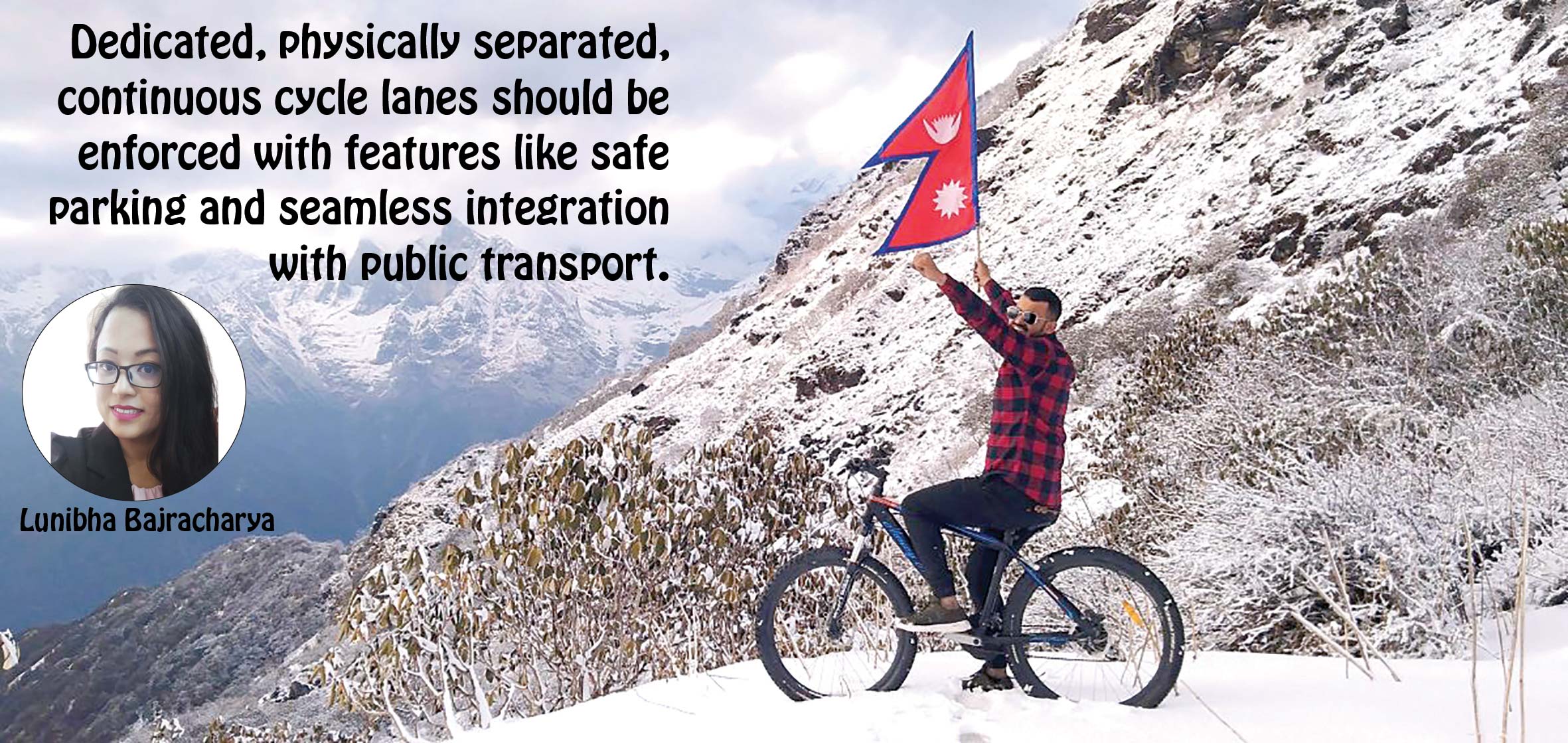
Learning from the Japanese modality of development and culture, we can also develop such a Kathmandu where people are happily compelled to ride cycles, making it a standard mode of transportation. Dedicated, physically separated, continuous cycle lanes should be enforced with features like safe parking and seamless integration with public transport. Policy interventions like subsidies for bicycle purchases should be looked forward to, and education should incorporate cycling as a safe and normalised mode of transportation. Events like the Kora Cycling Challenge should be promoted.
Kathmandu is now at such a juncture that, to move ahead from its sedentary lifestyles, smog, and congested streets, urgent action from policymakers, planners, and citizens is a must. If we could adopt cycling as a daily, accessible, respected choice for all Kathmandu residents, rather than just a poor man’s compulsion or a rich man’s hobby, a healthier, more disciplined, and prosperous Kathmandu would not be a far-fetched dream.
(The writer is a government officer pursuing her master’s degree at Hiroshima University of Japan as a JDS Scholar.)
-square-thumb.jpg)


-original-thumb.jpg)