- Monday, 4 May 2026

UK's Starmer On The Back Foot

Reality begins to dawn on Britain’s Prime Minister Keir Starmer and his Labour Party, in power since July, that steering the United Kingdom on an even keel is easier in speech-making than in walking the talk with speed and efficiency.
The plan to quietly align Britain with the European Union failed the other week, creating a serious crisis for the prime minister’s career at the top job. Britons were already dismayed over the lacklustre manner of governance under Starmer whose popularity ratings are declining. This has come about in less than a year after the July 2024 general election gave a big victory to Labour while handing out the Conservative Party its worst performance in four decades.
Controversies have chased the party and the prime minister in a series of cases. A number of prominent party members quit the Labour Party, expressing dissatisfaction over the government’s handling of state affairs. Press reports found Starmer having accepted expensive gifts for party campaign amidst complaints that he and MPs draw salaries more than an average Briton, even as the prime minister’s approval rating took a steep fall. Critics and political opponents see in Starmer a “Tory in disguise”, and with “no fire”.
In reference to the opposition Reform UK’s leader being mentioned 16 times in a Starmer’s speech, Nigel Farage jibed at him: “I’m living rent-free inside his head.”
Ill-prepared
In a foreign policy statement in parliament, Starmer rejected the “either America or Europe” option, and spoke of resetting ties with the superpower on the other side of the Atlantic. Despite his assertion that the country had bounced “back on the world stage”, US President Donald Trump came down heavily on his foreign policy: “He (Starmer) is soft on crime, soft on border and soft on everything that matters.”
Perceived as a declining power economically and militarily, and ill-prepared to compete with China's economy or fight a war with Russia, some quarters report Britain as a third-rate power. Some reports quote Britons describing their country as a client state of the US, which submitted to Washington’s agenda without questioning. And to think that imperial Britain once ruled over 25 per cent of the world population and 30 per cent of global land territories.
Europe’s economic decline is faster than the US. UK, no longer an EU member, faces a bigger challenge, now that Trump’s first and foremost policy is “America First”. Starmer warned the Trump administration that Britain would not side with the US against the EU. Brexit has inflicted some pain, and he knows which side of the bread is jammed and buttered.
Two-thirds of Britons are nostalgic about the times they were masters of the world. They recall the empire age as something to be proud of. Well, the merits of the stand can attract strong opinions for and against. Corbyn is being compared with Starmer. Labour fears that Starmer might bring the Labour MPs down with him. Some might loathe him but many more are now beginning to regret that Corbyn cannot, and should not, be ignored. There are suggestions that he should be at No. 10 Downing Street in London.
Seen as a man of integrity, Corbyn’s portrait is one of courage, consistency and a champion of workers and the downtrodden. He makes no apologies for it. With him, voters know what to expect. His integrity is a strong point that others in neither the Labour nor the Conservative Party match. Farage is brimming with hope. The party registered an impressive outcome in the May local elections in England, mostly in non-urban areas. It also won a byelection in a seat long considered one of the safest for Labour, the government party.
Brexit is yet to produce Singapore-on-Themes. Stagnant and sinking, the economy might collapse, some say. EU could emulate the US or risk to part policy company with Washington. Long known for its status as the hub of high-value services, London is losing its attraction.
Voters are disappointed with the government less than a year after the 2024 general election for the 650-member House of Commons saw Labour gain a massive majority in parliament. Their hopes of a significantly strong leadership and impressive delivery after the 14 “terrible” years of Conservative rule have not been addressed. The Tories collapsed with collected its lowest collection of seats in more than a century.
Troubles brew
Starmer failed to see how much of Europe and the United States are witnessing political landscapes veering right. The shift and tilt beg for an economic turn for the better. The crucial issue is the shaking and declining economy. Several days before last year’s general election, Starmer had declared during the campaign: “We want our country back.” The long Winter of Discontent in 1978-79 led to the country’s first woman prime minister to step down. Margaret Thatcher skippered her Tory ship to three consecutive victories in general elections. Latest public opinion polls show a majority of voters in Scotland and Northern Ireland keen on referendums on Britain’s break-up.
The largest empire in history enriched itself on five continents. That 43 per cent of Britons still think colonial empire as a source of pride echoes a telling story, whatever the true narrative on colonial rule and its repercussions on the local populations. In hindsight, even Britons who rejected Corbyn as a prime ministerial candidate are engaged in a reappraisal of the situation and regretting that the man who worked to carry out his principles instead of adopting a policy of appeasement for being in power.
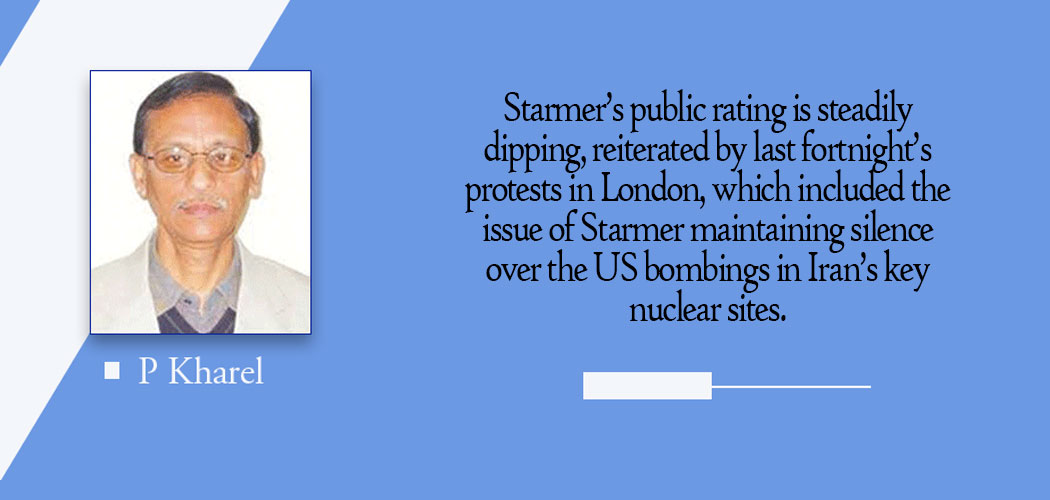
Starmer’s public rating is steadily dipping, reiterated by last fortnight’s protests in London, which included the issue of Starmer maintaining silence over the US bombings in Iran’s key nuclear sites. Labour has a comfortable majority but not a very popular leader. What it will do next should be intensely interesting. Starmer has to act fast and effectively to at least soothe Labour MPs.
(Professor Kharel specialises in political communication.)