- Tuesday, 5 May 2026

Learning Matters, Not Grades
 Sharmila Chandi Shrestha
Sharmila Chandi Shrestha
Sharmila Chandi Shrestha
With the SEE and Plus Two Board exam around the corner, students are leaving no stone unturned to secure the highest grade possible. These level of exams are usually considered iron gates and apparently, securing good grades is mandatory not only vital for students to secure a bright future but necessary for parents to blow their own trumpet and also for their educational institutions to capitalise on their students’ success to gain more publicity thereby securing more students enrolment.
Due to humungous societal pressure to conform, children often find themselves at a critical juncture of being overtly pressurised to secure high grades. Placing too much importance on grades while forcing them to confine themselves to standardised testing neglecting the true joy of the journey often results in reduced intrinsic motivation and increased anxiety in children. They are often found cramming theories during the ninth hour and the one who scores less may not be the least intelligent one but are often relegated to corners not because they are lesser than others but because the education system fails them with its inability to accommodate the diversity required to evaluate these students.
Single yardstick
Not only this, too much emphasis on grades often results in children comparing their grades with each other consequently setting them up for a lifetime of competition and eventually to them a single yardstick of success is being better than others. The pressure to conform, the pressure to be ahead of their friends have devastating consequences for these young minds, with some even taking up their lives, should their grades be below expectations. In Nepal, every year following the publication of SEE results, it's common to hear shocking news of many teenagers committing suicide owing to poor results. This is not only a huge loss to parents but also to the entire nation as the young mind with infinite potential who could have added value to their society perishes from the earth.
This is not just the end of a story of an innocent soul but also sets a bad example for society as it unknowingly legitimises the widespread misconception that the numbers in a report card is an ultimate indicator of one’s value. Since the time immemorial, there has been a dominance of high stakes exam based assessment throughout the student academic lives and the use of grades offers benefits in terms of convenience it offers for certification and to some extent, it may also be an effective yardstick of measurement of students’ performance; however, the practise of confining students intelligence and smartness to mere grades or percentage fails to encompass true meaning of learning which is critical thinking and skills development.
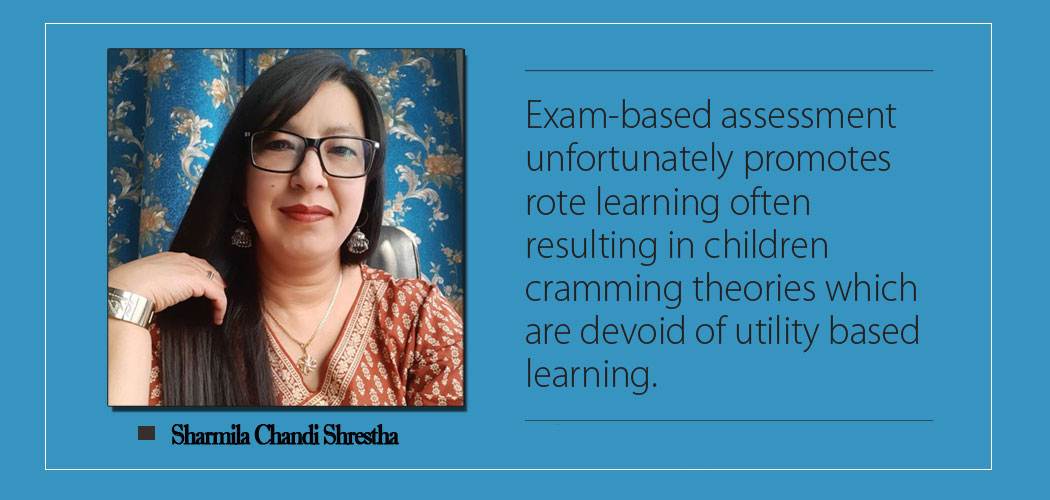
Exam-based assessment unfortunately promotes rote learning often resulting in children cramming theories which are devoid of utility based learning. Not only this, studying only for grades, learning often takes a bad seat and the intellectual part of the brain often remains underutilised and unexplored. While the failure of education systems cannot be ignored, its imperative for parents to comprehend that each child is unique and their journey is different and solely comparing children based on grades they secure is meting out huge injustice to these fragile minds. Different studies in psychology confirm that intelligence is not simply a one-size-fits all concept. Each child is unique with some thriving in logic, some in art, some in sport and some in empathy.
Not every child will end up becoming or would want to be doctors or engineers or scientists. They could have passion for different fields like sports, arts, acting, singing, photography and many more. The world is big enough to accommodate every profession and indeed the world is not simply run by doctors or engineers, it equally needs artists, politicians, sportspeople or many others. Parents and educators on their part instead of simply focusing on children’s grades and using it to erode a child's self-confidence and dignity should leverage on their child strengths so that their potential aligns with their true value, aspirations and passion.
Creativity
If grades were the only yardstick of students' success, perhaps Elon Musk would not be the richest man on the planet or Steve Jobs would not be the most revered entrepreneur and inventor in the world. The greatest scientist of all time, Albert Einstein became one of the greatest minds in history who once struggled in traditional schooling. Likewise, a leaf can be taken from a recent story of a 27 year old Nepali Gold Medalist student, Akalesh Kumar Mishra, who despite failing in SLC Board Exam went on to secure 4.0 GPA in MBA making it to the Dean’s List. All these glaring examples necessitates understanding of the uniqueness of everyone’s journey and judging someone purely based on test scores, we miss out brilliance that may not fit into standardised boxes.
Therefore, it is of utmost urgency on part of educational institutions to make the education system more practical based, arousing critical thinking and curiosity in their children while accommodating diversity required to be useful for feedback on the development of students. Simultaneously, it's imperative for parents to help their children discover the joy of learning as opposed to pressurising them to secure certain grades. While there is no harm in motivating children to secure high grades, it’s also important to tell our children that their worth is not measured by number on their report cards, but by their passion, creativity and kindness.
(Shrestha is a chief instructor/director Suva Consultancy & Training Institute, Kathmandu.)



-square-thumb.jpg)