- Wednesday, 6 May 2026

Elephantiasis still prevalent in Banke
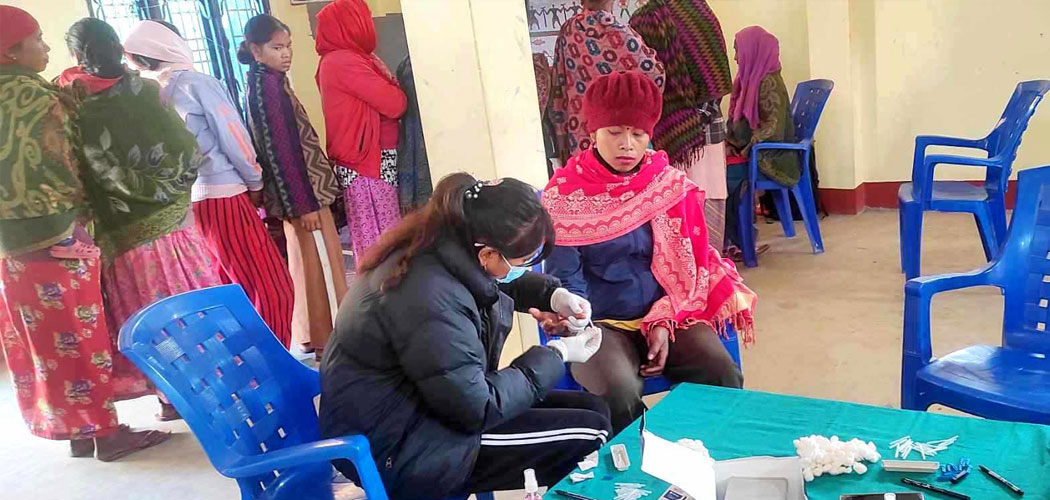

BY SIRAJ KHAN,Nepalgunj, Feb. 16: Despite administering medication 13 times, the campaign against elephantiasis has not been successful in three municipalities and one ward in Banke district.
After the failure of the campaign, the health office in Banke announced the commencement of the campaign for the 14th time.
Even after running the campaign 13 times, infected individuals were still found in Nepalgunj Sub Metropolitan City, Duduwa and Narainapur rural municipalities and Ward No. 4 of Baijnath Rural Municipality.
According to Senior Public Health Officer Ram Kumar Mahato from the Epidemiology and Disease Control Division, although the government aims to declare Nepal free of elephantiasis by 2030, the situation in Banke has created challenges in achieving this goal. He said that while all other districts in Nepal passed the first round of surveys, Banke's three municipalities and one ward failed in the first survey because infections were still found. He stated that this has become an obstacle to achieving Nepal's goal.
In Banke, 1.8 to 2.2 per cent of people in three municipalities were found to be infected, contributing to the ongoing problem, Mahato said. As a result, the medication distribution will continue exclusively in Banke District.
According to Mahato, the 14th round of medication distribution will begin from February 17. He said that 80 per cent of the population had not taken the medicine, leaving Banke's three municipalities at high risk.
Angad Bahadur Shahi, Chief of the Health Office in Banke, said that the medication intake rate has not reached 80 per cent in any of the wards in Nepalgunj Sub Metropolitan City. The campaign cannot be considered successful until the intake rate reaches 80 per cent.
A survey revealed that 33.28 per cent of people in Nepalgunj avoided taking the medicine due to fear of side effects and 32.53 per cent did not take it because of a lack of public awareness.
Dr. Yaduchandra Ghimire, Director of the Epidemiology and Disease Control Division, stated that the three municipalities of Banke have become the main challenge in eliminating elephantiasis from Nepal. He urged all stakeholders to take the campaign seriously this time.
He said that the main reason for the ongoing risk in Banke despite 13 rounds of medication is that not everyone is taking the medicine. He emphasised that a one-month-long campaign in Banke, with the full participation of all stakeholders, is crucial for achieving the goal.
This time, the campaign will target everyone for medication distribution. According to Health Officer of the Health Office Banke Durga Gautam, a plan is being devised where ward chairs, religious leaders, social workers, women leaders, teachers and political activists will go door-to-door to administer the medication.

-square-thumb.jpg)