- Friday, 8 May 2026

PM Prachanda seeking confidence vote today
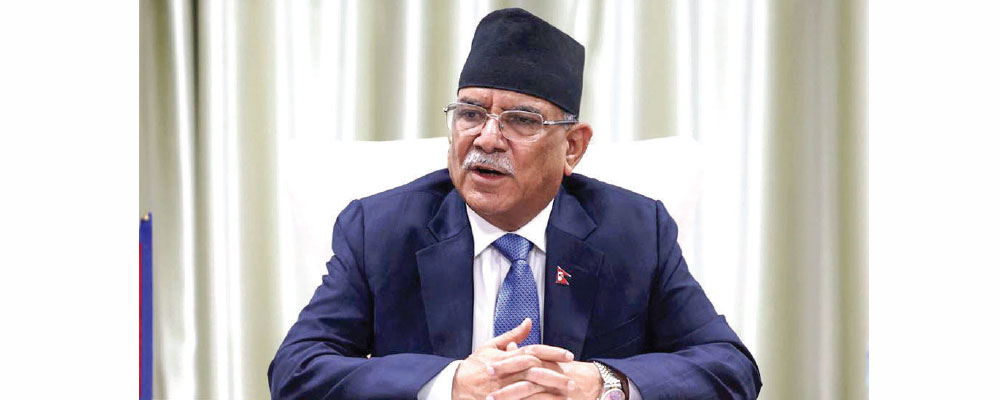

By Pallav Bhusal,Kathmandu, July 12: Prime Minister Pushpa Kamal Dahal 'Prachanda' is seeking a vote of confidence for the fifth time in the House of Representatives on Friday.
Appointed to the top executive post on December 25, 2022, Prime Minister Prachanda garnered a vote of confidence in the House for the fourth time on May 20 this year
after he changed the coalition partners by replacing Nepali Congress with CPN-UML.
However, after Nepali Congress and CPN-UML on July 1 inked an agreement to form a national consensus government, initially under the leadership of UML chairman KP Sharma Oli, and CPN-UML and the
Janata Samajwadi Party withdrew their support to the government, PM Prachanda decided to undergo a floor test once again.
Although both NC and UML, which enjoy a majority with 166 members combined in the 275-member House of Representatives, urged the PM to pave the way for the formation of new government, he denied and prepared to seek a vote of confidence.
He has to get the support of 138 lawmakers to prove his majority, which looks impossible for now.
"Prime Minister Prachanda's decision not to resign but to seek a vote of confidence suggests he's exploring constitutional avenues to remain in power although he may not be able to prove a majority. There are specific Articles in the constitution outlining the procedure for appointing the next prime minister, and Prachanda is operating within those parameters," said Nepali Congress vice president and lawmaker Dhanraj Gurung.
Gurung adds, "The alliance between Nepali Congress and CPN-UML aims to address public discontent caused by political instability. Prime Minister Prachanda has faced multiple votes of confidence and frequent changes in alliances, leading to deadlock and ministerial turnover.
To establish a stable government, Nepali Congress and UML have forged alliance, recognising that our constitution is a product of collective participation from all political parties. We are committed to inclusive dialogue and, if needed, amendment to the constitution to foster stability and good governance."
Gurung highlighted that the constitution belongs to all Nepali citizens, including the Prime Minister, and its principles should guide our actions towards a cohesive and effective government.
Similar are the views of CPN-UML leaders. They argued that they forged alliance with NC to maintain political stability.
Mahesh Kumar Bartaula, Chief Whip of CPN-UML, shared his perspective, disapproving Prime Minister Prachanda for missing an opportunity to resign gracefully when the Nepali Congress and CPN-UML decided to form a national consensus government. "His decision to cling to power for 10 days has heightened political uncertainty and poses the risk of a deadlock," he said. "Instead, he should have ensured a seamless transition to the new alliance of Nepali Congress and UML, prioritising the nation's urgent need for effective governance," he added.
"The absence of a functioning government is critical, especially amidst ongoing challenges and disasters. It's disappointing that Prime Minister Prachanda has chosen to take a vote of confidence, despite knowing that he is in minority. This approach undermines the spirit of cooperation needed in Nepali politics," said Bartaula.
Highlighting the new alliance's objectives, Bartaula emphasised that their goal was to restore hope by establishing a stable government capable of fulfilling the national aspirations of 'Prosperous Nepal, Happy Nepali'. He highlighted their commitment to studying electoral reforms to tackle lingering political instability, ensuring that the constitution benefits all parties and promotes effective governance.
Jiwan Pariyar, an MP from Nepali Congress, reflected on the recent political developments, "After CPN-UML exited the government to forge a national alliance with Nepali Congress, Prime Minister Prachanda is aware that securing a vote of confidence will be challenging. While he has the constitutional right to seek this vote, it would have been more constructive for him to resign and facilitate smooth formation of a new government," he said.
"Initially, Nepali Congress had not proposed joining a new alliance to form a government, our preference was to remain in the opposition. However, the existing alliance and government dynamics were not conducive to effective governance, leading CPN-UML to seek a new path without Maoist Centre," said Pariyar.
Drawing on past experiences, Pariyar noted, "Nepali Congress and CPN-UML have a history of collaborating as part of national consensus governments. Once again, we are committed to working together to ensure political stability and promote the prosperity of our people."
Nepali Congress has 88 members and CPN-UML 79 in the House of Representatives while CPN (Maoist Centre) has 32 members.
While the PM is seeking vote of confidence, the two big parties are doing homework to form a new government under CPN-UML’s Oli.