- Friday, 8 May 2026

Rare herb Bhotelahara being protected in Makwanpur
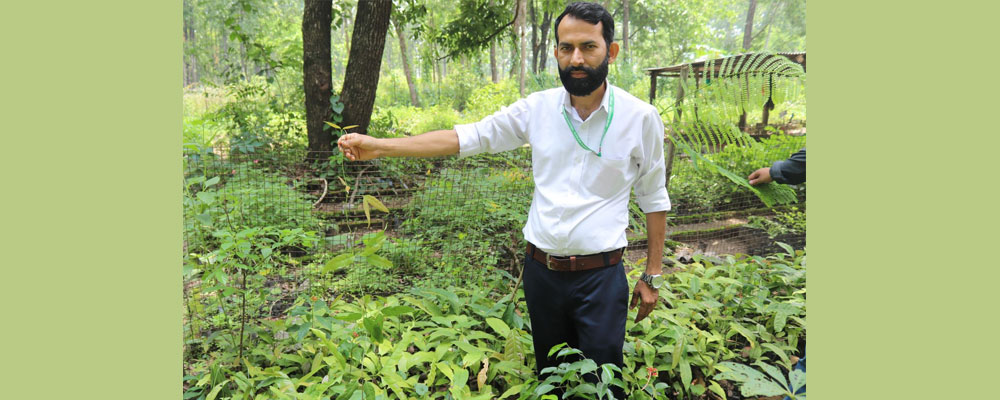

By Anil Parajuli,Hetauda, June 13: A rare plant Gnetum montanum, commonly known as Bhotelahara in Nepali, is being protected in Makwanpur. Planting of the Bhotelahara saplings has begun in the district's community forests for its conservation.
Saplings of Bhotelahara, suspected to have disappeared from Nepal and listed in the Convention on International Trade in Endangered Species of Wild Fauna and Flora (CITES), have been replanted in community forests, said Raghuram Parajuli, chief and senior scientific officer of the Plant Research Centre, Makwanpur. The rare plant Gnetum montanum is being conserved and nurtured in the nursery of the Plant Research Centre, Makwanpur.
The plant, which was first recovered in ward No. 11 of Bakaiya Rural Municipality of the district in 2021 is now being planted in various locations.
According to Parajuli, the plant is found only in Sankhuwasabha, Tanahun and Makwanpur districts. This plant is also found in countries like China, India, Myanmar, Thailand, and Cambodia.
Its leaves are long, broad, and green. The stem has nodes and internodes and is tough.
According to the records of the National Herbarium and Plant Laboratory, a team led by M.L. Banerjee first collected Gnetum montanum from the Sidhuwa area of eastern Nepal in 1965. In 1966, it was collected from the Brindavan Botanical Farm area of Makwanpur.
Over time, it has also been collected from Ratua Khola in Jhapa, Chulachuli in Ilam, Chitwan, and various locations in Sankhuwasabha and Tanahun districts.
Parajuli said that the plant has been collected from Num in Sankhuwasabha and Dhorphirdi and Dhorbarahi temple areas in Tanahun. According to studies, there are about 40 species of the Gnetum genus worldwide, which belong to the Gnetaceae family, a critically endangered species. The species found in Nepal is Gnetum montanum, locally known as Bhotelahara.
As Nepal has been a signatory to the CITES since 2016, it has implemented the act related to it and Rules (in 2019) to regulate and control the international trade of endangered wildlife and plant species.
Bhotelahara falls under Schedule 3 of CITES. It is a slow-growing evergreen plant.
Since male and female plants are separate, the lack of pollination has prevented the expansion of new plants. Studies have shown that its fruit is useful in treating coughs and its fibers are used to make gun bags. The Plant Research Centre, Makwanpur, conserves over 650 species of plant genetic resources in its three botanical gardens.
It conducts plant surveys, collections, identification and preservation of herbarium samples from various locations within the district and the Chure region.