- Friday, 8 May 2026

With picturesque landscape Pokhara Valley holds water colour legacy
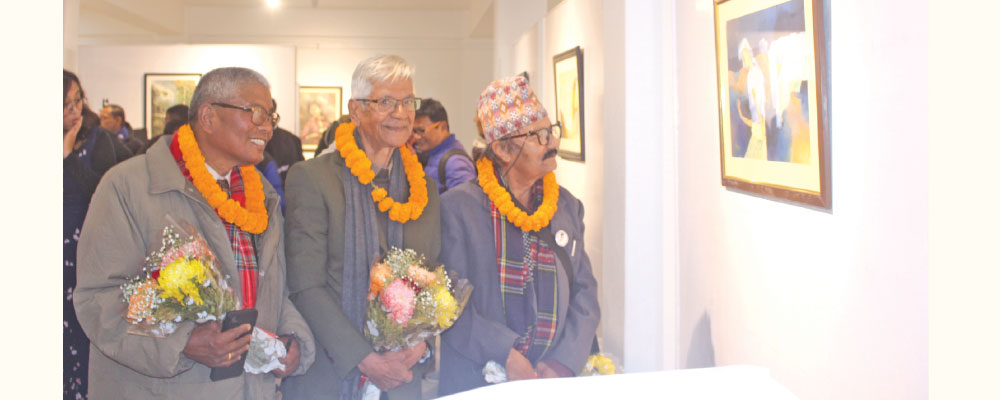

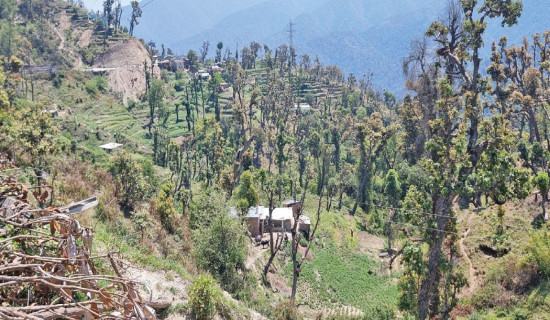
Phadindra Adhikary,Pokhara, June 4: Village houses with thatched roofs, piles of straw in the yard, and clean mountains visible from every window or door. This is the picturesque landscape of Pokhara Valley.
The geographical beauty of Pokhara Valley gained recognition both domestically and internationally in the 1930s. Pokhara eventually became known as the city of watercolour thanks to artist Durga Baral ‘Vatsyayan’. He began depicting the natural splendour and daily life of Pokhara using watercolours on canvas.
Now in his 80s, Vatsyayan continues to paint with watercolours a medium he popularised in Pokhara during the 40s and 50s. His works, often featuring this medium, have remained highly sought after due to their affordability and simplicity.
Professor Buddhi Gurung, a student of Vatsyayan, recalls how watercolour paintings of mountains and local life were particularly favoured by foreigners.
However, he expresses concern that while the number of watercolour artists has grown, the originality in their work is diminishing.
“Artists have increased significantly. When many adopt Western styles, our unique originality is at risk,” he said. “Preserving history while seeking originality is crucial.” To foster the art scene, Pokhara artists have formed the Creative Artists Group.
Hemkanti Gurung, Secretary of the Artists' Umbrella Organisation Group, emphasises that local nature, society, and life are often depicted through watercolours. “Pokhara has a special relationship with water and watercolours. Water, which defines Pokhara and contributes to its high rainfall, is also its artistic symbol,” he explains. “Even with access to modern technologies, we must not forget our originality.”
Pokhara’s identity is closely tied to its artists’ use of watercolours. Yadav Chandra Bhurtel, one of the oldest and most revered watercolour artists, remains active even after seven decades in the field.
As the first person from Pokhara to graduate in Fine Art, he notes, “Most of the art that sells is watercolour. The new generation is exploring other mediums, but there’s a risk of losing our traditional originality without fully embracing the new.”
The fine art gallery Bhurtel opened in 2034 BS features predominantly watercolour works.
Despite the evolution of art forms, veteran artist Vatsyayan remains hopeful about the future.
“The new generation does not stay in the old place. The art field will be enriched with new experiments and the experiences of others,” he said, expressing optimism about the innovative spirit of young artists.