- Friday, 8 May 2026

Hives distributed to farmers to conserve indigenous bees
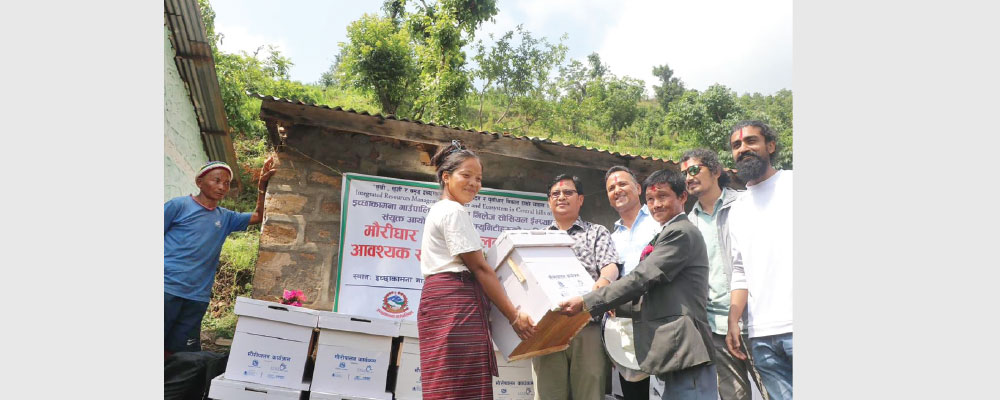

By A Staff Reporter,Kathmandu, June 3: Modern beehives have been distributed to local farmers for conservation of indigenous bees in Ichchhakamana Rural Municipality of Chitwan. Modern beehives have been distributed to local farmers who are keeping bees in hives made of wood.
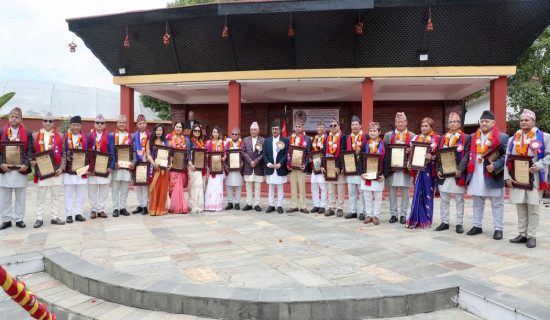
Sapana Village Social Impact (SVSI) and Ichchhakamana Rural Municipality jointly distributed 80 beehives to 40 households. Chairman of Ichchhakamana Rural Municipality Dan Bahadur Gurung and President of SVSI Dhruba Giri handed over the beehives to farmers in three separate programmes on Friday.
President of Sapana Village Social Impact Dhruba Giri said that beehives were distributed to 20 households of Ghurkas of Ichchhakamana Rural Municipality-2 and 20 households of Kaule in the same ward with 50 per cent investment of the rural municipality and 50 per cent of SVSI.
Farmers here who could not buy beehives due to lack of finance have been producing honey by keeping bees at home in traditional ways (house hole, wooden boxes and broken trees). Talking to The Rising Nepal, Giri said that they had distributed modern beehives aiming to increase honey production through modern beekeeping.
Along with the beehives, the tools required for beekeeping have also been provided, he said. Giri said that caps and gloves, among others, required for beekeeping have been provided along with super beehives.
"The Mayatar of the same ward has been developed as a tourist spot. Around 150 tourists come here daily.
Tourists who come here enjoy the natural heritage and traditional food. Indigenous bee protection work has been started for the development of tourism in the settlements near Mayatar," said Giri.
It was seen that local bees should be protected by preserving the resources of bees along with the bees, he said. President Giri said that they provided hives to protect indigenous bees, not for commercial beekeeping.
Plants such as Chiuri, Laligurans, Taki, Padke, Rudilo, Kimbu, Chilaune are sources of beekeeping in Mayatar and its surrounding areas.
There is a good market for Chiuri honey produced in remote area of Chitwan.
Sujan Basnet, programme director of Sapana Village Social Impact, said that before the distribution of hives, SVSI also provided a two-day training to the beekeeping farmers.
At the beehives hand over programme, chairman Gurung said that beehives were provided for the protection of local bees, uplift the livelihood of the local community, and the development of tourism.
Earlier, Sapana Village Social Impact had distributed 400 beehives to 20 households in Siddhi in Kalika Municipality of Chitwan.
The beehives were distributed to Chepangs five years ago with an investment of Rs. 4 million in collaboration with the municipality, according to SVSI.