- Wednesday, 27 May 2026

Pension protests raise tension between police, demonstrators
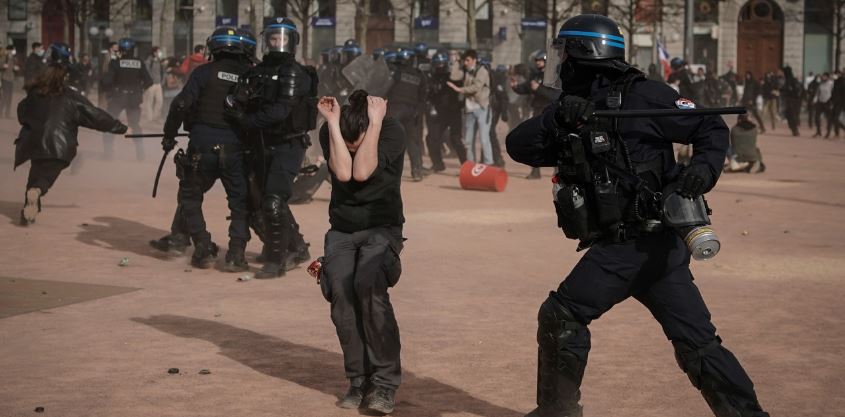

Paris, Apr. 4: French authorities see the police as protectors who are ensuring that citizens can peacefully protest President Emmanuel Macron’s contentious retirement age increase. But to human rights advocates and demonstrators who were clubbed or tear-gassed, officers have overstepped their mission.
In the months since mass protests against the proposed pension changes began roiling France, some law enforcement officers have been accused of resorting to gratuitous violence. A man in Paris lost a testicle to an officer’s club, and a police grenade took the thumb of a woman in Rouen. A railroad worker hit by grenade fragments lost an eye.
“Where is your humanity?” a woman shouted at officers who knocked an apparently homeless man to the ground in Paris, kicked him and used vulgar language while ordering him to get up and go. In a video posted on Twitter, another passerby helped the man to his feet at the scene last month near the Place de la Bastille.
The violence adds to the anger in the streets and complicates efforts to invite dialogue between the government and labour unions, who are planning an 11th round of mass demonstrations Thursday.
The protests, which began in January, gained momentum after Macron’s decision last month to push a bill to raise the retirement age through the lower house of parliament without a vote. The common French reference to law enforcement officers as “forces of order” has been turned on its head. Now the question is whether police represent force or order.
Jarred by the bad publicity, authorities have shifted to damage control by offering accolades for security forces.
“There is no police violence,” Interior Minister Gerald Darmanin said Wednesday on RTL radio while condemning “individual acts” of officers who use disproportionate force. “Can’t we occasionally thank the forces of order?” he pleaded.
The concerns about police brutality have reverberated beyond France. Amnesty International, the International Federation of Human Rights and the Council of Europe — the continent’s main human rights body — were among the organizations that cited excessive police violence during what has been a largely peaceful protest movement.
French police are sent into demonstrations with weapons that are prohibited in most European countries, including stun grenades and rubber bullets, according to Sebastian Roche, an expert on security forces with France’s National Centre for Scientific Research.
Demonstrations and potentially mutilating weapons are a combustible combination, Roche said, because “the temptation will be very big to use these armaments” especially when police come under a cascade of objects hurled at them, including Molotov cocktails.
The strategy is “at once very violent” and in some aspects illegal, Roche said, citing cases in which demonstrators were detained en masse and then released without charges the next morning. Lawyers’ and magistrates’ associations have said such practices are an abuse of the law.
Jonas Cardoso, a 20-year-old student, was among more than 100 people detained during a March 23 protest in Paris.
“I spent hours in a cell for four people with nine other protesters. I slept on the floor,” he told The Associated Press. Cardoso denied any wrongdoing and was released without charges. (AP)