- Thursday, 28 May 2026

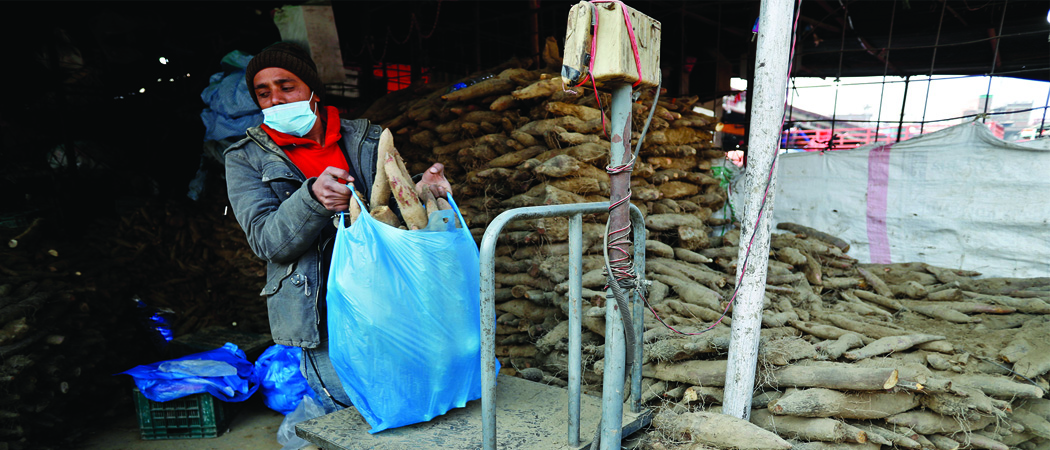
Kathmandu denizens busy purchasing yams for Maghe Sankranti festival

By Laxman Kafle
Kathmandu, Jan 13 : Kathmandu Valley residents are busy purchasing yam of their choice, one of the widely eaten items during the Maghe Sankranti festival, which falls on Sunday.
They boil the yam on the last day of Poush and eat it the next morning with ghee, chaku and Sakhkhar.
People consume various kinds of yams, either boiled or with some condiments, while marking the Maghe Sankranti festival.
Almost a dozen yam varieties are available in the retail market, with their prices ranging from Rs. 70 to Rs. 210 per kg.
The yam varieties known as Hattipaile, Ban Tarul, Seto Ghar Tarul, Pani Tarul, root of Josephine, Patale Tarul and Rato Tarul, among others, are being sold in the market.
The prices of the yams vary based on their varieties.
Sachita Simkhada of Suryabinayak, Bhaktapur said that she bought six kilograms of yam worth Rs. 670 Thursday morning.
“I purchased three kilograms of Hattipaile at 100 per kilogram, two kilograms of Seto Tarul at Rs. 80 per kilogram and a kilogram of Ban Tarul at Rs. 210,” she said.
She said that the price of yams varies from shop to shop.
The price per kg of yam stood at Rs. 70 to Rs. 210 in the retail market, she said, adding that the price of Ban Tarul and Root of Josephine was highly expensive compared to other varieties of yams.
She, however, said that different varieties of yams are available in the market but differences in their prices and high profit margins kept by different retailers were forcing the consumers to pay more than they would in the wholesale market.
A retailer of Gatthaghar, Bhaktapur Sanjaya Shrestha said that he was selling yams at Rs. 70 to 210 per kilo based on their quality.
Large number of consumers used to buy yams which are available at Rs. 70-150 per kg. The flow of consumers has started to increase in the shops from Thursday.
“I am selling a kilo of root of Josephine at Rs. 140 per kilo and Ban Tarul at Rs. 210 per kilogram,” he said.
The price of yams supplied from Terai, especially from Sarlahi, is less than from other districts due to quality, said traders.
The demand for the roots of Josephine and Ban Tarul is very low compared to other varieties due to high rates.
A consumer normally buys around 5-8 kilograms of yam as per their choice and price, he said.
The price of per kilogram of yam ranges from a minimum Rs. 60 to the maximum of Rs. 200 at wholesale market, said Binaya Shrestha, information officer of Kalimati Fruit and Vegetable Market Development Board (KFVMDB).
He said the Ban Tarul variety was being sold at Rs. 200 per kg which makes it the most expensive variety of yam currently available in the market.
Another variety of yam, which is supplied from Sarlahi district, is being sold at Rs. 60 per kg. This is the cheapest variety in the wholesale market.
The root of Josephine, regarded as another variety of yam, is being sold at Rs. 180 per kg. This variety of yam is being imported from India.
The price of yams is almost similar by Thursday this year compared to last year, he said, adding that the price of yam might increase by up to Rs. 10-20 per kg on Friday and Saturday as the demand for yams would be high in these days.
He said that the transaction of yam has been increasing day by day for the last few days as it is the main season to consume the item.
The domestic production of yam is enough to meet the demand this season, he said, adding that more than 45 per cent of yam in Kathmandu is supplied from Sarlahi district and the rest is supplied from other districts. Only 10 per cent yam, mostly Josephine roots, arrive from India, he said.
Daily, around 300 tons of yams is being supplied from various districts, including Sarlahi, Sunsari, Dhading, Dolakha, Palpa, Sindhuli, Nawalparasi, Chitwan, and Kavre to the Kathmandu Valley for the last three days.
Around 1,127 tonnes of yam entered the Kalimati market by Thursday of the month of Poush, according to KFVMDB. Similarly, around 246 tonnes of cocoyam and 166 tonnes of sweet potatoes entered the Kalimati market during the period.
Out of the total supply of yam, around 509 tonnes (45 per cent arrived from Sarlahi, 156 tonnes (14 per cent) from Sunsari and 104 tonnes (9 per cent) from Dhading. Share of yam imported from India stood at 10 per cent of total yam that entered in Kalimati. Around 105 tonnes of yam entered Kalimati in the month of Poush.
Meanwhile, according to our Sarlahi correspondent, farmers and traders of western part of Sarlahi are busy digging yam for the last few days.
The farmers have already sold the yam from their fields to the traders. As there are only a few days left for Sankranti, the traders are also using labourers to dig the yams bought from the farmers. Traders have been supplying yam from here to Kathmandu, Pokhara, Itahari, Birgunj and other major cities of the country.
Farmer Harka Bahadur Bishwakarma of Bagmati Municipality-5, said that he sold yam produced in around 17 kattha of land worth Rs. 240,000.








-original-thumb.jpg)