- Saturday, 11 April 2026

New Changes As Global Football Fiesta Returns To Asia

Pramod Joshi
The World Cup has returned to Asia for the second time, as Qatar has become the first Middle-East Arabian country to host the world's largest sporting event other than the Olympics.
The global football extravaganza first came to Asia in 2002, when South Korea and Japan co-hosted the FIFA World Cup, which was organised by FIFA, the world football governing body.
Taking advantage of home soil, South Korea pulled off a dream run to finish fourth while co-host Japan progressed to the round of 16 in 2002. The performances are still the best by Asian teams in World Cup football.
Today, the continent is represented by a record six teams: Australia, Iran, Japan, Saudi Arabia, South Korea, and hosts Qatar.
The first World Cup in the Arab world features three teams from the Persian Gulf: host Qatar, Iran, and Saudi Arabia.
Being familiar with the desert climate, the three Middle Eastern nations are expected to take full advantage and get past Asia’s best performance in 2002. As a debutant, Qatar will do well if it avoids becoming the second host nation to be knocked out in the first round of the World Cup after South Africa in 2010.
Qatar, which is playing in the World Cup as a host, is not a pushover, however. The 2019 Asian Cup champions have gained the required exposure at the international level.
The national team of one of the richest Gulf nations, Qatar, has already rubbed shoulders with South American sides when it competed in the 2019 Copa America. They reached the semi-finals of the 2021 Gold Cup, which featured Caribbean, North, and Central American sides.
Iran, Saudi Arabia, Japan, South Korea, and Australia look to give everything they have, every last drop, to create history in the globe's top-tier football tournament. Only their best will be enough as Asia looks to rise once again.
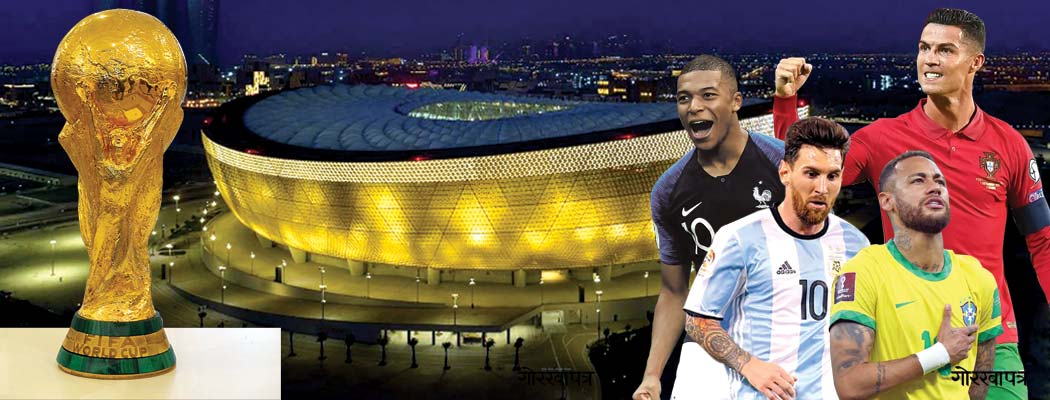
When the world's two best players, Lionel Messi and Cristiano Ronaldo, make their last-ditch effort to have their hands on the most coveted trophy, football pundits predict that the title race will be confined to the football powerhouses of two continents: South America and Europe.
Dominating the club and international football for more than one and a half decades, both Messi and Ronaldo will be looking to solidify themselves as all-time football greats like Pele and Maradona.
Messi And Ronaldo
They distinguished themselves as the most decorated footballers by winning as many best-individual awards in world football. They have tasted victory in the top football leagues many times and have won the continental title with their national team. They, however, are left with only one title to lay their hands on: the World Cup.
Owing to their age, the Qatar World Cup will be the last chance for both of the world's best players. Messi, the seven-time world player of the year, will make one last push for the World Cup gold medal after being denied by Germany in the 2014 final.
The leading scorer in international football, Ronaldo, 37, has not advanced to the final of the World Cup. The Argentine is in stellar form at his club, Paris Saint-Germain, whereas Ronaldo is not the first choice at Manchester United.
The World Cup may provide an answer to Messi and Ronaldo's rivalry over who is the greatest footballer of this generation. Football fans will still be torn apart in support of either the European or South American national football teams.
Despite the participation of 32 nations around the globe, contention for the trophy to be awarded on December 18 will be mostly among the nations of two continents: Europe and South America.
Favourite Teams
Argentina and Brazil have always been the favourites from South America. Since Brazil won its fifth trophy in the 2002 World Cup, the South American nations have not won the finals. Both South American powerhouses will be looking to end the 20-year title drought at the 22nd edition.
Since winning its fifth title in Japan and South Korea in 2002, Brazil has been eliminated as soon as it faced a European team in the knockout round. Selecao suffered a humiliating 7-1 loss at home to eventual champion Germany in 2014. The record holders, led by Neymar, have been craving their sixth World Cup triumph.
Two-time champions Argentina has not won a World Cup since 1986. Messi-led Argentina came close to winning the title in 2014 but lost the final to Germany. Argentina was eliminated in the round of 16 in Russia four years ago by champions France.
The 2018 champions France will be looking to defend their title and lift the world title for the third time. Germany is eager to tie Brazil for a fifth World Cup title. Italy, the tournament's four-time champion, will be missed, but other European powerhouses like Spain, the Netherlands, England, and Belgium will give the South Americans a run for their money.
For the teams from Asia, Africa, and North America, surging past the quarterfinals or even to the semifinals will be taken as a great achievement. Looked upon as underdogs, teams from these three continents are expected to provide upsets.
Being the first-ever FIFA World Cup to be hosted in the Middle East, the Qatar World Cup will also be the most expensive and controversial in history.
Right after being awarded the World Cup, Qatar was embroiled in corruption allegations, human rights violations, and mistreatment of migrant workers who died in the 12 years it took to build the World Cup in the small but wealthy Gulf nation.
Hundreds of Nepali migrant workers have also toiled in the making of the infrastructure for the World Cup in Qatar. Many have lost their lives.
The sweat, blood, and tears the migrant workers have spent in Qatar have connected Nepal emotionally to the FIFA World Cup.
The 2022 World Cup will feature brand-new changes as Qatar leaves no stone unturned in its relentless pursuit of hosting the world's most beloved sporting event.
Most Expensive
Qatar has spent billions on stadiums and other infrastructure projects to display its sporting might. With total expenses reported to be more than USD 220 billion, the World Cup in Qatar became the most expensive one in history.
Never in the history of football has any country seen any country spend such an amount of money for any FIFA world cup. The Brazil project cost $11.5 billion in 2014, and the Russia project in 2018 will cost around $14 billion.
The stylish new stadiums cost more than $6.5 billion, as Qatar highlighted Arabic tradition and culture through them.
First In Winter
Breaking the tradition of running the tournament during the summer, the 2022 FIFA World Cup is happening in the winter. Originally, football's most coveted event was held during the summer in the Northern Hemisphere.
Due to the sweltering heat in Qatar during the summer, the schedule was changed, and the event was eventually played in the fall and winter.
To address the concerns about high temperatures, Qatar had readied itself to counter the heat by equipping each stadium, training facility, and fan zone with solar-powered cooling technology.
The temperature in the stadiums can be regulated during the games, although it may not be required due to the low temperatures during November and December.
The schedule change, however, has disrupted the calendar of top-tier leagues in Europe. Normally, the World Cup happens after the end of the football season in Europe.
Except for European nations, all other nations have adjusted the league calendar and prepared well for the tournament.
The European Leagues took a break during the World Cup and will resume their 2022–23 season right after the final in December. However, injury worries are going to mount for the national teams as the World Cup is happening in the middle of the league.
New Technology
A brand new technology to assist video assistant referees, semi-automated offside technology, will be used for the first time in a World Cup.
The new technology will detect the position of the ball with an "inertial measurement unit sensor" inside the official Al Riha ball. The sensor inside the ball will also collect and track the player's position during a possible offside chance.
The semi-automated offside technology and the connected ball technology have successfully been implemented during the FIFA Arab Cup 2021 and FIFA Club World Cup 2021.
The new technology allows video match referees to make accurate and reproducible offside decisions in a shorter period of time.
Five Substitutes
FIFA has implemented the rule of using five substitutes for the first time in the history of the World Cup. The Qatar World Cup will debut the option of five substitutions in every game instead of three. The use of the five substitutes came into practise after COVID-19.
It was initially done to protect players during the COVID pandemic. This practice has been widely adopted in club football. The top-tier leagues in Europe have already benefited from this rule. I hope this substitute rule helps the coaches of the national team in their strategies during football's global tournament.
26-Player Rosters
With the five-sub rule coming into effect in every game, the rosters of the national teams participating in the World Cup also increased. Normally, 23 players are included in the final squad of any international football match.
Owing to the pandemic, the International Football Association Board relaxed the rules by allowing 26 players in the final cut. National football teams competing in Qatar are allowed to have a 26-man squad instead of the usual 23. The managers would have an easier time making the first eleven picks if they had three more men.
In One City
Unlike the previous World Cup, the 22nd edition is organised in one city. The eight stadiums in Doha, the capital city of Qatar, will host the 64 matches.
All the stadiums are an hour's drive from each other, allowing fans to attend more than one game a day. The country's 11,586 square kilometres is expected to welcome more than 1.2 million fans during the tournament.
Not having adequate accommodation for travelling has been a concern for many in the tiny nation of the Arabian Peninsula.
Home to less than three million people, Qatar has built hotels, apartments, villas, and infrastructure to prepare for the event. To ease the residents' accommodation concerns, the organisers have allowed residents to put their houses and rooms up for rent.
They have managed cruise ships, erected tents on the man-made island, and docked floating hotels in Doha.
A Female Referee
For the first time, a woman will be in charge on football's biggest stage. FIFA has picked Japanese referee Yoshimi Yamashita, French referee Stephanie Frappart, and Rwandan referee Salima Mukansanga to officiate matches at the men's World Cup. They are in a pool of 36 referees listed for Qatar.
All three have experience officiating men's matches. Before their debut in the World
Cup, Yamashita had been in charge of the Asian Champions League and had refereed at the Tokyo Olympics. She has also refereed in Japan's men's league.
Frappart has handled men's World Cup qualifying, the European Champions League, and the French Cup final. Mukansanga is the first woman to referee an Africa Cup of Nations match.
FIFA has also named three female assistant referees: Neuza Back of Brazil, Karen Diaz Medina of Mexico, and Kathryn Nesbitt of the United States.
Last To Be Played By 32 Teams
Following the decision to expand the teams in 2026, the Qatar World Cup will be the last to be played by 32 teams. From the 23rd edition onwards, 48 national football teams will lock horns for the World Cup trophy.
FIFA decided to increase the quota of national teams for the 2026 World Cup, which will be held jointly in the USA and Mexico.
Asia will have eight guaranteed representatives, and one extra may make it through the intercontinental playoffs. Africa won the expanded World Cup, earning nine automatic slots. With three extra slots, Europe will be the most represented continent in the World Cup.
After the World Cup in 2022, what comes next?
Qatar has looked beyond the World Cup of 2022 for stadium usage. Once the World Cup concludes, all eight stadiums will see massive transformations. Qatar has thought of providing a lasting legacy for the FIFA World Cup beyond its borders.
The Gulf nation has pledged to build as many as 22 new stadiums in emerging economies.
Moreover, Qatar also does not require stadiums with large capacities built as per FIFA standards for the World Cup.
So, the organisers have decided to dismantle the stadiums and donate the seats and other construction materials to sporting projects in the most needy countries.
For that purpose, organisers built the stadiums with modular elements so that they could be reconfigured easily.
Around 170,000 seats from the stadiums will be disassembled and donated to developing nations that require sporting infrastructure. The 40000-seat Stadium 974 will be completely dismantled after the World Cup, and the materials used in its construction will be re-utilized.
Similarly, the 80,000-seat Lusail Stadium will be transformed into a community space, with cafes, schools, and health clinics inside it.
The 60,000-capacity Al Bayt Stadium will be downsized to a 32,000-seat venue. The capacity of the Al Thumama and Al Janoub stadiums will also be reduced by half.
The Education City Stadium will retain almost half of its seats and will be used by university athletic teams.
(Joshi is Associate Editor at TRN)